
FREE SHIPPING ON ORDERS ABOVE ₹999
Sold
out

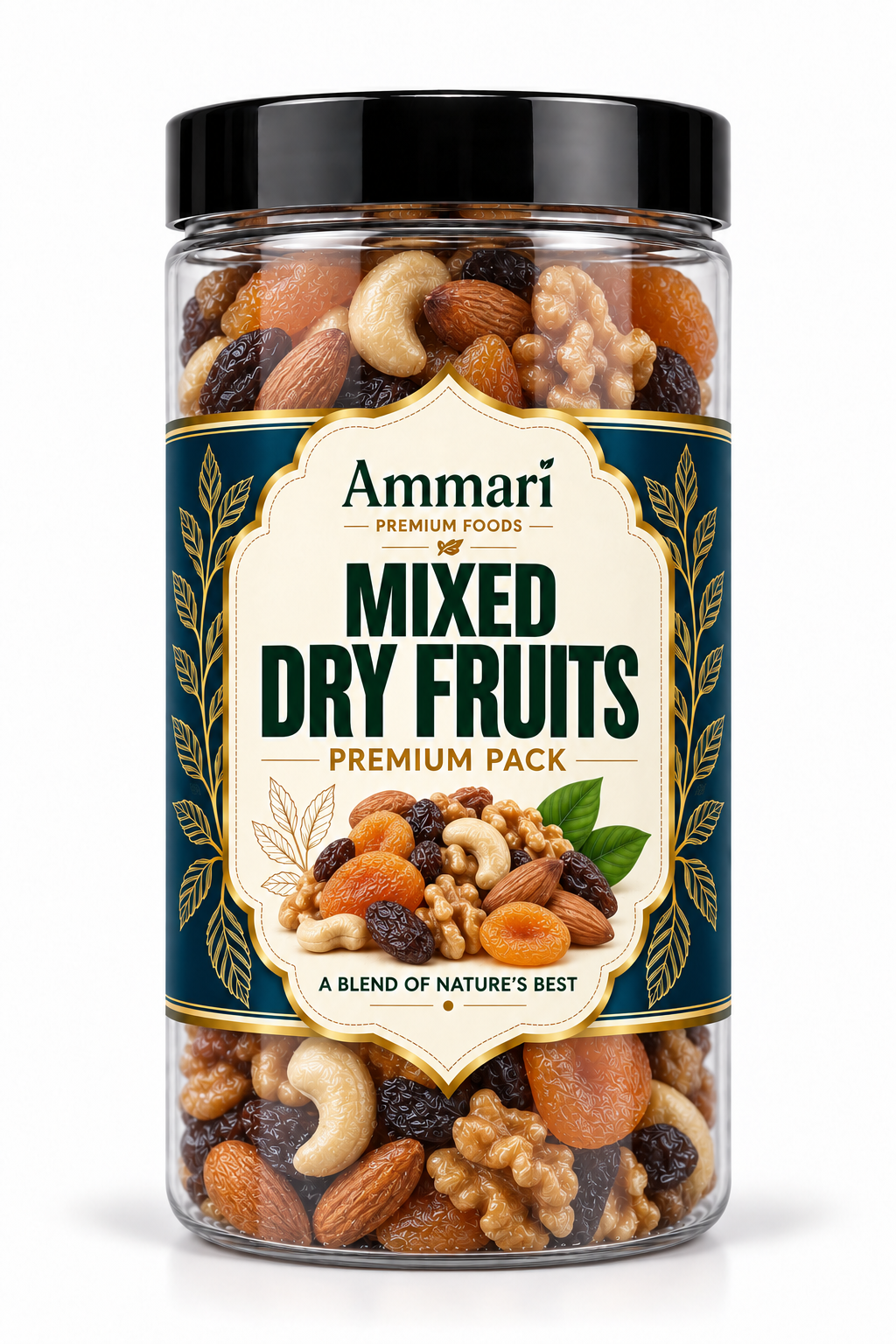
Premium Mixed Dry Fruits Pack

Original price was: ₹999.00.Current price is: ₹849.00.
22 people are viewing this right now
Out of stock
Estimated Delivery:
29 Aug - 05 Sep, 2026
Trust Badge
Guaranteed safe & secure checkout

Product details

One of our most-asked-for products, the Ammari Mixed Dry Fruits Pack brings together six of our best-selling varieties in a single, balanced 200g blend. It is the pack we keep on our own kitchen counter — handy for school tiffins, evening chai, festival platters, or that small daily handful Ayurveda recommends for energy and immunity. Every component is direct-sourced from the same farms and cooperatives that supply our single-origin packs, then portioned by hand at our Jaipur facility.

What’s Inside

  • California almonds — 120g: Nonpareil variety, lightly roasted-friendly raw kernels.
  • W320 cashews — 100g: Whole, creamy-white grade from Mangaluru.
  • Iranian pistachios — 80g: Akbari kernels, naturally split, lightly salted.
  • Kashmiri walnuts — 80g: Light-amber halves and quarters, paper-shell origin.
  • Black raisins — 60g: Seedless, sun-dried from Vijayapura, Karnataka.
  • Date pieces — 60g: De-pitted Mazafati dates, chopped for easy mixing.

Why Mixed

A single dry fruit gives you one nutrient profile; a thoughtful mix gives you the full spectrum. Almonds and walnuts contribute heart-friendly fats and vitamin E, cashews bring magnesium and zinc, pistachios add plant protein and lutein, and the raisins and dates round it off with quick-release energy and iron. For households juggling family snacking, school lunches, and festive entertaining, one mixed pack does the work of six. It is also our most popular pack for corporate gifting and Diwali hampers — universally liked, never wrong.

How to Enjoy

  • Daily handful: One small katori (about 30g) in the morning is the traditional Ayurvedic dose.
  • Trail mix: Toss with a pinch of sea salt and dark chocolate chunks for travel snacking.
  • Festive platters: Serve in brass or silver thalis alongside mithai during Diwali and Eid.
  • Baking: Fold into halwa, kheer, granola bars, or a no-bake energy ladoo.

Storage & Freshness

Transfer to an airtight glass or steel container after opening and store in a cool, dry place. The pack stays fresh for 9 to 12 months unopened, and 4 to 6 months once opened. In Jaipur’s summer, we recommend refrigerating the container, particularly because of the dates and raisins which can soften or bloom in heat. Avoid storing near strong-smelling spices, as nuts readily absorb ambient aromas.

Nutritional Snapshot (per 30g serving)

  • Calories: approx. 165 kcal
  • Protein: 4.5 g | Fibre: 2.5 g
  • Iron: 1 mg | Potassium: 220 mg
  • Antioxidants: vitamin E, polyphenols, lutein, resveratrol
  • Key micronutrients: magnesium, zinc, copper, omega-3 ALA

Frequently Asked

Can I customise the mix?
For single packs we ship the standard ratio above, which has been refined over four years of customer feedback. For bulk orders of 5kg or more — typically corporate Diwali gifting or wedding favours — we are happy to tweak the proportions, add saffron strands, or include cardamom pods. Write to us at hello@ammari.in with your requirements at least seven working days before your delivery date.

Is this pack good for diabetics?
The nuts in this pack (almonds, cashews, pistachios, walnuts) are diabetic-friendly in moderate quantities and have a low glycaemic load. The raisins and dates are higher in natural sugars, so a diabetic customer should either eat the pack in smaller portions or pick out the nut components only. We also offer a nuts-only mix on request — just leave a note at checkout.

Are the nuts roasted or raw?
Everything in this mix is shipped raw and naturally dried, with the exception of the pistachios which are lightly salted in the traditional Iranian style. We prefer raw because it preserves nutrient content and lets you decide how to prepare the nuts — dry-roast in a kadhai for two minutes, toast in the oven at 160°C for ten minutes, or eat as-is. Roasting on demand keeps flavour at its peak.

Free delivery on orders over ₹999. Direct-sourced. Naturally processed.

Quick Comparison

Premium Mixed Dry Fruits Pack removeRoasted Salted Cashews removeAjwa Dates (Khajoor) removePremium Dried Apricots (Khubani) removeAmmari Festive Gift Box removeAfghan Black Raisins (Munakka) remove
NamePremium Mixed Dry Fruits Pack removeRoasted Salted Cashews removeAjwa Dates (Khajoor) removePremium Dried Apricots (Khubani) removeAmmari Festive Gift Box removeAfghan Black Raisins (Munakka) remove
ImagePremium mixed dry fruits packRoasted Salted CashewsAjwa Dates (Khajoor)Premium dried apricots khubaniAmmari festive gift boxAfghan Black Raisins (Munakka)
SKUAMM-MIX-PCK-500AMM-CSH-RST-500AMM-DTS-AJW-500AMM-APR-DRD-500AMM-GFT-FST-001AMM-RSN-MUN-500
Rating
Price
Original price was: ₹999.00.Current price is: ₹849.00.
Save 15%
Original price was: ₹949.00.Current price is: ₹799.00.
Save 16%
Original price was: ₹1,499.00.Current price is: ₹1,299.00.
Save 13%
Original price was: ₹699.00.Current price is: ₹599.00.
Save 14%
Original price was: ₹1,999.00.Current price is: ₹1,699.00.
Save 15%
Original price was: ₹399.00.Current price is: ₹349.00.
Save 13%
Stock
Out of stock
Out of stock
Out of stock
Out of stock
Out of stock
Out of stock
AvailabilityOut of stockOut of stockOut of stockOut of stockOut of stockOut of stock
Add to cart

Description

Size: 200g

Size: 200g

Size: 200g

Size: 200g

Size: 1kg

Size: 200g

Content

One of our most-asked-for products, the Ammari Mixed Dry Fruits Pack brings together six of our best-selling varieties in a single, balanced 200g blend. It is the pack we keep on our own kitchen counter — handy for school tiffins, evening chai, festival platters, or that small daily handful Ayurveda recommends for energy and immunity. Every component is direct-sourced from the same farms and cooperatives that supply our single-origin packs, then portioned by hand at our Jaipur facility.

What's Inside

  • California almonds — 120g: Nonpareil variety, lightly roasted-friendly raw kernels.
  • W320 cashews — 100g: Whole, creamy-white grade from Mangaluru.
  • Iranian pistachios — 80g: Akbari kernels, naturally split, lightly salted.
  • Kashmiri walnuts — 80g: Light-amber halves and quarters, paper-shell origin.
  • Black raisins — 60g: Seedless, sun-dried from Vijayapura, Karnataka.
  • Date pieces — 60g: De-pitted Mazafati dates, chopped for easy mixing.

Why Mixed

A single dry fruit gives you one nutrient profile; a thoughtful mix gives you the full spectrum. Almonds and walnuts contribute heart-friendly fats and vitamin E, cashews bring magnesium and zinc, pistachios add plant protein and lutein, and the raisins and dates round it off with quick-release energy and iron. For households juggling family snacking, school lunches, and festive entertaining, one mixed pack does the work of six. It is also our most popular pack for corporate gifting and Diwali hampers — universally liked, never wrong.

How to Enjoy

  • Daily handful: One small katori (about 30g) in the morning is the traditional Ayurvedic dose.
  • Trail mix: Toss with a pinch of sea salt and dark chocolate chunks for travel snacking.
  • Festive platters: Serve in brass or silver thalis alongside mithai during Diwali and Eid.
  • Baking: Fold into halwa, kheer, granola bars, or a no-bake energy ladoo.

Storage & Freshness

Transfer to an airtight glass or steel container after opening and store in a cool, dry place. The pack stays fresh for 9 to 12 months unopened, and 4 to 6 months once opened. In Jaipur's summer, we recommend refrigerating the container, particularly because of the dates and raisins which can soften or bloom in heat. Avoid storing near strong-smelling spices, as nuts readily absorb ambient aromas.

Nutritional Snapshot (per 30g serving)

  • Calories: approx. 165 kcal
  • Protein: 4.5 g | Fibre: 2.5 g
  • Iron: 1 mg | Potassium: 220 mg
  • Antioxidants: vitamin E, polyphenols, lutein, resveratrol
  • Key micronutrients: magnesium, zinc, copper, omega-3 ALA

Frequently Asked

Can I customise the mix?
For single packs we ship the standard ratio above, which has been refined over four years of customer feedback. For bulk orders of 5kg or more — typically corporate Diwali gifting or wedding favours — we are happy to tweak the proportions, add saffron strands, or include cardamom pods. Write to us at hello@ammari.in with your requirements at least seven working days before your delivery date.

Is this pack good for diabetics?
The nuts in this pack (almonds, cashews, pistachios, walnuts) are diabetic-friendly in moderate quantities and have a low glycaemic load. The raisins and dates are higher in natural sugars, so a diabetic customer should either eat the pack in smaller portions or pick out the nut components only. We also offer a nuts-only mix on request — just leave a note at checkout.

Are the nuts roasted or raw?
Everything in this mix is shipped raw and naturally dried, with the exception of the pistachios which are lightly salted in the traditional Iranian style. We prefer raw because it preserves nutrient content and lets you decide how to prepare the nuts — dry-roast in a kadhai for two minutes, toast in the oven at 160°C for ten minutes, or eat as-is. Roasting on demand keeps flavour at its peak.

Free delivery on orders over ₹999. Direct-sourced. Naturally processed.

The same premium W240 whole cashews from our raw range, taken to the next stage. We dry-roast them gently — no oil, no coating — until the kernel turns a soft golden hue and that natural sweet-savoury cashew aroma fills the kitchen. A light scatter of fine sea salt finishes them. Crisp, buttery, and substantial enough to feel like a treat without the heaviness of fried snacks, these are the cashews you reach for during a cricket match, a long meeting, or unexpected guests at chai time.

Where We Source

The kernel base is identical to our raw W240 cashew pack — sourced from the Mangalore and Goa coastal belt with selective Vietnamese lots during off-season, all conforming to the W240 grade of approximately 240 unbroken white kernels per pound. We chose this grade specifically for roasting because the larger, denser kernel holds heat evenly and develops a uniform colour without burning at the tips. Roasting is done in small batches at our Jaipur facility so the cashews reach you fresh, with the salt crystals still distinct rather than absorbed into stale oil.

How to Enjoy

  • Namkeen alternative: Pour into a brass katori for evening chai instead of fried sev or bhujia — the same crunch, none of the heaviness.
  • Cocktail and bar snack: A natural pairing with whisky, white wine, and beer at home gatherings.
  • Office drawer: A small handful at three pm beats biscuits and vending-machine chocolate every time.
  • Festive mithai platter: Mix with raisins and roasted almonds in a silver tray for unexpected guests during Diwali or Eid.

Storage & Freshness

Roasted cashews stay fresh for six to nine months sealed, but once opened the clock speeds up. Transfer to an airtight glass jar and refrigerate, particularly through summer, to keep the crunch intact and the oils from going stale. Humidity is the enemy here — a single afternoon left open in monsoon air will turn them soft. If that happens, a five-minute revival in a 150C oven will restore the snap.

Nutritional Snapshot (per 30g serving)

  • Calories: approximately 168 kcal
  • Protein: 5 g
  • Healthy fats: 13.2 g (mostly monounsaturated)
  • Fibre: 1 g
  • Key micronutrients: copper, magnesium, sodium (added)

Frequently Asked

How do these compare to fried namkeen calorie-wise?
A 30g serving of these dry-roasted cashews delivers around 168 calories with 13g of mostly monounsaturated fat — comparable to most savoury snacks, but with meaningful protein, fibre, and minerals attached. Fried namkeen of the same weight typically carries refined oil, refined flour, and added sugars or maida. The trade is not zero-calorie versus calorie-heavy; it is empty calories versus nourishing ones.

Why dry-roasted instead of oil-roasted?
Oil-roasting is faster and cheaper, but it adds calories from the cooking oil — usually palm or refined sunflower — and the oil itself can go rancid on the shelf, dulling the cashew flavour. Dry-roasting takes longer and demands attention so the kernels do not scorch, but it preserves the cashew's own buttery oil and keeps the ingredient list to two: cashews and salt. We think the difference is worth it.

Will the salt level overpower the cashew?
No. We salt at a level that wakes up the natural sweetness rather than dominating it. Our test is simple — you should still taste cashew first, salt second. If you compare these to mass-market roasted cashews, ours come across noticeably less salty, which is intentional. For a fully unsalted version, our raw W240 pack is a quick home-roast away from this exact product.

Free delivery on orders over 999. Direct-sourced. Naturally processed.

Ajwa is a date held with reverence. Small, almost jet-black, finely wrinkled, and yielding to the touch, it carries a quieter sweetness than the larger Medjool, with notes of raisin, prune and a soft, almost liquorice finish. For Muslim families it is the date of the Prophet, traditionally eaten in odd numbers, often three or seven, at the breaking of fast. For everyone else, it is simply one of the finest dates in the world, and we treat each box with the seriousness it deserves.

Where We Source

True Ajwa is grown in one place: the volcanic-soil orchards around Madinah in Saudi Arabia. The variety has been cultivated there for centuries and is geographically protected, much in the way Champagne or Darjeeling tea are tied to a single region. Dates labelled Ajwa from any other origin are not authentic. Our supply comes through a long-standing relationship with a Madinah cooperative; each consignment carries Saudi origin documentation. Harvest is in late August and September, and we receive stock carefully air-shipped and cold-chain handled, so the soft, signature texture is preserved from the palm to your kitchen.

How to Enjoy

  • Iftar tradition: Break the fast with three or seven Ajwa and a glass of water, the way the sunnah is observed.
  • Daily piece: Many families keep a small jar and eat one or two each morning with a few almonds.
  • Stuffed simply: Pit and fill with a single peeled almond; no further seasoning is needed.
  • Hajj and Umrah gifting: A 200g gift box is a meaningful return gift for friends and family.

Storage & Freshness

Ajwa is a soft, moisture-rich date and is best stored refrigerated in an airtight container, where it keeps its texture and flavour for nine to twelve months. At cool room temperature it holds well for four to six weeks. Avoid warm, sunlit shelves, which dry and harden the fruit. If the dates do firm up, a few hours back at room temperature, or a brief warm-water dip, restores their characteristic soft bite.

Nutritional Snapshot (per 30g serving, roughly 4 dates)

  • Calories: ~85 kcal
  • Natural sugars: ~20 g (glucose and fructose, no added sugar)
  • Fibre: ~2.2 g
  • Iron: ~0.5 mg | Potassium: ~210 mg
  • Key micronutrients: Magnesium, Calcium, Selenium, Polyphenols

Frequently Asked

How do I know these Ajwa are authentic?
Authentic Ajwa is small, almost uniformly dark brown to black, soft to the press, with very fine surface wrinkles and a clean, mild sweetness. It will never be glossy, oversized or bright. Our consignments arrive with Saudi origin documentation from a Madinah-based cooperative, and the lot reference on your box ties back to that paperwork. If anyone offers you Ajwa at a price close to ordinary dates, or in a shiny large form, it is almost certainly mislabelled.

What is the significance of seven Ajwa in Islamic tradition?
A well-known hadith narrates that the Prophet Muhammad, peace be upon him, said that whoever eats seven Ajwa dates from Madinah in the morning will be protected from harm that day. Many Muslim families therefore keep Ajwa specifically for this daily practice, distinct from other dates used for general eating or cooking. We mention this because it is the most common reason customers seek out Ajwa specifically, and we want to honour that intention with genuine fruit.

Why are Ajwa dates less sweet than Medjool?
Ajwa has a naturally lower sugar concentration and a higher mineral content than larger varieties like Medjool or Kimia. The flavour is more savoury, with hints of prune, dried fig and a subtle earthiness from the volcanic soil it grows in. Many people who find other dates too sweet find Ajwa balanced and easy to eat daily. The lower sweetness also makes it a preferred choice for those who want the nutritional benefit without a strong sugar hit.

Free delivery on orders over Rs.999. Direct-sourced. Naturally processed.

Good apricots (Khubani) taste of summer mountains — bright, slightly tart, and finishing with deep honeyed sweetness. We source from two of the world's great apricot regions: Malatya in eastern Turkey, and the high Karakoram valleys of Ladakh. Both produce fruit that is naturally golden-orange, soft to the bite, and free of sulphur treatment. The result is a dried apricot that looks darker than the bright orange supermarket variety, but tastes considerably more like the original fruit.

Where We Source

Malatya, in the highlands of eastern Anatolia, accounts for nearly half of the world's dried apricot production. Its altitude (around 900 metres), continental climate, and long sunny days produce the soft, plump Hacıhaliloğlu variety we favour. From India, we work with smallholder cooperatives in the Nubra and Sham valleys of Ladakh, where the indigenous Halman and Raktsey Karpo apricots are harvested each August and laid out to dry on stone roofs. Both origins are sun-dried without sulphur dioxide, which is why the fruit is amber-brown rather than fluorescent orange.

How to Enjoy

  • Tagines and curries: Slow-cook with lamb, cinnamon, and almonds for a classic Mughlai or Moroccan dish.
  • Granola and muesli: Chop and toast with oats, almonds, and honey for a make-ahead breakfast.
  • Soaked breakfast: Steep three apricots in water overnight, then eat with curd and a drizzle of honey.
  • Biryani garnish: Stir whole apricots into the final dum stage for a sweet counterpoint to the spice.

Storage & Freshness

Keep apricots in an airtight container in a cool, dry place; they will stay soft and flavourful for 9 to 12 months. Because they retain natural moisture, we strongly recommend refrigerating the bag during Jaipur's summer (April to September) to prevent any surface stickiness or fermentation. If apricots firm up after long storage, soak briefly in warm water to restore their original texture before using.

Nutritional Snapshot (per 30g serving)

  • Calories: approx. 72 kcal
  • Fibre: 2.2 g
  • Iron: 0.8 mg | Potassium: 350 mg
  • Antioxidants: high in beta-carotene and lutein
  • Key micronutrients: vitamin A, vitamin E, copper

Frequently Asked

Why are your apricots dark, not bright orange?
Bright orange dried apricots are treated with sulphur dioxide, which preserves colour and extends shelf life but alters flavour and is unsuitable for many sensitive customers. Our apricots are sun-dried without sulphur, so they oxidise to a natural amber-brown over a few days of drying. The colour is the most reliable visual cue that you are buying genuinely natural Khubani, the way it has been prepared in Anatolia and Ladakh for generations.

Malatya or Ladakh — which is better?
Both are excellent and we ship a blend or single-origin depending on season. Malatya apricots are larger, softer, and sweeter — preferred for desserts, stuffing, and gifting. Ladakh apricots are smaller, more tart, and have a deeper, almost wine-like flavour — preferred by chefs and customers who like a complex, less sugary fruit. Tell us your preference at checkout and we will do our best to accommodate.

Are these the same as Khubani ka Meetha apricots?
Yes, our Malatya variety is the type traditionally used for Hyderabadi Khubani ka Meetha — soft, sweet, and large enough to hold their shape when stewed. Soak them overnight, simmer with sugar and a touch of cardamom, and serve warm with malai or vanilla ice cream. Ladakh apricots also work but produce a tarter, more rustic version of the dish.

Free delivery on orders over ₹999. Direct-sourced. Naturally processed.

The Ammari Festive Gift Box is what we send to our own family and closest customers each Diwali. Inside a sturdy kraft hamper, finished with a satin ribbon and an optional handwritten card, sit five of our most-loved varieties in individual reusable pouches. It is a gift designed to feel considered rather than commercial — direct-sourced fruit, restrained packaging, and the kind of presentation that looks at home on a Diwali pooja thali, a corporate desk, or a wedding sagan tray.

Inside the Box

  • California almonds — 250g: Whole Nonpareil kernels, in a kraft pouch.
  • W320 cashews — 250g: Creamy-white whole grade from Mangaluru.
  • Iranian pistachios — 200g: Akbari kernels, naturally split and lightly salted.
  • Mazafati dates — 200g: Soft, caramel-toned dates from Bam, Iran.
  • Smyrna fig sampler — 100g: Large amber Turkish Anjeer to round off the box.

Total weight: 1kg. Each variety is sealed in its own food-grade pouch, then nested in shredded kraft inside the outer hamper.

Perfect For

  • Diwali corporate gifting: Premium yet appropriate for clients, vendors, and senior team members.
  • Weddings and sagan: Substantial enough as a standalone shagun gift or part of a larger hamper.
  • Raksha Bandhan: A thoughtful sister-to-brother or brother-to-sister gift that travels well.
  • Housewarming and Eid: Universally welcome; halal-friendly contents; no alcohol or pork derivatives.

Storage & Freshness

Each pouch inside the box is sealed for freshness and stays good for 9 to 12 months unopened. Once the recipient opens a pouch, we recommend transferring the contents to an airtight container and storing in a cool, dry place. Dates and figs benefit from refrigeration in summer. The kraft outer box is dry-storage only — please keep away from direct heat, sunlight, and humidity until gifting.

Box Specifications

  • Total net weight: 1000g (1kg) of dry fruits across five pouches
  • Outer hamper: premium 350gsm kraft, magnetic-flap closure
  • Approximate dimensions: 30cm x 22cm x 8cm
  • Finishing: satin ribbon in Ammari brand colour, kraft shred lining
  • Optional add-ons: handwritten message card (free), wax-seal stamping (₹49)
  • Shelf life from dispatch: minimum 8 months on all pouches

Frequently Asked

Can I ship the box directly to a gift recipient?
Yes. At checkout, enter the recipient's address as the delivery address and your address as the billing address. We do not include a price slip or invoice in any gift box — only the optional message card. If you would like us to schedule delivery for a specific date (for example, the day before Diwali or a wedding), add a note at checkout and we will dispatch accordingly.

Do you take bulk corporate orders?
Bulk Diwali and year-end gifting is one of our most-requested services. For orders of 25 boxes or more we offer custom branding (your company logo on the kraft sleeve), custom message cards, and consolidated PAN-India dispatch. We typically need 10 to 14 working days from confirmation. Write to us at hello@ammari.in with quantity, delivery dates, and target locations for a tailored quote.

Can I add a personal message and customise contents?
A handwritten message card up to 40 words is included free with every box — add your text in the order notes at checkout. For content customisation (for example, swapping pistachios for walnuts, or upgrading to a 2kg box), please reach out before placing the order. We are a small family team, so the more notice you give us, the better we can tailor the hamper to your occasion.

Free delivery on orders over ₹999. Direct-sourced. Naturally processed.

Munakka is the elder cousin of the everyday raisin: bigger, darker, deeply sweet, and carrying a single seed in the old way. Our Afghan Munakka has a wrinkled mahogany skin and a soft, jammy interior that tastes of dried plum and dark caramel. Generations of Indian households have kept a small jar of these on the kitchen shelf, soaked overnight in milk or water for children with a winter cough, or stirred into kahwa on cold mornings.

Where We Source

True Munakka comes from grapes grown in the high, dry plateaus of Afghanistan, primarily around Kandahar and Herat, with a smaller share from the Iranian provinces bordering Khorasan. The vines benefit from cold winters, hot summers and very low humidity, which concentrates the sugars before drying. The grapes are dried slowly in traditional mud-brick kishmish khanas, ventilated rooms with slatted walls that let dry air circulate without direct sun. This shade-drying over several weeks is what gives Munakka its characteristic depth of flavour and chewy texture, very different from quickly sun-dried table raisins.

How to Enjoy

  • Ayurvedic soak: Soak two to three Munakka overnight in warm water; eat on an empty stomach for traditional iron and digestion support.
  • Kahwa and milk: Simmer with saffron and a stick of cinnamon for a winter night drink.
  • Biryani and pulao: Fry briefly in ghee with cashews; their size holds up beautifully against the rice.
  • Sherbet and chutney: Blend soaked Munakka with tamarind and rock salt for a classic North Indian sweet-sour sherbet.

Storage & Freshness

Keep Munakka in an airtight container in a cool, dark cupboard. Best consumed within nine to twelve months of packing. Because Munakka has higher residual moisture than seedless raisins, refrigeration is recommended in summer or in humid coastal climates after the pouch is opened. If they stiffen over time, a five-minute soak in warm water restores the original soft texture.

Nutritional Snapshot (per 30g serving)

  • Calories: ~95 kcal
  • Natural sugars: ~21 g (fructose and glucose, no added sugar)
  • Fibre: ~1.4 g
  • Iron: ~1.1 mg | Potassium: ~250 mg
  • Key micronutrients: Calcium, Magnesium, Polyphenols

Frequently Asked

What is the difference between Munakka and Kishmish?
Both are dried grapes, but they come from different varieties and traditions. Kishmish is small, seedless, and lighter in colour, eaten as a snack and used in everyday cooking. Munakka is larger, retains its seed, and is dried far longer, which deepens both colour and flavour. In Ayurveda, Munakka is considered more medicinal, especially for respiratory health, anaemia, and constipation. Many households use the two interchangeably in sweets, but the soaked-overnight ritual specifically calls for Munakka.

Why does Munakka have a seed inside?
The traditional Munakka grape is a seeded variety, and Ayurvedic texts specifically recommend the seeded form. The seed is small, soft after soaking, and edible, though most people split the fruit and remove it before eating. Removing the seed is also how Munakka is prepared for children. The presence of the seed is a sign that you are getting the authentic varietal, not a relabelled seedless raisin.

Is Munakka safe during pregnancy?
Soaked Munakka is a long-standing traditional remedy in Indian households during pregnancy, valued for its iron, fibre and gentle natural sweetness. Two to four soaked pieces a day, eaten in the morning, are commonly recommended. That said, every pregnancy is different. If you have gestational diabetes or any condition that requires monitoring blood sugar, please consult your doctor before adding any dried fruit, including Munakka, to your daily routine.

Free delivery on orders over Rs.999. Direct-sourced. Naturally processed.

Weight0.5 lbs0.5 lbs0.5 lbs0.5 lbs1.0 lbs0.5 lbs
DimensionsN/AN/AN/AN/AN/AN/A
Additional information
Weight 0.5 lbs
Weight 0.5 lbs
Weight 0.5 lbs
Weight 0.5 lbs
Weight 1.0 lbs
Weight 0.5 lbs
Sold000000
Shipping

Related products

Select the fields to be shown. Others will be hidden. Drag and drop to rearrange the order.
  • Image
  • SKU
  • Rating
  • Price
  • Stock
  • Description
  • Weight
  • Dimensions
  • Additional information
  • Add to cart
Click outside to hide the comparison bar
Compare