FREE SHIPPING ON ORDERS ABOVE ₹999
Sold
out

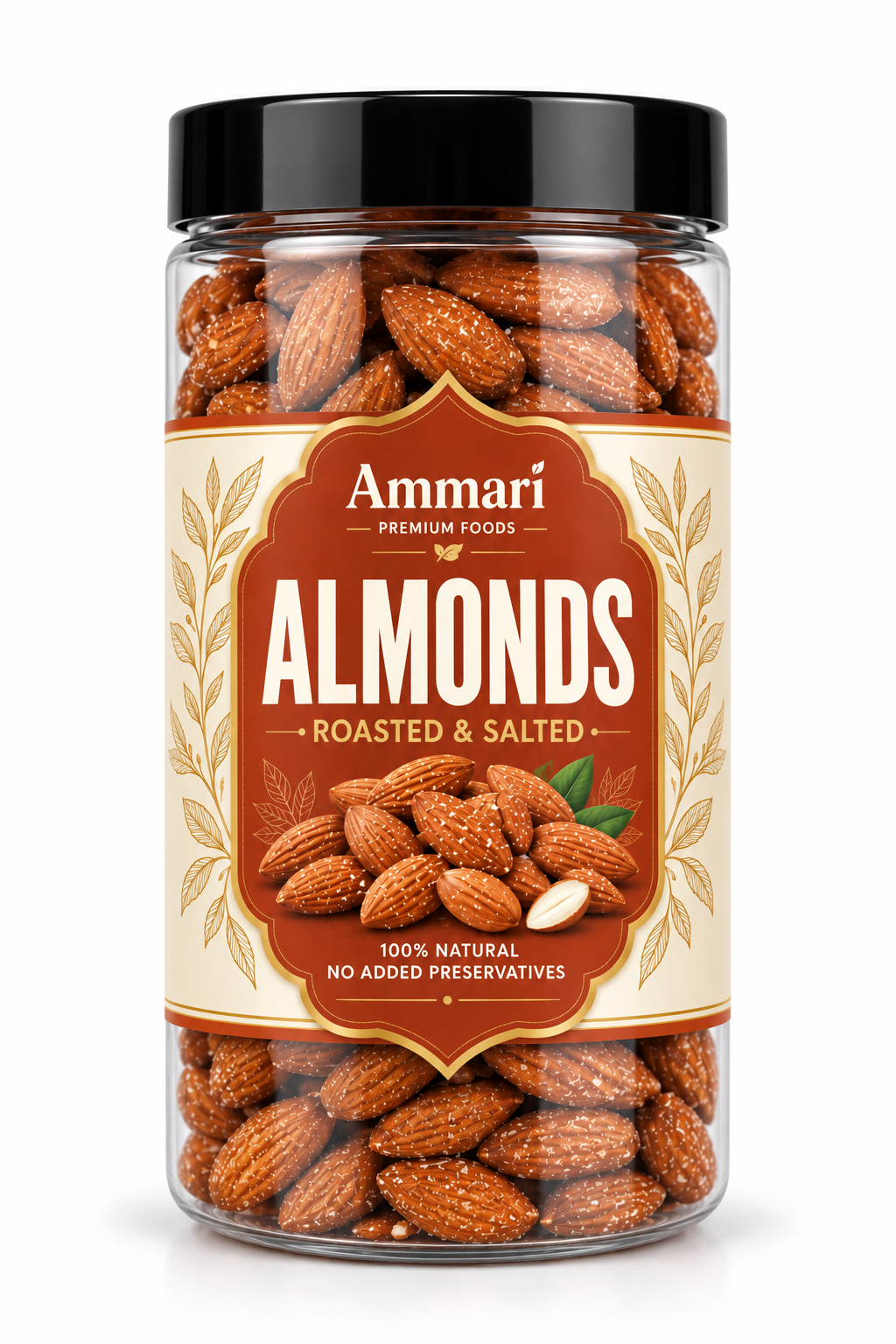
Roasted & Salted Almonds

Original price was: ₹649.00.Current price is: ₹549.00.
27 people are viewing this right now
Out of stock
Estimated Delivery:
23 - 30 Aug, 2026
Trust Badge
Guaranteed safe & secure checkout

Product details

The same premium Nonpareil kernels from our raw range, this time taken a step further. We dry-roast them slowly over even heat — no oil, no coating — until the natural sugars caramelise and the kernel turns a warm golden brown. A light dusting of fine sea salt is added at the end, just enough to lift the buttery flavour without overwhelming it. The result is a deeply savoury, satisfying crunch that is equally at home with evening chai, a cocktail, or a long flight.

Where We Source

The base kernel is identical to our raw almond pack — Nonpareil variety, harvested in California’s Central Valley around Modesto and Sacramento. We chose Nonpareil specifically for roasting because the thin, uniform kernel toasts evenly and develops sweetness without burning at the tips. Roasting is done in small batches at our Jaipur facility so the almonds reach you within weeks of being seasoned, rather than sitting on a shelf for months. We use food-grade fine sea salt, never iodised table salt, which can leave a metallic aftertaste on roasted nuts.

How to Enjoy

  • Evening snack jar: Keep a small bowl on the coffee table — a clean alternative to fried namkeen during cricket matches and movie nights.
  • Cocktail companion: Serve alongside whisky, gin, or a glass of red wine; the salt cuts beautifully through tannin.
  • Salad topper: Roughly chop and scatter over a green salad with feta and pomegranate for crunch and savoury depth.
  • Travel pack: Portion into 30g pouches for office drawers, school bags, or long drives.

Storage & Freshness

Roasted nuts have a slightly shorter window than raw because the oils are activated by heat. Sealed, expect six to nine months of freshness in a cool, dry pantry. Once opened, transfer to an airtight jar and refrigerate to preserve the crunch — exposure to humid Jaipur air will soften them within days otherwise. If they ever lose their snap, ten minutes in a 150C oven will revive them.

Nutritional Snapshot (per 30g serving)

  • Calories: approximately 178 kcal
  • Protein: 6.2 g
  • Healthy fats: 15.2 g (mostly monounsaturated)
  • Fibre: 3.5 g
  • Key micronutrients: vitamin E, magnesium, sodium (added)

Frequently Asked

Is there any oil used in the roasting?
No. These are dry-roasted, meaning the almonds are heated directly without any added cooking oil, palm oil, or fat coating. The visible sheen on a roasted kernel comes from its own natural oils being drawn to the surface during the roast. This keeps the calorie count close to raw almonds and avoids the rancidity that cheap oil-roasted nuts can develop on the shelf.

How salty are they?
Lightly salted by design. Our intention is to enhance the almond, not mask it, so the salt level sits well below typical packaged snacks. If you are watching sodium intake, a 30g serving contributes a modest amount and remains a far cleaner choice than fried namkeen, chips, or biscuits. For a completely salt-free option, our raw almond pack is the right pick.

Can children eat these?
Yes, for children above three years who can chew whole nuts safely. Whole almonds are not recommended for toddlers due to choking risk; for younger children, crush or sliver them before adding to porridge or yoghurt. The light salting is well within everyday limits, but for very young kids the unsalted raw pack is a gentler starting point.

Free delivery on orders over 999. Direct-sourced. Naturally processed.

Quick Comparison

Roasted & Salted Almonds removePremium Dried Apricots (Khubani) removeAmmari Festive Gift Box removeKashmiri Walnuts (Akhrot) removePremium California Almonds removePremium Chilean Walnuts remove
NameRoasted & Salted Almonds removePremium Dried Apricots (Khubani) removeAmmari Festive Gift Box removeKashmiri Walnuts (Akhrot) removePremium California Almonds removePremium Chilean Walnuts remove
ImageRoasted & Salted AlmondsPremium dried apricots khubaniAmmari festive gift boxKashmiri Walnuts (Akhrot)Ammari premium California almonds pouchPremium chilean walnuts
SKUAMM-ALM-RST-500AMM-APR-DRD-500AMM-GFT-FST-001AMM-WAL-KSH-500AMM-ALM-CAL-500AMM-WAL-CHL-500
Rating
Price
Original price was: ₹649.00.Current price is: ₹549.00.
Save 15%
Original price was: ₹699.00.Current price is: ₹599.00.
Save 14%
Original price was: ₹1,999.00.Current price is: ₹1,699.00.
Save 15%
Original price was: ₹899.00.Current price is: ₹799.00.
Save 11%
Original price was: ₹599.00.Current price is: ₹499.00.
Save 17%
Original price was: ₹799.00.Current price is: ₹699.00.
Save 13%
Stock
Out of stock
Out of stock
Out of stock
Out of stock
100 in stock
Out of stock
AvailabilityOut of stockOut of stockOut of stockOut of stock100 in stockOut of stock
Add to cart

Description

Size: 200g

Size: 200g

Size: 1kg

Size: 200g

Size: 200g

Size: 200g

Content

The same premium Nonpareil kernels from our raw range, this time taken a step further. We dry-roast them slowly over even heat — no oil, no coating — until the natural sugars caramelise and the kernel turns a warm golden brown. A light dusting of fine sea salt is added at the end, just enough to lift the buttery flavour without overwhelming it. The result is a deeply savoury, satisfying crunch that is equally at home with evening chai, a cocktail, or a long flight.

Where We Source

The base kernel is identical to our raw almond pack — Nonpareil variety, harvested in California's Central Valley around Modesto and Sacramento. We chose Nonpareil specifically for roasting because the thin, uniform kernel toasts evenly and develops sweetness without burning at the tips. Roasting is done in small batches at our Jaipur facility so the almonds reach you within weeks of being seasoned, rather than sitting on a shelf for months. We use food-grade fine sea salt, never iodised table salt, which can leave a metallic aftertaste on roasted nuts.

How to Enjoy

  • Evening snack jar: Keep a small bowl on the coffee table — a clean alternative to fried namkeen during cricket matches and movie nights.
  • Cocktail companion: Serve alongside whisky, gin, or a glass of red wine; the salt cuts beautifully through tannin.
  • Salad topper: Roughly chop and scatter over a green salad with feta and pomegranate for crunch and savoury depth.
  • Travel pack: Portion into 30g pouches for office drawers, school bags, or long drives.

Storage & Freshness

Roasted nuts have a slightly shorter window than raw because the oils are activated by heat. Sealed, expect six to nine months of freshness in a cool, dry pantry. Once opened, transfer to an airtight jar and refrigerate to preserve the crunch — exposure to humid Jaipur air will soften them within days otherwise. If they ever lose their snap, ten minutes in a 150C oven will revive them.

Nutritional Snapshot (per 30g serving)

  • Calories: approximately 178 kcal
  • Protein: 6.2 g
  • Healthy fats: 15.2 g (mostly monounsaturated)
  • Fibre: 3.5 g
  • Key micronutrients: vitamin E, magnesium, sodium (added)

Frequently Asked

Is there any oil used in the roasting?
No. These are dry-roasted, meaning the almonds are heated directly without any added cooking oil, palm oil, or fat coating. The visible sheen on a roasted kernel comes from its own natural oils being drawn to the surface during the roast. This keeps the calorie count close to raw almonds and avoids the rancidity that cheap oil-roasted nuts can develop on the shelf.

How salty are they?
Lightly salted by design. Our intention is to enhance the almond, not mask it, so the salt level sits well below typical packaged snacks. If you are watching sodium intake, a 30g serving contributes a modest amount and remains a far cleaner choice than fried namkeen, chips, or biscuits. For a completely salt-free option, our raw almond pack is the right pick.

Can children eat these?
Yes, for children above three years who can chew whole nuts safely. Whole almonds are not recommended for toddlers due to choking risk; for younger children, crush or sliver them before adding to porridge or yoghurt. The light salting is well within everyday limits, but for very young kids the unsalted raw pack is a gentler starting point.

Free delivery on orders over 999. Direct-sourced. Naturally processed.

Good apricots (Khubani) taste of summer mountains — bright, slightly tart, and finishing with deep honeyed sweetness. We source from two of the world's great apricot regions: Malatya in eastern Turkey, and the high Karakoram valleys of Ladakh. Both produce fruit that is naturally golden-orange, soft to the bite, and free of sulphur treatment. The result is a dried apricot that looks darker than the bright orange supermarket variety, but tastes considerably more like the original fruit.

Where We Source

Malatya, in the highlands of eastern Anatolia, accounts for nearly half of the world's dried apricot production. Its altitude (around 900 metres), continental climate, and long sunny days produce the soft, plump Hacıhaliloğlu variety we favour. From India, we work with smallholder cooperatives in the Nubra and Sham valleys of Ladakh, where the indigenous Halman and Raktsey Karpo apricots are harvested each August and laid out to dry on stone roofs. Both origins are sun-dried without sulphur dioxide, which is why the fruit is amber-brown rather than fluorescent orange.

How to Enjoy

  • Tagines and curries: Slow-cook with lamb, cinnamon, and almonds for a classic Mughlai or Moroccan dish.
  • Granola and muesli: Chop and toast with oats, almonds, and honey for a make-ahead breakfast.
  • Soaked breakfast: Steep three apricots in water overnight, then eat with curd and a drizzle of honey.
  • Biryani garnish: Stir whole apricots into the final dum stage for a sweet counterpoint to the spice.

Storage & Freshness

Keep apricots in an airtight container in a cool, dry place; they will stay soft and flavourful for 9 to 12 months. Because they retain natural moisture, we strongly recommend refrigerating the bag during Jaipur's summer (April to September) to prevent any surface stickiness or fermentation. If apricots firm up after long storage, soak briefly in warm water to restore their original texture before using.

Nutritional Snapshot (per 30g serving)

  • Calories: approx. 72 kcal
  • Fibre: 2.2 g
  • Iron: 0.8 mg | Potassium: 350 mg
  • Antioxidants: high in beta-carotene and lutein
  • Key micronutrients: vitamin A, vitamin E, copper

Frequently Asked

Why are your apricots dark, not bright orange?
Bright orange dried apricots are treated with sulphur dioxide, which preserves colour and extends shelf life but alters flavour and is unsuitable for many sensitive customers. Our apricots are sun-dried without sulphur, so they oxidise to a natural amber-brown over a few days of drying. The colour is the most reliable visual cue that you are buying genuinely natural Khubani, the way it has been prepared in Anatolia and Ladakh for generations.

Malatya or Ladakh — which is better?
Both are excellent and we ship a blend or single-origin depending on season. Malatya apricots are larger, softer, and sweeter — preferred for desserts, stuffing, and gifting. Ladakh apricots are smaller, more tart, and have a deeper, almost wine-like flavour — preferred by chefs and customers who like a complex, less sugary fruit. Tell us your preference at checkout and we will do our best to accommodate.

Are these the same as Khubani ka Meetha apricots?
Yes, our Malatya variety is the type traditionally used for Hyderabadi Khubani ka Meetha — soft, sweet, and large enough to hold their shape when stewed. Soak them overnight, simmer with sugar and a touch of cardamom, and serve warm with malai or vanilla ice cream. Ladakh apricots also work but produce a tarter, more rustic version of the dish.

Free delivery on orders over ₹999. Direct-sourced. Naturally processed.

The Ammari Festive Gift Box is what we send to our own family and closest customers each Diwali. Inside a sturdy kraft hamper, finished with a satin ribbon and an optional handwritten card, sit five of our most-loved varieties in individual reusable pouches. It is a gift designed to feel considered rather than commercial — direct-sourced fruit, restrained packaging, and the kind of presentation that looks at home on a Diwali pooja thali, a corporate desk, or a wedding sagan tray.

Inside the Box

  • California almonds — 250g: Whole Nonpareil kernels, in a kraft pouch.
  • W320 cashews — 250g: Creamy-white whole grade from Mangaluru.
  • Iranian pistachios — 200g: Akbari kernels, naturally split and lightly salted.
  • Mazafati dates — 200g: Soft, caramel-toned dates from Bam, Iran.
  • Smyrna fig sampler — 100g: Large amber Turkish Anjeer to round off the box.

Total weight: 1kg. Each variety is sealed in its own food-grade pouch, then nested in shredded kraft inside the outer hamper.

Perfect For

  • Diwali corporate gifting: Premium yet appropriate for clients, vendors, and senior team members.
  • Weddings and sagan: Substantial enough as a standalone shagun gift or part of a larger hamper.
  • Raksha Bandhan: A thoughtful sister-to-brother or brother-to-sister gift that travels well.
  • Housewarming and Eid: Universally welcome; halal-friendly contents; no alcohol or pork derivatives.

Storage & Freshness

Each pouch inside the box is sealed for freshness and stays good for 9 to 12 months unopened. Once the recipient opens a pouch, we recommend transferring the contents to an airtight container and storing in a cool, dry place. Dates and figs benefit from refrigeration in summer. The kraft outer box is dry-storage only — please keep away from direct heat, sunlight, and humidity until gifting.

Box Specifications

  • Total net weight: 1000g (1kg) of dry fruits across five pouches
  • Outer hamper: premium 350gsm kraft, magnetic-flap closure
  • Approximate dimensions: 30cm x 22cm x 8cm
  • Finishing: satin ribbon in Ammari brand colour, kraft shred lining
  • Optional add-ons: handwritten message card (free), wax-seal stamping (₹49)
  • Shelf life from dispatch: minimum 8 months on all pouches

Frequently Asked

Can I ship the box directly to a gift recipient?
Yes. At checkout, enter the recipient's address as the delivery address and your address as the billing address. We do not include a price slip or invoice in any gift box — only the optional message card. If you would like us to schedule delivery for a specific date (for example, the day before Diwali or a wedding), add a note at checkout and we will dispatch accordingly.

Do you take bulk corporate orders?
Bulk Diwali and year-end gifting is one of our most-requested services. For orders of 25 boxes or more we offer custom branding (your company logo on the kraft sleeve), custom message cards, and consolidated PAN-India dispatch. We typically need 10 to 14 working days from confirmation. Write to us at hello@ammari.in with quantity, delivery dates, and target locations for a tailored quote.

Can I add a personal message and customise contents?
A handwritten message card up to 40 words is included free with every box — add your text in the order notes at checkout. For content customisation (for example, swapping pistachios for walnuts, or upgrading to a 2kg box), please reach out before placing the order. We are a small family team, so the more notice you give us, the better we can tailor the hamper to your occasion.

Free delivery on orders over ₹999. Direct-sourced. Naturally processed.

Open these and you'll understand why Kashmiri grandmothers insisted on local akhrot for the family halwa. Kashmiri walnuts (Akhrot) carry a sweetness and clean finish that imported varieties simply do not match — the result of high-altitude orchards, a short concentrated growing season, and centuries of cultivar selection in the Kashmir valley. The kernels are pale honey-cream, plump, and break with the gentle resistance of a properly aged nut. This is the walnut for traditional recipes, for winter strength, and for gifts that mean something.

Where We Source

Our Kashmiri walnuts come from family orchards in Pulwama, Shopian, and Anantnag districts of South Kashmir, at elevations between 1,600 and 2,400 metres in the Pir Panjal foothills. We work primarily with the Kagzi variety — the paper-shell cultivar prized for its thin shell and clean kernel release — alongside a smaller share of Mamra, the wild-type with denser meat. Cultivation here is centuries old; many trees in these orchards are forty to seventy years in production. Harvest happens in September and October. We collect through a cooperative of growers and ship from Srinagar within weeks of shelling.

How to Enjoy

  • Doon chetin (Kashmiri walnut chutney): Pound with green chilli, mint, salt, and curd — the signature Kashmiri accompaniment to rice and rogan josh.
  • Sheer khurma and halwa: Coarsely chop into milk-based vermicelli pudding for Eid, or fold into ghee-cooked halwa.
  • Winter immune support: Two or three kernels with morning honey through the cold months — an Ayurvedic and Unani habit followed across North India.
  • Raw snacking and gifting: Crack and eat alongside dried apricots and saffron tea, or pack into Diwali and Karva Chauth gift boxes.

Storage & Freshness

In-shell Kashmiri walnuts keep beautifully — store the unopened pouch in a cool, dark, dry cupboard for up to nine months and the shell does the protection work. Once shelled, transfer kernels to an airtight container and refrigerate; use within three months for peak flavour. Freezing extends life to a year. Discard any kernel that tastes sharp, bitter, or paint-like — that's oxidised oil, not the nut itself.

Nutritional Snapshot (per 30g serving)

  • Calories: 195 kcal
  • Protein: 4.5 g
  • Healthy fats: 19 g (rich in plant-based omega-3 ALA)
  • Fibre: 2 g
  • Key micronutrients: Magnesium, manganese, polyphenols

Frequently Asked

What is the difference between Kagzi and Mamra walnuts?
Kagzi (literally paper-shell) walnuts have a thin shell and a larger, lighter kernel — the most common premium grade in Kashmir. Mamra is the harder-shell, smaller, denser-kerneled variety, often considered richer in oil but harder to crack and lower in yield. Our pack runs primarily Kagzi with some Mamra in season. Both are authentic Kashmiri akhrot.

Why do Kashmiri walnuts cost more than Chilean or Californian?
Kashmir's walnut industry is family-orchard scale, with no industrial processing infrastructure. Yields per tree are lower than mechanised American operations, the harvest window is short, and logistics out of the valley add cost. You're paying for a smaller, slower-grown, hand-sorted nut with regional character. For traditional Indian recipes built around the Kashmiri profile, the difference is tangible on the plate.

Is the Ayurvedic association with brain health based on real evidence?
The classical association is partly symbolic — the kernel resembles a brain in miniature — and partly observational, with walnuts long recommended in Ayurvedic and Unani traditions as medhya (intellect-supporting). Modern research adds context: walnuts are rich in plant omega-3 ALA, polyphenols, and Vitamin E, which feature in studies on cognitive ageing. A small daily handful is one of the better food habits a household can keep.

Free delivery on orders over Rs.999. Direct-sourced. Naturally processed.

A clean, milky-sweet almond with the pale ivory kernel and elegant teardrop shape that defines the Nonpareil variety. Snap one between your teeth and you get that signature crisp bite, followed by a subtle marzipan finish. These are the almonds Indian mothers soak overnight, peel at dawn, and feed to children before exams — chosen here in their natural raw form so you can roast, soak, grind, or simply eat them by the handful.

Where We Source

Our almonds come from the Central Valley of California, primarily the Modesto and Sacramento growing belts where over eighty percent of the world's almond supply is cultivated. The variety is Nonpareil — widely considered the benchmark almond for its thin, smooth shell, light kernel colour, and consistent size. California's hot dry summers and cool wet winters create ideal conditions for almond development, and the region's mature orchard infrastructure ensures the kernels we receive are graded for size and uniformity. We taste each lot before it ships, rejecting any consignment that shows bitter notes or uneven moisture.

How to Enjoy

  • Daily soak: Soak 8 to 10 almonds overnight, peel in the morning, and eat on an empty stomach — a routine rooted in Ayurveda for memory and skin.
  • Badam kheer: Blanch, grind to a fine paste, and simmer with full-fat milk, saffron, and cardamom for a festival classic.
  • Sliver and toast: Slice thin, dry-toast, and scatter over pulao, halwa, or a morning bowl of yoghurt and honey.
  • Almond milk: Soak, blend with filtered water, strain through muslin for a fresh, additive-free drink.

Storage & Freshness

Sealed and unopened, these almonds stay fresh for six to nine months in a cool, dry pantry. Once you open the pack, transfer the kernels to an airtight glass or steel container. For longer life — especially through Jaipur summers — refrigerate after opening. Keep them away from direct sunlight, strong-smelling spices, and humidity, all of which can dull the natural sweetness and shorten shelf life.

Nutritional Snapshot (per 30g serving)

  • Calories: approximately 174 kcal
  • Protein: 6.3 g
  • Healthy fats: 15 g (mostly monounsaturated)
  • Fibre: 3.7 g
  • Key micronutrients: vitamin E, magnesium, riboflavin

Frequently Asked

Should I soak these almonds before eating? Soaking is a tradition for good reason. An overnight soak softens the brown skin, which contains tannins that some find slightly bitter, and many people report easier digestion afterwards. That said, raw unsoaked almonds are perfectly nutritious and convenient for travel or a quick handful. Choose what suits your routine — the kernel quality is the same either way. Are these the same almonds sold as Mamra? No. Mamra is a separate variety grown chiefly in Iran and parts of Kashmir, with a smaller, oilier, more wrinkled kernel and a higher price point. Our offering is California Nonpareil — larger, smoother, and milder in flavour. Both have their place; Nonpareil is the everyday-use almond that performs reliably in soaking, baking, grinding, and snacking. Why no salt or roasting on this pack? This is the raw natural kernel, kept untouched so you have full flexibility. Roast them at home in a dry pan for ten minutes if you prefer warmth and crunch, soak them for the morning ritual, or grind them for kheer and barfi. If you want a ready-to-eat snacking option, look at our Roasted and Salted Almonds in the same range. Free delivery on orders over 999. Direct-sourced. Naturally processed.

These are the walnuts that bake without bitterness. Chilean walnut halves and pieces, pale cream in colour, mild on the palate, with the snap-clean break of a properly cured kernel. Counter-season harvesting in the southern hemisphere means our crop arrives in Indian kitchens within months of being picked, not after a year in a warehouse. The result is a walnut that tastes of fresh oil and faint sweetness rather than the dusty edge of old stock — a meaningful difference once you bake with them.

Where We Source

Chilean walnuts come from the long valleys running south from Santiago — primarily the O'Higgins, Maule, and Metropolitana regions, where the Andes meet the Pacific in a microclimate of warm dry summers and cold wet winters that walnuts thrive in. Chile harvests in March and April, opposite to California and China. By the time these reach Jaipur, they're typically four to six months out of the orchard, while northern hemisphere stock in the same retail year may already be twelve to fourteen months old. We work with growers in the Maule valley who hand-sort halves from pieces.

How to Enjoy

  • Brownies and banana bread: Fold chopped pieces into the batter — the mild profile keeps cocoa and banana centre stage.
  • Walnut chutney: Grind with green chilli, garlic, and curd for a Kashmiri-style accompaniment to rice.
  • Salads and grain bowls: Toast lightly in a dry pan and scatter over rocket with pear and blue cheese, or quinoa with roasted pumpkin.
  • Breakfast and granola: Stir into oats with banana and honey, or build into homemade granola with seeds and cardamom.

Storage & Freshness

Walnuts have the highest oil content of any common tree nut, which makes them the most susceptible to rancidity. Keep the unopened pouch in a cool dark cupboard for up to six months. Once opened, transfer to an airtight container and store in the refrigerator — this slows oxidation noticeably and preserves the fresh-pressed oil character. For storage beyond three months after opening, freeze in portioned bags. Discard if the kernels smell sharp or paint-like.

Nutritional Snapshot (per 30g serving)

  • Calories: 195 kcal
  • Protein: 4.5 g
  • Healthy fats: 19 g (rich in plant-based omega-3 ALA)
  • Fibre: 2 g
  • Key micronutrients: Magnesium, manganese, copper

Frequently Asked

How are Chilean walnuts different from Kashmiri walnuts?
Chilean walnuts are typically larger, lighter in colour, milder in flavour, with thinner inner skins that contribute less tannin and bitterness. Kashmiri walnuts are smaller, deeper amber, sweeter on the finish, and carry high-altitude character. Neither is better — they suit different uses. Chilean is our pick for Western baking and salads where the walnut supports rather than dominates. Kashmiri shines in chutneys, halwa, and raw snacking.

Why do mine taste fresher than walnuts I've bought before?
Most walnuts in Indian retail are northern hemisphere stock that's been in non-refrigerated warehouses for nine to fourteen months. Walnut oils oxidise across that period, producing the slightly bitter, papery taste people often assume is just how walnuts are. Chilean counter-season crop reaches you closer to harvest, and we ship from cool storage. Once you taste a fresh kernel, the old stock becomes obvious.

Are these suitable for daily heart-health intake?
Walnuts are one of the few plant sources rich in alpha-linolenic acid, the omega-3 linked in long-running studies to favourable cardiovascular markers. A handful — roughly 30 grams, or seven to eight halves — is the portion most clinical guidance suggests for daily inclusion. Eat them raw or lightly toasted; deep-frying or heavy roasting damages the omega-3 profile.

Free delivery on orders over Rs.999. Direct-sourced. Naturally processed.

Weight0.5 lbs0.5 lbs1.0 lbs0.5 lbs0.5 lbs0.5 lbs
DimensionsN/AN/AN/AN/AN/AN/A
Additional information
Weight 0.5 lbs
Weight 0.5 lbs
Weight 1.0 lbs
Weight 0.5 lbs
Weight 0.5 lbs
Weight 0.5 lbs
Sold000000
Shipping

Related products

Select the fields to be shown. Others will be hidden. Drag and drop to rearrange the order.
  • Image
  • SKU
  • Rating
  • Price
  • Stock
  • Description
  • Weight
  • Dimensions
  • Additional information
  • Add to cart
Click outside to hide the comparison bar
Compare