Sold
out

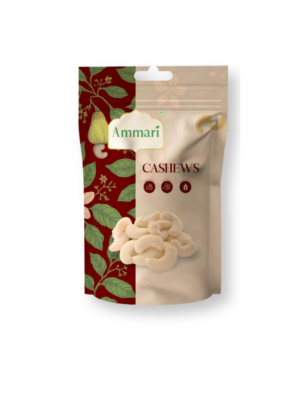
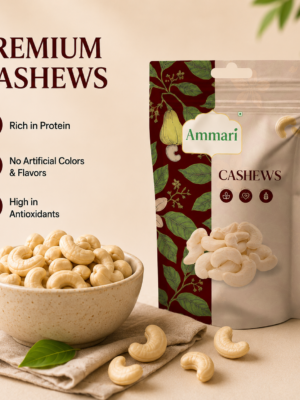
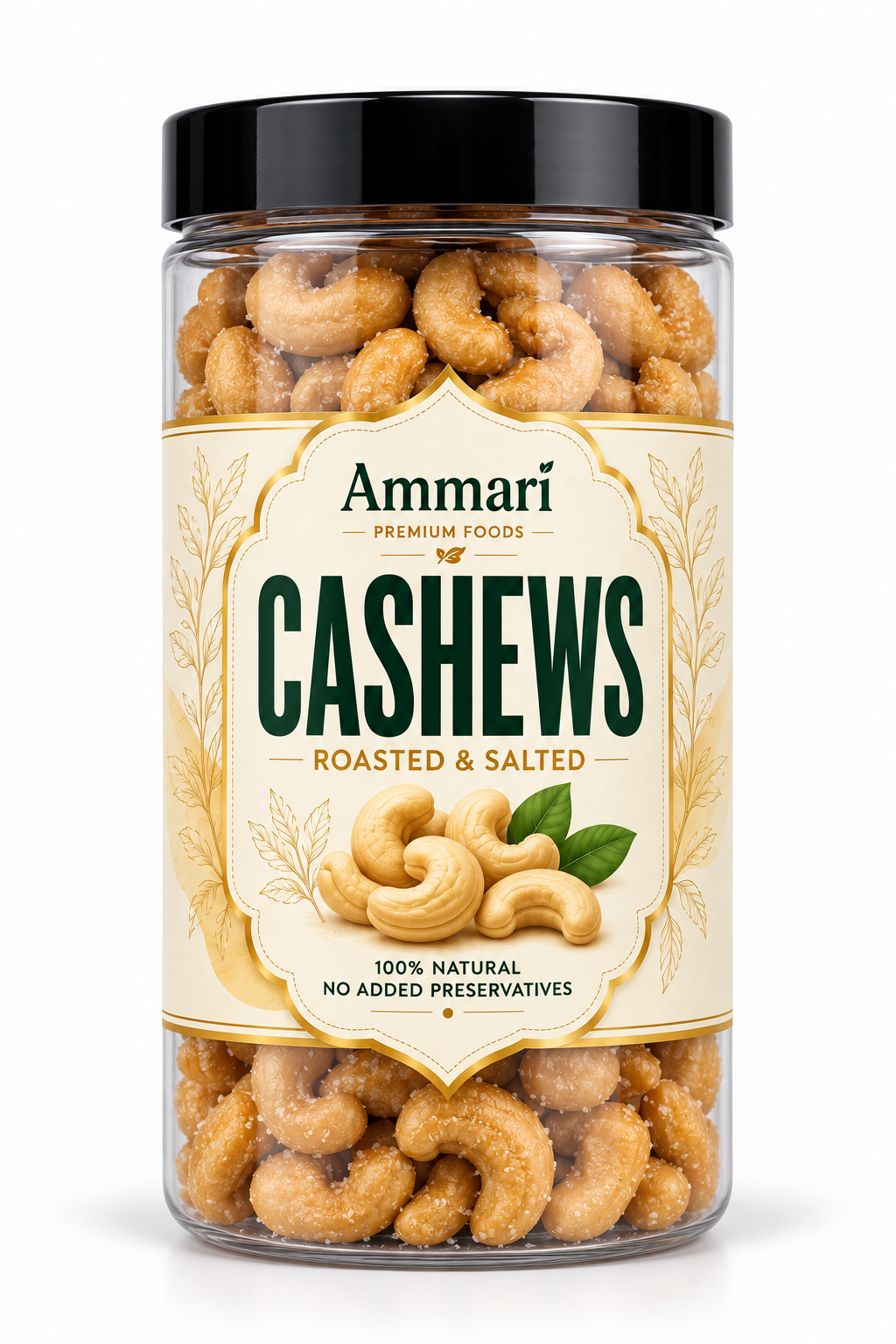
Roasted Salted Cashews

Original price was: ₹949.00.Current price is: ₹799.00.
27 people are viewing this right now
Out of stock
Estimated Delivery:
18 - 25 May, 2026
Trust Badge
Guaranteed safe & secure checkout

Product details

The same premium W240 whole cashews from our raw range, taken to the next stage. We dry-roast them gently — no oil, no coating — until the kernel turns a soft golden hue and that natural sweet-savoury cashew aroma fills the kitchen. A light scatter of fine sea salt finishes them. Crisp, buttery, and substantial enough to feel like a treat without the heaviness of fried snacks, these are the cashews you reach for during a cricket match, a long meeting, or unexpected guests at chai time.

Where We Source

The kernel base is identical to our raw W240 cashew pack — sourced from the Mangalore and Goa coastal belt with selective Vietnamese lots during off-season, all conforming to the W240 grade of approximately 240 unbroken white kernels per pound. We chose this grade specifically for roasting because the larger, denser kernel holds heat evenly and develops a uniform colour without burning at the tips. Roasting is done in small batches at our Jaipur facility so the cashews reach you fresh, with the salt crystals still distinct rather than absorbed into stale oil.

How to Enjoy

  • Namkeen alternative: Pour into a brass katori for evening chai instead of fried sev or bhujia — the same crunch, none of the heaviness.
  • Cocktail and bar snack: A natural pairing with whisky, white wine, and beer at home gatherings.
  • Office drawer: A small handful at three pm beats biscuits and vending-machine chocolate every time.
  • Festive mithai platter: Mix with raisins and roasted almonds in a silver tray for unexpected guests during Diwali or Eid.

Storage & Freshness

Roasted cashews stay fresh for six to nine months sealed, but once opened the clock speeds up. Transfer to an airtight glass jar and refrigerate, particularly through summer, to keep the crunch intact and the oils from going stale. Humidity is the enemy here — a single afternoon left open in monsoon air will turn them soft. If that happens, a five-minute revival in a 150C oven will restore the snap.

Nutritional Snapshot (per 30g serving)

  • Calories: approximately 168 kcal
  • Protein: 5 g
  • Healthy fats: 13.2 g (mostly monounsaturated)
  • Fibre: 1 g
  • Key micronutrients: copper, magnesium, sodium (added)

Frequently Asked

How do these compare to fried namkeen calorie-wise?
A 30g serving of these dry-roasted cashews delivers around 168 calories with 13g of mostly monounsaturated fat — comparable to most savoury snacks, but with meaningful protein, fibre, and minerals attached. Fried namkeen of the same weight typically carries refined oil, refined flour, and added sugars or maida. The trade is not zero-calorie versus calorie-heavy; it is empty calories versus nourishing ones.

Why dry-roasted instead of oil-roasted?
Oil-roasting is faster and cheaper, but it adds calories from the cooking oil — usually palm or refined sunflower — and the oil itself can go rancid on the shelf, dulling the cashew flavour. Dry-roasting takes longer and demands attention so the kernels do not scorch, but it preserves the cashew’s own buttery oil and keeps the ingredient list to two: cashews and salt. We think the difference is worth it.

Will the salt level overpower the cashew?
No. We salt at a level that wakes up the natural sweetness rather than dominating it. Our test is simple — you should still taste cashew first, salt second. If you compare these to mass-market roasted cashews, ours come across noticeably less salty, which is intentional. For a fully unsalted version, our raw W240 pack is a quick home-roast away from this exact product.

Free delivery on orders over 999. Direct-sourced. Naturally processed.

Quick Comparison

Roasted Salted Cashews removePremium Dried Apricots (Khubani) removeAjwa Dates (Khajoor) removePremium Whole Cashews (W240) removeAfghan Black Raisins (Munakka) removePremium Chilean Walnuts remove
NameRoasted Salted Cashews removePremium Dried Apricots (Khubani) removeAjwa Dates (Khajoor) removePremium Whole Cashews (W240) removeAfghan Black Raisins (Munakka) removePremium Chilean Walnuts remove
ImagePremium whole cashews w240Premium dried apricots khubaniPremium medjool datesPremium whole cashews w240Afghan black raisins munakkaPremium chilean walnuts
SKUAMM-CSH-RST-500AMM-APR-DRD-500AMM-DTS-AJW-500AMM-CSH-W240-500AMM-RSN-MUN-500AMM-WAL-CHL-500
Rating
Price
Original price was: ₹949.00.Current price is: ₹799.00.
Save 16%
Original price was: ₹699.00.Current price is: ₹599.00.
Save 14%
Original price was: ₹1,499.00.Current price is: ₹1,299.00.
Save 13%
Original price was: ₹899.00.Current price is: ₹749.00.
Save 17%
Original price was: ₹399.00.Current price is: ₹349.00.
Save 13%
Original price was: ₹799.00.Current price is: ₹699.00.
Save 13%
Stock
Out of stock
Out of stock
Out of stock
100 in stock
Out of stock
Out of stock
AvailabilityOut of stockOut of stockOut of stock100 in stockOut of stockOut of stock
Add to cart

Description

W240 cashews dry-roasted with fine sea salt — the cleanest TV snack in your pantry, and a worthy upgrade from fried namkeen for everyday munching.

Soft golden Khubani sourced from Malatya, Turkey and our Ladakh partners. Sulphur-free, naturally sun-dried, with a clean tart-sweet finish.

Authentic Ajwa dates from Madinah, Saudi Arabia. Small, jet-black, soft, mildly sweet. Geographically protected origin. 500g, gift-ready for Ramadan and Hajj season.

W240 grade whole cashews (Kaju) — large, ivory-white, unbroken kernels graded for size and uniformity. The premium baseline for kheer, katli, and a clean handful.

Large, with-seed Afghan Munakka from Kandahar and Herat. Deep amber-black, intensely sweet, the Ayurvedic raisin traditionally used for cough, cold and iron support. 500g.

Light, cream-coloured Chilean walnut halves and pieces from the Andes valleys. Mild, clean flavour with no bitter aftertaste — ideal for baking, salads, and breakfast bowls.

Content

The same premium W240 whole cashews from our raw range, taken to the next stage. We dry-roast them gently — no oil, no coating — until the kernel turns a soft golden hue and that natural sweet-savoury cashew aroma fills the kitchen. A light scatter of fine sea salt finishes them. Crisp, buttery, and substantial enough to feel like a treat without the heaviness of fried snacks, these are the cashews you reach for during a cricket match, a long meeting, or unexpected guests at chai time.

Where We Source

The kernel base is identical to our raw W240 cashew pack — sourced from the Mangalore and Goa coastal belt with selective Vietnamese lots during off-season, all conforming to the W240 grade of approximately 240 unbroken white kernels per pound. We chose this grade specifically for roasting because the larger, denser kernel holds heat evenly and develops a uniform colour without burning at the tips. Roasting is done in small batches at our Jaipur facility so the cashews reach you fresh, with the salt crystals still distinct rather than absorbed into stale oil.

How to Enjoy

  • Namkeen alternative: Pour into a brass katori for evening chai instead of fried sev or bhujia — the same crunch, none of the heaviness.
  • Cocktail and bar snack: A natural pairing with whisky, white wine, and beer at home gatherings.
  • Office drawer: A small handful at three pm beats biscuits and vending-machine chocolate every time.
  • Festive mithai platter: Mix with raisins and roasted almonds in a silver tray for unexpected guests during Diwali or Eid.

Storage & Freshness

Roasted cashews stay fresh for six to nine months sealed, but once opened the clock speeds up. Transfer to an airtight glass jar and refrigerate, particularly through summer, to keep the crunch intact and the oils from going stale. Humidity is the enemy here — a single afternoon left open in monsoon air will turn them soft. If that happens, a five-minute revival in a 150C oven will restore the snap.

Nutritional Snapshot (per 30g serving)

  • Calories: approximately 168 kcal
  • Protein: 5 g
  • Healthy fats: 13.2 g (mostly monounsaturated)
  • Fibre: 1 g
  • Key micronutrients: copper, magnesium, sodium (added)

Frequently Asked

How do these compare to fried namkeen calorie-wise?
A 30g serving of these dry-roasted cashews delivers around 168 calories with 13g of mostly monounsaturated fat — comparable to most savoury snacks, but with meaningful protein, fibre, and minerals attached. Fried namkeen of the same weight typically carries refined oil, refined flour, and added sugars or maida. The trade is not zero-calorie versus calorie-heavy; it is empty calories versus nourishing ones.

Why dry-roasted instead of oil-roasted?
Oil-roasting is faster and cheaper, but it adds calories from the cooking oil — usually palm or refined sunflower — and the oil itself can go rancid on the shelf, dulling the cashew flavour. Dry-roasting takes longer and demands attention so the kernels do not scorch, but it preserves the cashew's own buttery oil and keeps the ingredient list to two: cashews and salt. We think the difference is worth it.

Will the salt level overpower the cashew?
No. We salt at a level that wakes up the natural sweetness rather than dominating it. Our test is simple — you should still taste cashew first, salt second. If you compare these to mass-market roasted cashews, ours come across noticeably less salty, which is intentional. For a fully unsalted version, our raw W240 pack is a quick home-roast away from this exact product.

Free delivery on orders over 999. Direct-sourced. Naturally processed.

Good apricots (Khubani) taste of summer mountains — bright, slightly tart, and finishing with deep honeyed sweetness. We source from two of the world's great apricot regions: Malatya in eastern Turkey, and the high Karakoram valleys of Ladakh. Both produce fruit that is naturally golden-orange, soft to the bite, and free of sulphur treatment. The result is a dried apricot that looks darker than the bright orange supermarket variety, but tastes considerably more like the original fruit.

Where We Source

Malatya, in the highlands of eastern Anatolia, accounts for nearly half of the world's dried apricot production. Its altitude (around 900 metres), continental climate, and long sunny days produce the soft, plump Hacıhaliloğlu variety we favour. From India, we work with smallholder cooperatives in the Nubra and Sham valleys of Ladakh, where the indigenous Halman and Raktsey Karpo apricots are harvested each August and laid out to dry on stone roofs. Both origins are sun-dried without sulphur dioxide, which is why the fruit is amber-brown rather than fluorescent orange.

How to Enjoy

  • Tagines and curries: Slow-cook with lamb, cinnamon, and almonds for a classic Mughlai or Moroccan dish.
  • Granola and muesli: Chop and toast with oats, almonds, and honey for a make-ahead breakfast.
  • Soaked breakfast: Steep three apricots in water overnight, then eat with curd and a drizzle of honey.
  • Biryani garnish: Stir whole apricots into the final dum stage for a sweet counterpoint to the spice.

Storage & Freshness

Keep apricots in an airtight container in a cool, dry place; they will stay soft and flavourful for 9 to 12 months. Because they retain natural moisture, we strongly recommend refrigerating the bag during Jaipur's summer (April to September) to prevent any surface stickiness or fermentation. If apricots firm up after long storage, soak briefly in warm water to restore their original texture before using.

Nutritional Snapshot (per 30g serving)

  • Calories: approx. 72 kcal
  • Fibre: 2.2 g
  • Iron: 0.8 mg | Potassium: 350 mg
  • Antioxidants: high in beta-carotene and lutein
  • Key micronutrients: vitamin A, vitamin E, copper

Frequently Asked

Why are your apricots dark, not bright orange?
Bright orange dried apricots are treated with sulphur dioxide, which preserves colour and extends shelf life but alters flavour and is unsuitable for many sensitive customers. Our apricots are sun-dried without sulphur, so they oxidise to a natural amber-brown over a few days of drying. The colour is the most reliable visual cue that you are buying genuinely natural Khubani, the way it has been prepared in Anatolia and Ladakh for generations.

Malatya or Ladakh — which is better?
Both are excellent and we ship a blend or single-origin depending on season. Malatya apricots are larger, softer, and sweeter — preferred for desserts, stuffing, and gifting. Ladakh apricots are smaller, more tart, and have a deeper, almost wine-like flavour — preferred by chefs and customers who like a complex, less sugary fruit. Tell us your preference at checkout and we will do our best to accommodate.

Are these the same as Khubani ka Meetha apricots?
Yes, our Malatya variety is the type traditionally used for Hyderabadi Khubani ka Meetha — soft, sweet, and large enough to hold their shape when stewed. Soak them overnight, simmer with sugar and a touch of cardamom, and serve warm with malai or vanilla ice cream. Ladakh apricots also work but produce a tarter, more rustic version of the dish.

Free delivery on orders over ₹999. Direct-sourced. Naturally processed.

Ajwa is a date held with reverence. Small, almost jet-black, finely wrinkled, and yielding to the touch, it carries a quieter sweetness than the larger Medjool, with notes of raisin, prune and a soft, almost liquorice finish. For Muslim families it is the date of the Prophet, traditionally eaten in odd numbers, often three or seven, at the breaking of fast. For everyone else, it is simply one of the finest dates in the world, and we treat each box with the seriousness it deserves.

Where We Source

True Ajwa is grown in one place: the volcanic-soil orchards around Madinah in Saudi Arabia. The variety has been cultivated there for centuries and is geographically protected, much in the way Champagne or Darjeeling tea are tied to a single region. Dates labelled Ajwa from any other origin are not authentic. Our supply comes through a long-standing relationship with a Madinah cooperative; each consignment carries Saudi origin documentation. Harvest is in late August and September, and we receive stock carefully air-shipped and cold-chain handled, so the soft, signature texture is preserved from the palm to your kitchen.

How to Enjoy

  • Iftar tradition: Break the fast with three or seven Ajwa and a glass of water, the way the sunnah is observed.
  • Daily piece: Many families keep a small jar and eat one or two each morning with a few almonds.
  • Stuffed simply: Pit and fill with a single peeled almond; no further seasoning is needed.
  • Hajj and Umrah gifting: A 500g gift box is a meaningful return gift for friends and family.

Storage & Freshness

Ajwa is a soft, moisture-rich date and is best stored refrigerated in an airtight container, where it keeps its texture and flavour for nine to twelve months. At cool room temperature it holds well for four to six weeks. Avoid warm, sunlit shelves, which dry and harden the fruit. If the dates do firm up, a few hours back at room temperature, or a brief warm-water dip, restores their characteristic soft bite.

Nutritional Snapshot (per 30g serving, roughly 4 dates)

  • Calories: ~85 kcal
  • Natural sugars: ~20 g (glucose and fructose, no added sugar)
  • Fibre: ~2.2 g
  • Iron: ~0.5 mg | Potassium: ~210 mg
  • Key micronutrients: Magnesium, Calcium, Selenium, Polyphenols

Frequently Asked

How do I know these Ajwa are authentic?
Authentic Ajwa is small, almost uniformly dark brown to black, soft to the press, with very fine surface wrinkles and a clean, mild sweetness. It will never be glossy, oversized or bright. Our consignments arrive with Saudi origin documentation from a Madinah-based cooperative, and the lot reference on your box ties back to that paperwork. If anyone offers you Ajwa at a price close to ordinary dates, or in a shiny large form, it is almost certainly mislabelled.

What is the significance of seven Ajwa in Islamic tradition?
A well-known hadith narrates that the Prophet Muhammad, peace be upon him, said that whoever eats seven Ajwa dates from Madinah in the morning will be protected from harm that day. Many Muslim families therefore keep Ajwa specifically for this daily practice, distinct from other dates used for general eating or cooking. We mention this because it is the most common reason customers seek out Ajwa specifically, and we want to honour that intention with genuine fruit.

Why are Ajwa dates less sweet than Medjool?
Ajwa has a naturally lower sugar concentration and a higher mineral content than larger varieties like Medjool or Kimia. The flavour is more savoury, with hints of prune, dried fig and a subtle earthiness from the volcanic soil it grows in. Many people who find other dates too sweet find Ajwa balanced and easy to eat daily. The lower sweetness also makes it a preferred choice for those who want the nutritional benefit without a strong sugar hit.

Free delivery on orders over Rs.999. Direct-sourced. Naturally processed.

Plump, ivory-white, and pleasingly heavy in the hand, these are W240 grade whole cashews — the size and consistency professional kitchens specify when they want their kaju katli to set cleanly and their biryani garnish to hold its shape. The flavour is gently sweet and creamy, with that distinctive buttery finish that makes cashews the most versatile nut in Indian cooking. We sell them raw and unbroken so you can roast, blend, or grind to your own preference.

Where We Source

Our cashews are sourced from the western coastal belt — primarily growers and processors around Mangalore and Goa, with selective lots from Vietnam during off-season months to maintain year-round quality. The W in W240 stands for white whole, and the number refers to the count per pound: roughly 240 kernels per pound, which makes them larger and more premium than the more common W320 grade. Larger kernels mean fewer broken pieces, better visual appeal in sweets and pulao, and a richer mouthfeel. We hand-check every consignment for chipping, scorching, and uniform colour before packing.

How to Enjoy

  • Kaju katli: Soak briefly, grind to a smooth paste, and cook with sugar syrup for the festival sweet that defines Diwali gifting.
  • Cashew milk and cream: Soak overnight and blend with water for a dairy-free milk; reduce the water for a luxurious cooking cream.
  • Biryani and pulao garnish: Fry whole in ghee until golden, scatter over rice along with fried onions and raisins.
  • Raw snacking: A small handful straight from the pack — naturally sweet enough to satisfy a mid-afternoon craving without sugar.

Storage & Freshness

Sealed, our W240 cashews stay fresh for six to nine months in a cool, dry place. Once opened, transfer to an airtight container and ideally move to the refrigerator, especially during summer. Cashews are particularly sensitive to humidity and absorb fridge odours easily, so a tight glass jar is preferable to plastic. Avoid storing near onions, garlic, or strong masalas, which can taint the delicate flavour.

Nutritional Snapshot (per 30g serving)

  • Calories: approximately 165 kcal
  • Protein: 5.1 g
  • Healthy fats: 13 g (mostly monounsaturated)
  • Fibre: 1 g
  • Key micronutrients: copper, magnesium, zinc

Frequently Asked

What does W240 actually mean?
W240 is an industry grade. The W stands for white whole — meaning the kernel is unbroken and has a clean, light ivory colour with no scorching from the de-shelling process. The 240 indicates approximately 240 kernels per pound, so a higher number like W320 means smaller cashews and W180 means even larger. W240 is widely considered the premium everyday grade for both eating and cooking.

Are these Indian or Vietnamese cashews?
Both, depending on season. India and Vietnam are the two largest producers of quality cashews, and the truth is that processing standards matter more than country of origin. Our primary sourcing is from Mangalore and Goa, but during certain months we draw from carefully chosen Vietnamese lots that meet the same W240 grade and freshness benchmarks. The pack will reflect the current origin transparently.

Why are these more expensive than supermarket cashews?
Three reasons. First, W240 is a larger, more premium grade than the W320 or broken splits often sold cheaply. Second, we buy directly from processors rather than through multiple distributors, but we also reject lots that fail our taste and visual checks — that quality bar costs us volume. Third, freshness: our turnover is fast, so the kernel you receive is closer to harvest than retail-shelf stock.

Free delivery on orders over 999. Direct-sourced. Naturally processed.

Munakka is the elder cousin of the everyday raisin: bigger, darker, deeply sweet, and carrying a single seed in the old way. Our Afghan Munakka has a wrinkled mahogany skin and a soft, jammy interior that tastes of dried plum and dark caramel. Generations of Indian households have kept a small jar of these on the kitchen shelf, soaked overnight in milk or water for children with a winter cough, or stirred into kahwa on cold mornings.

Where We Source

True Munakka comes from grapes grown in the high, dry plateaus of Afghanistan, primarily around Kandahar and Herat, with a smaller share from the Iranian provinces bordering Khorasan. The vines benefit from cold winters, hot summers and very low humidity, which concentrates the sugars before drying. The grapes are dried slowly in traditional mud-brick kishmish khanas, ventilated rooms with slatted walls that let dry air circulate without direct sun. This shade-drying over several weeks is what gives Munakka its characteristic depth of flavour and chewy texture, very different from quickly sun-dried table raisins.

How to Enjoy

  • Ayurvedic soak: Soak two to three Munakka overnight in warm water; eat on an empty stomach for traditional iron and digestion support.
  • Kahwa and milk: Simmer with saffron and a stick of cinnamon for a winter night drink.
  • Biryani and pulao: Fry briefly in ghee with cashews; their size holds up beautifully against the rice.
  • Sherbet and chutney: Blend soaked Munakka with tamarind and rock salt for a classic North Indian sweet-sour sherbet.

Storage & Freshness

Keep Munakka in an airtight container in a cool, dark cupboard. Best consumed within nine to twelve months of packing. Because Munakka has higher residual moisture than seedless raisins, refrigeration is recommended in summer or in humid coastal climates after the pouch is opened. If they stiffen over time, a five-minute soak in warm water restores the original soft texture.

Nutritional Snapshot (per 30g serving)

  • Calories: ~95 kcal
  • Natural sugars: ~21 g (fructose and glucose, no added sugar)
  • Fibre: ~1.4 g
  • Iron: ~1.1 mg | Potassium: ~250 mg
  • Key micronutrients: Calcium, Magnesium, Polyphenols

Frequently Asked

What is the difference between Munakka and Kishmish?
Both are dried grapes, but they come from different varieties and traditions. Kishmish is small, seedless, and lighter in colour, eaten as a snack and used in everyday cooking. Munakka is larger, retains its seed, and is dried far longer, which deepens both colour and flavour. In Ayurveda, Munakka is considered more medicinal, especially for respiratory health, anaemia, and constipation. Many households use the two interchangeably in sweets, but the soaked-overnight ritual specifically calls for Munakka.

Why does Munakka have a seed inside?
The traditional Munakka grape is a seeded variety, and Ayurvedic texts specifically recommend the seeded form. The seed is small, soft after soaking, and edible, though most people split the fruit and remove it before eating. Removing the seed is also how Munakka is prepared for children. The presence of the seed is a sign that you are getting the authentic varietal, not a relabelled seedless raisin.

Is Munakka safe during pregnancy?
Soaked Munakka is a long-standing traditional remedy in Indian households during pregnancy, valued for its iron, fibre and gentle natural sweetness. Two to four soaked pieces a day, eaten in the morning, are commonly recommended. That said, every pregnancy is different. If you have gestational diabetes or any condition that requires monitoring blood sugar, please consult your doctor before adding any dried fruit, including Munakka, to your daily routine.

Free delivery on orders over Rs.999. Direct-sourced. Naturally processed.

These are the walnuts that bake without bitterness. Chilean walnut halves and pieces, pale cream in colour, mild on the palate, with the snap-clean break of a properly cured kernel. Counter-season harvesting in the southern hemisphere means our crop arrives in Indian kitchens within months of being picked, not after a year in a warehouse. The result is a walnut that tastes of fresh oil and faint sweetness rather than the dusty edge of old stock — a meaningful difference once you bake with them.

Where We Source

Chilean walnuts come from the long valleys running south from Santiago — primarily the O'Higgins, Maule, and Metropolitana regions, where the Andes meet the Pacific in a microclimate of warm dry summers and cold wet winters that walnuts thrive in. Chile harvests in March and April, opposite to California and China. By the time these reach Jaipur, they're typically four to six months out of the orchard, while northern hemisphere stock in the same retail year may already be twelve to fourteen months old. We work with growers in the Maule valley who hand-sort halves from pieces.

How to Enjoy

  • Brownies and banana bread: Fold chopped pieces into the batter — the mild profile keeps cocoa and banana centre stage.
  • Walnut chutney: Grind with green chilli, garlic, and curd for a Kashmiri-style accompaniment to rice.
  • Salads and grain bowls: Toast lightly in a dry pan and scatter over rocket with pear and blue cheese, or quinoa with roasted pumpkin.
  • Breakfast and granola: Stir into oats with banana and honey, or build into homemade granola with seeds and cardamom.

Storage & Freshness

Walnuts have the highest oil content of any common tree nut, which makes them the most susceptible to rancidity. Keep the unopened pouch in a cool dark cupboard for up to six months. Once opened, transfer to an airtight container and store in the refrigerator — this slows oxidation noticeably and preserves the fresh-pressed oil character. For storage beyond three months after opening, freeze in portioned bags. Discard if the kernels smell sharp or paint-like.

Nutritional Snapshot (per 30g serving)

  • Calories: 195 kcal
  • Protein: 4.5 g
  • Healthy fats: 19 g (rich in plant-based omega-3 ALA)
  • Fibre: 2 g
  • Key micronutrients: Magnesium, manganese, copper

Frequently Asked

How are Chilean walnuts different from Kashmiri walnuts?
Chilean walnuts are typically larger, lighter in colour, milder in flavour, with thinner inner skins that contribute less tannin and bitterness. Kashmiri walnuts are smaller, deeper amber, sweeter on the finish, and carry high-altitude character. Neither is better — they suit different uses. Chilean is our pick for Western baking and salads where the walnut supports rather than dominates. Kashmiri shines in chutneys, halwa, and raw snacking.

Why do mine taste fresher than walnuts I've bought before?
Most walnuts in Indian retail are northern hemisphere stock that's been in non-refrigerated warehouses for nine to fourteen months. Walnut oils oxidise across that period, producing the slightly bitter, papery taste people often assume is just how walnuts are. Chilean counter-season crop reaches you closer to harvest, and we ship from cool storage. Once you taste a fresh kernel, the old stock becomes obvious.

Are these suitable for daily heart-health intake?
Walnuts are one of the few plant sources rich in alpha-linolenic acid, the omega-3 linked in long-running studies to favourable cardiovascular markers. A handful — roughly 30 grams, or seven to eight halves — is the portion most clinical guidance suggests for daily inclusion. Eat them raw or lightly toasted; deep-frying or heavy roasting damages the omega-3 profile.

Free delivery on orders over Rs.999. Direct-sourced. Naturally processed.

Weight0.5 lbs0.5 lbs0.5 lbs0.5 lbs0.5 lbs0.5 lbs
DimensionsN/AN/AN/AN/AN/AN/A
Additional information
Weight 0.5 lbs
Weight 0.5 lbs
Weight 0.5 lbs
Weight 0.5 lbs
Weight 0.5 lbs
Weight 0.5 lbs
Sold000000
Shipping

Related products

Select the fields to be shown. Others will be hidden. Drag and drop to rearrange the order.
  • Image
  • SKU
  • Rating
  • Price
  • Stock
  • Description
  • Weight
  • Dimensions
  • Additional information
  • Add to cart
Click outside to hide the comparison bar
Compare