out
Afghan Black Raisins (Munakka)

Product details
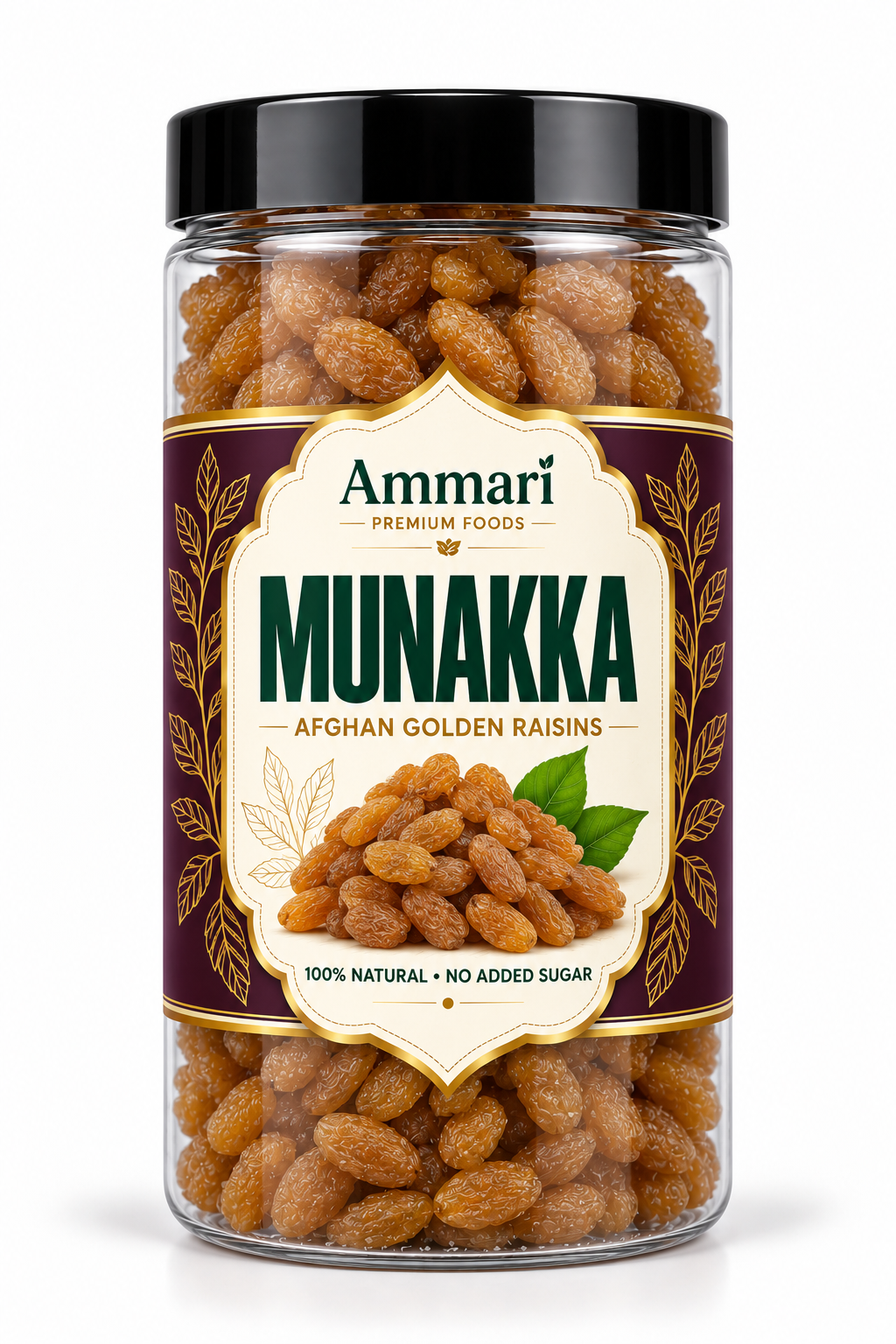
Munakka is the elder cousin of the everyday raisin: bigger, darker, deeply sweet, and carrying a single seed in the old way. Our Afghan Munakka has a wrinkled mahogany skin and a soft, jammy interior that tastes of dried plum and dark caramel. Generations of Indian households have kept a small jar of these on the kitchen shelf, soaked overnight in milk or water for children with a winter cough, or stirred into kahwa on cold mornings.
Where We Source
True Munakka comes from grapes grown in the high, dry plateaus of Afghanistan, primarily around Kandahar and Herat, with a smaller share from the Iranian provinces bordering Khorasan. The vines benefit from cold winters, hot summers and very low humidity, which concentrates the sugars before drying. The grapes are dried slowly in traditional mud-brick kishmish khanas, ventilated rooms with slatted walls that let dry air circulate without direct sun. This shade-drying over several weeks is what gives Munakka its characteristic depth of flavour and chewy texture, very different from quickly sun-dried table raisins.
How to Enjoy
- Ayurvedic soak: Soak two to three Munakka overnight in warm water; eat on an empty stomach for traditional iron and digestion support.
- Kahwa and milk: Simmer with saffron and a stick of cinnamon for a winter night drink.
- Biryani and pulao: Fry briefly in ghee with cashews; their size holds up beautifully against the rice.
- Sherbet and chutney: Blend soaked Munakka with tamarind and rock salt for a classic North Indian sweet-sour sherbet.
Storage & Freshness
Keep Munakka in an airtight container in a cool, dark cupboard. Best consumed within nine to twelve months of packing. Because Munakka has higher residual moisture than seedless raisins, refrigeration is recommended in summer or in humid coastal climates after the pouch is opened. If they stiffen over time, a five-minute soak in warm water restores the original soft texture.
Nutritional Snapshot (per 30g serving)
- Calories: ~95 kcal
- Natural sugars: ~21 g (fructose and glucose, no added sugar)
- Fibre: ~1.4 g
- Iron: ~1.1 mg | Potassium: ~250 mg
- Key micronutrients: Calcium, Magnesium, Polyphenols
Frequently Asked
What is the difference between Munakka and Kishmish?
Both are dried grapes, but they come from different varieties and traditions. Kishmish is small, seedless, and lighter in colour, eaten as a snack and used in everyday cooking. Munakka is larger, retains its seed, and is dried far longer, which deepens both colour and flavour. In Ayurveda, Munakka is considered more medicinal, especially for respiratory health, anaemia, and constipation. Many households use the two interchangeably in sweets, but the soaked-overnight ritual specifically calls for Munakka.
Why does Munakka have a seed inside?
The traditional Munakka grape is a seeded variety, and Ayurvedic texts specifically recommend the seeded form. The seed is small, soft after soaking, and edible, though most people split the fruit and remove it before eating. Removing the seed is also how Munakka is prepared for children. The presence of the seed is a sign that you are getting the authentic varietal, not a relabelled seedless raisin.
Is Munakka safe during pregnancy?
Soaked Munakka is a long-standing traditional remedy in Indian households during pregnancy, valued for its iron, fibre and gentle natural sweetness. Two to four soaked pieces a day, eaten in the morning, are commonly recommended. That said, every pregnancy is different. If you have gestational diabetes or any condition that requires monitoring blood sugar, please consult your doctor before adding any dried fruit, including Munakka, to your daily routine.
Free delivery on orders over Rs.999. Direct-sourced. Naturally processed.
Shipping and Returns
Shipping cost is based on weight. Just add products to your cart and use the Shipping Calculator to see the shipping price.
We want you to be 100% satisfied with your purchase. Items can be returned or exchanged within 30 days of delivery.
There are no question found.
Quick Comparison
| Afghan Black Raisins (Munakka) remove | Ammari Festive Gift Box remove | Premium Chilean Walnuts remove | Kashmiri Walnuts (Akhrot) remove | Roasted & Salted Almonds remove | Roasted Salted Cashews remove | |||||||||||||
|---|---|---|---|---|---|---|---|---|---|---|---|---|---|---|---|---|---|---|
| Name | Afghan Black Raisins (Munakka) remove | Ammari Festive Gift Box remove | Premium Chilean Walnuts remove | Kashmiri Walnuts (Akhrot) remove | Roasted & Salted Almonds remove | Roasted Salted Cashews remove | ||||||||||||
| Image | ![]() | ![]() | ![]() | ![]() | ![]() | ![]() | ||||||||||||
| SKU | AMM-RSN-MUN-500 | AMM-GFT-FST-001 | AMM-WAL-CHL-500 | AMM-WAL-KSH-500 | AMM-ALM-RST-500 | AMM-CSH-RST-500 | ||||||||||||
| Rating | ||||||||||||||||||
| Price | Original price was: ₹399.00.₹349.00Current price is: ₹349.00. Save 13% | Original price was: ₹1,999.00.₹1,699.00Current price is: ₹1,699.00. Save 15% | Original price was: ₹799.00.₹699.00Current price is: ₹699.00. Save 13% | Original price was: ₹899.00.₹799.00Current price is: ₹799.00. Save 11% | Original price was: ₹649.00.₹549.00Current price is: ₹549.00. Save 15% | Original price was: ₹949.00.₹799.00Current price is: ₹799.00. Save 16% | ||||||||||||
| Stock |
Out of stock
|
Out of stock
|
Out of stock
|
Out of stock
|
Out of stock
|
Out of stock
| ||||||||||||
| Availability | Out of stock | Out of stock | Out of stock | Out of stock | Out of stock | Out of stock | ||||||||||||
| Add to cart | ||||||||||||||||||
| Description | Size: 200g | Size: 1kg | Size: 200g | Size: 200g | Size: 200g | Size: 200g | ||||||||||||
| Content | Munakka is the elder cousin of the everyday raisin: bigger, darker, deeply sweet, and carrying a single seed in the old way. Our Afghan Munakka has a wrinkled mahogany skin and a soft, jammy interior that tastes of dried plum and dark caramel. Generations of Indian households have kept a small jar of these on the kitchen shelf, soaked overnight in milk or water for children with a winter cough, or stirred into kahwa on cold mornings. Where We SourceTrue Munakka comes from grapes grown in the high, dry plateaus of Afghanistan, primarily around Kandahar and Herat, with a smaller share from the Iranian provinces bordering Khorasan. The vines benefit from cold winters, hot summers and very low humidity, which concentrates the sugars before drying. The grapes are dried slowly in traditional mud-brick kishmish khanas, ventilated rooms with slatted walls that let dry air circulate without direct sun. This shade-drying over several weeks is what gives Munakka its characteristic depth of flavour and chewy texture, very different from quickly sun-dried table raisins. How to Enjoy
Storage & FreshnessKeep Munakka in an airtight container in a cool, dark cupboard. Best consumed within nine to twelve months of packing. Because Munakka has higher residual moisture than seedless raisins, refrigeration is recommended in summer or in humid coastal climates after the pouch is opened. If they stiffen over time, a five-minute soak in warm water restores the original soft texture. Nutritional Snapshot (per 30g serving)
Frequently AskedWhat is the difference between Munakka and Kishmish? Why does Munakka have a seed inside? Is Munakka safe during pregnancy? Free delivery on orders over Rs.999. Direct-sourced. Naturally processed. | The Ammari Festive Gift Box is what we send to our own family and closest customers each Diwali. Inside a sturdy kraft hamper, finished with a satin ribbon and an optional handwritten card, sit five of our most-loved varieties in individual reusable pouches. It is a gift designed to feel considered rather than commercial — direct-sourced fruit, restrained packaging, and the kind of presentation that looks at home on a Diwali pooja thali, a corporate desk, or a wedding sagan tray. Inside the Box
Total weight: 1kg. Each variety is sealed in its own food-grade pouch, then nested in shredded kraft inside the outer hamper. Perfect For
Storage & FreshnessEach pouch inside the box is sealed for freshness and stays good for 9 to 12 months unopened. Once the recipient opens a pouch, we recommend transferring the contents to an airtight container and storing in a cool, dry place. Dates and figs benefit from refrigeration in summer. The kraft outer box is dry-storage only — please keep away from direct heat, sunlight, and humidity until gifting. Box Specifications
Frequently AskedCan I ship the box directly to a gift recipient? Do you take bulk corporate orders? Can I add a personal message and customise contents? Free delivery on orders over ₹999. Direct-sourced. Naturally processed. | These are the walnuts that bake without bitterness. Chilean walnut halves and pieces, pale cream in colour, mild on the palate, with the snap-clean break of a properly cured kernel. Counter-season harvesting in the southern hemisphere means our crop arrives in Indian kitchens within months of being picked, not after a year in a warehouse. The result is a walnut that tastes of fresh oil and faint sweetness rather than the dusty edge of old stock — a meaningful difference once you bake with them. Where We SourceChilean walnuts come from the long valleys running south from Santiago — primarily the O'Higgins, Maule, and Metropolitana regions, where the Andes meet the Pacific in a microclimate of warm dry summers and cold wet winters that walnuts thrive in. Chile harvests in March and April, opposite to California and China. By the time these reach Jaipur, they're typically four to six months out of the orchard, while northern hemisphere stock in the same retail year may already be twelve to fourteen months old. We work with growers in the Maule valley who hand-sort halves from pieces. How to Enjoy
Storage & FreshnessWalnuts have the highest oil content of any common tree nut, which makes them the most susceptible to rancidity. Keep the unopened pouch in a cool dark cupboard for up to six months. Once opened, transfer to an airtight container and store in the refrigerator — this slows oxidation noticeably and preserves the fresh-pressed oil character. For storage beyond three months after opening, freeze in portioned bags. Discard if the kernels smell sharp or paint-like. Nutritional Snapshot (per 30g serving)
Frequently AskedHow are Chilean walnuts different from Kashmiri walnuts? Why do mine taste fresher than walnuts I've bought before? Are these suitable for daily heart-health intake? Free delivery on orders over Rs.999. Direct-sourced. Naturally processed. | Open these and you'll understand why Kashmiri grandmothers insisted on local akhrot for the family halwa. Kashmiri walnuts (Akhrot) carry a sweetness and clean finish that imported varieties simply do not match — the result of high-altitude orchards, a short concentrated growing season, and centuries of cultivar selection in the Kashmir valley. The kernels are pale honey-cream, plump, and break with the gentle resistance of a properly aged nut. This is the walnut for traditional recipes, for winter strength, and for gifts that mean something. Where We SourceOur Kashmiri walnuts come from family orchards in Pulwama, Shopian, and Anantnag districts of South Kashmir, at elevations between 1,600 and 2,400 metres in the Pir Panjal foothills. We work primarily with the Kagzi variety — the paper-shell cultivar prized for its thin shell and clean kernel release — alongside a smaller share of Mamra, the wild-type with denser meat. Cultivation here is centuries old; many trees in these orchards are forty to seventy years in production. Harvest happens in September and October. We collect through a cooperative of growers and ship from Srinagar within weeks of shelling. How to Enjoy
Storage & FreshnessIn-shell Kashmiri walnuts keep beautifully — store the unopened pouch in a cool, dark, dry cupboard for up to nine months and the shell does the protection work. Once shelled, transfer kernels to an airtight container and refrigerate; use within three months for peak flavour. Freezing extends life to a year. Discard any kernel that tastes sharp, bitter, or paint-like — that's oxidised oil, not the nut itself. Nutritional Snapshot (per 30g serving)
Frequently AskedWhat is the difference between Kagzi and Mamra walnuts? Why do Kashmiri walnuts cost more than Chilean or Californian? Is the Ayurvedic association with brain health based on real evidence? Free delivery on orders over Rs.999. Direct-sourced. Naturally processed. | The same premium Nonpareil kernels from our raw range, this time taken a step further. We dry-roast them slowly over even heat — no oil, no coating — until the natural sugars caramelise and the kernel turns a warm golden brown. A light dusting of fine sea salt is added at the end, just enough to lift the buttery flavour without overwhelming it. The result is a deeply savoury, satisfying crunch that is equally at home with evening chai, a cocktail, or a long flight. Where We SourceThe base kernel is identical to our raw almond pack — Nonpareil variety, harvested in California's Central Valley around Modesto and Sacramento. We chose Nonpareil specifically for roasting because the thin, uniform kernel toasts evenly and develops sweetness without burning at the tips. Roasting is done in small batches at our Jaipur facility so the almonds reach you within weeks of being seasoned, rather than sitting on a shelf for months. We use food-grade fine sea salt, never iodised table salt, which can leave a metallic aftertaste on roasted nuts. How to Enjoy
Storage & FreshnessRoasted nuts have a slightly shorter window than raw because the oils are activated by heat. Sealed, expect six to nine months of freshness in a cool, dry pantry. Once opened, transfer to an airtight jar and refrigerate to preserve the crunch — exposure to humid Jaipur air will soften them within days otherwise. If they ever lose their snap, ten minutes in a 150C oven will revive them. Nutritional Snapshot (per 30g serving)
Frequently AskedIs there any oil used in the roasting? How salty are they? Can children eat these? Free delivery on orders over 999. Direct-sourced. Naturally processed. | The same premium W240 whole cashews from our raw range, taken to the next stage. We dry-roast them gently — no oil, no coating — until the kernel turns a soft golden hue and that natural sweet-savoury cashew aroma fills the kitchen. A light scatter of fine sea salt finishes them. Crisp, buttery, and substantial enough to feel like a treat without the heaviness of fried snacks, these are the cashews you reach for during a cricket match, a long meeting, or unexpected guests at chai time. Where We SourceThe kernel base is identical to our raw W240 cashew pack — sourced from the Mangalore and Goa coastal belt with selective Vietnamese lots during off-season, all conforming to the W240 grade of approximately 240 unbroken white kernels per pound. We chose this grade specifically for roasting because the larger, denser kernel holds heat evenly and develops a uniform colour without burning at the tips. Roasting is done in small batches at our Jaipur facility so the cashews reach you fresh, with the salt crystals still distinct rather than absorbed into stale oil. How to Enjoy
Storage & FreshnessRoasted cashews stay fresh for six to nine months sealed, but once opened the clock speeds up. Transfer to an airtight glass jar and refrigerate, particularly through summer, to keep the crunch intact and the oils from going stale. Humidity is the enemy here — a single afternoon left open in monsoon air will turn them soft. If that happens, a five-minute revival in a 150C oven will restore the snap. Nutritional Snapshot (per 30g serving)
Frequently AskedHow do these compare to fried namkeen calorie-wise? Why dry-roasted instead of oil-roasted? Will the salt level overpower the cashew? Free delivery on orders over 999. Direct-sourced. Naturally processed. | ||||||||||||
| Weight | 0.5 lbs | 1.0 lbs | 0.5 lbs | 0.5 lbs | 0.5 lbs | 0.5 lbs | ||||||||||||
| Dimensions | N/A | N/A | N/A | N/A | N/A | N/A | ||||||||||||
| Additional information |
|
|
|
|
|
| ||||||||||||
| Sold | 0 | 0 | 0 | 0 | 0 | 0 | ||||||||||||
| Shipping |


Rating & Review
There are no reviews yet.