TL;DR
- Cashews are graded by a number, W180 through W450, that counts roughly how many whole kernels make up one pound; the lower the number, the larger and pricier the kernel.
- W240 is the most common premium grade sold in India, a large, evenly sized whole kernel that balances size, snap and price.
- Fresh cashews smell faintly sweet and nutty; a sharp, waxy or paint-like smell signals oil rancidity and the pack should be returned or discarded.
- At room temperature in an airtight container, cashews stay fresh for about a month; refrigerated for three to four months; frozen for up to a year.
- Because cashews carry more unsaturated fat than most other dry fruits, they turn rancid faster once opened, so buying in a size that gets used within a month matters more than buying in bulk.
Buying and storing cashews well comes down to two separate skills: reading the grade number printed on the pack, and keeping the kernels away from heat, light and air once it is open. Cashews (Kaju) are one of the more delicate dry fruits to keep fresh at home, since they carry a higher share of unsaturated fat than almonds or pistachios, which makes them quicker to turn rancid if stored carelessly. Ammari’s cashew storage and shelf life guide covers the science of that fat content in more depth; this piece walks through buying and storing as one practical routine.
What the cashew grading numbers actually mean
Whole cashew kernels are graded by a W-number, W180, W210, W240, W320 and W450 being the common ones, that counts roughly how many whole kernels make up one pound of nuts. A lower number means fewer, larger kernels per pound, so W180 is the largest and most expensive grade, while W450 kernels are noticeably smaller and cheaper. The grading is a size and count standard, not a quality tier by itself; a W320 kernel that is fresh and unbroken can taste better than a W180 kernel that has sat in a warm warehouse for months.
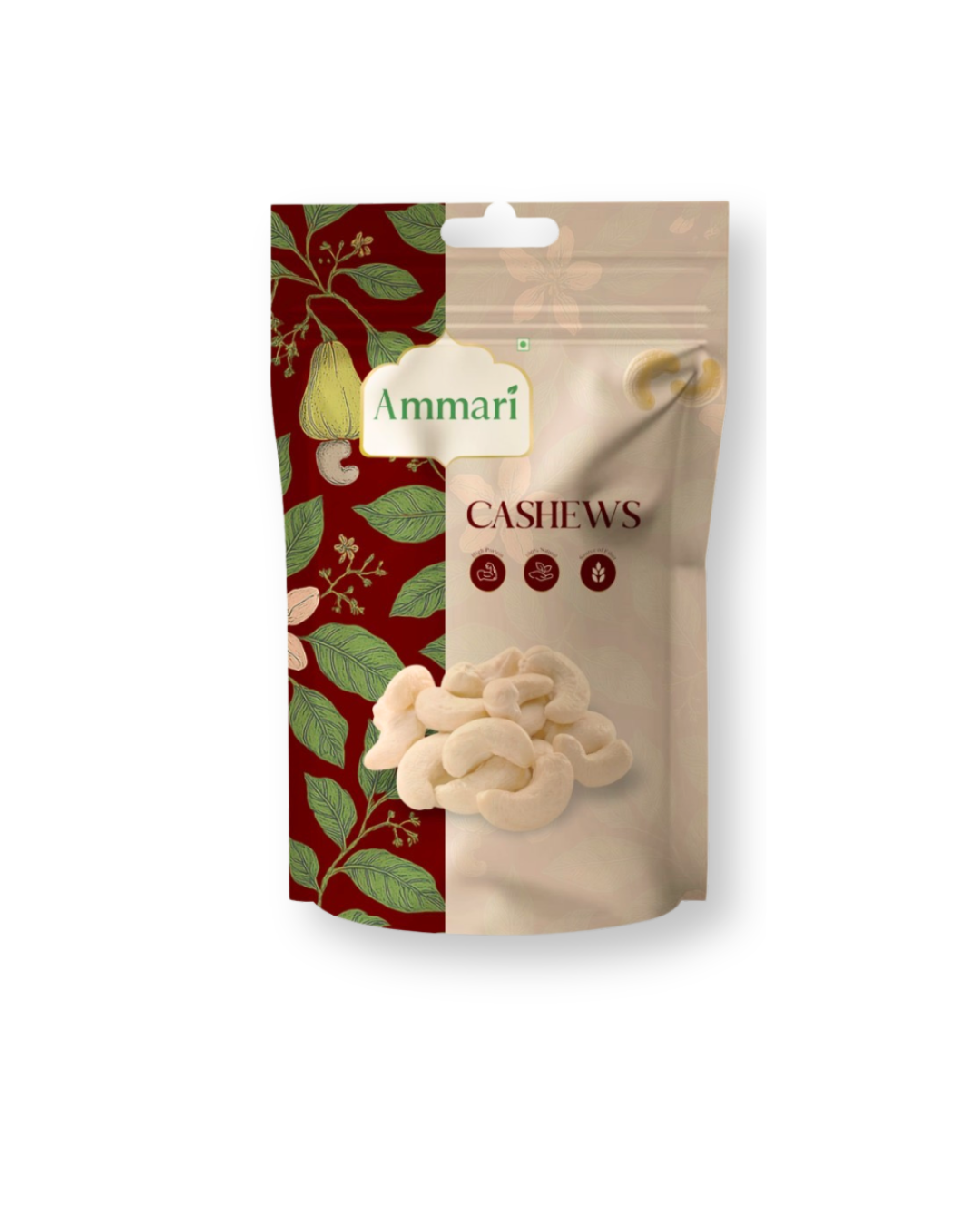
W240 is the grade most Indian households and gifting boxes reach for, a large, evenly sized whole kernel with a clean bite and enough size to snack on directly rather than only using in cooking. Ammari’s Premium Whole Cashews (W240) are graded and sorted before packing, so the pack matches the size on the label. For a roasted, ready-to-eat option in the same grade family, the Roasted Salted Cashews use a similar large kernel. Ammari’s cashew price per kg in India guide breaks down how grade affects what a pack costs.
How to spot a fresh cashew before you buy
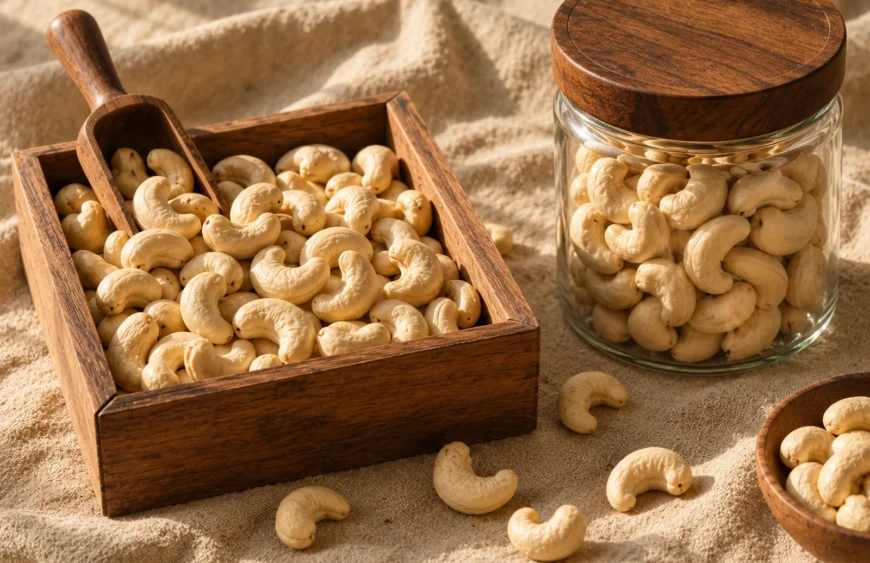
A fresh, whole cashew kernel is pale ivory to light cream in color, with a smooth, slightly curved surface and no dark spots, cracks, or shriveling. A kernel that looks yellowish, has visible oil sheen on the surface, or feels soft and slightly sticky rather than firm has likely been sitting too long or was stored in heat. Broken kernels are not a food-safety problem, but a pack with a high share of broken pieces usually means rougher handling somewhere in the supply chain, and broken surfaces expose more of the kernel’s fat to air, so they turn rancid faster than whole kernels.
The most reliable check is smell. Fresh cashews smell faintly sweet, buttery and nutty. A sharp, waxy, or paint-like smell is oil rancidity setting in, and that pack should be returned or thrown out rather than eaten through out of habit. Taste is a secondary check: a fresh cashew tastes clean and mildly sweet, while a rancid one tastes bitter or slightly soapy at the back of the tongue. Ammari’s cashew health benefits guide covers the nutrition profile that makes freshness worth protecting in the first place.
Airtight storage: room temperature, fridge and freezer
Once a pack is open, the single most important habit is transferring cashews into an airtight container immediately, glass or heavy plastic with a tight seal, rather than leaving the original pack loosely folded shut. Air, heat and light are the three things that speed up oil rancidity, so an airtight jar kept in a cool, dark cupboard is a meaningfully better home than a shelf near a stove or a window.
At room temperature in an airtight container, cashews stay fresh for roughly a month. In the refrigerator, that extends to three to four months, and the kernels stay crisper for snacking directly out of the fridge. In the freezer, airtight cashews hold their quality for up to a year, which makes freezing the better option for anyone who buys in bulk for festive gifting or a household that goes through cashews slowly. Frozen cashews do not need thawing before use in cooking, and only need about ten minutes at room temperature before eating as a snack.
| Storage method | Typical shelf life | Best for |
|---|---|---|
| Airtight, room temperature | About 1 month | Everyday snacking, small packs |
| Airtight, refrigerated | 3 to 4 months | Regular use, warmer climates |
| Airtight, frozen | Up to 1 year | Bulk buys, festive stock |
Buying in bulk versus buying smaller packs
Because cashews turn rancid faster than most other dry fruits once opened, the right pack size depends on how quickly a household actually goes through them, not on the lowest per-kilogram price. A single person snacking occasionally is usually better off with a smaller pack that finishes within the one-month room-temperature window than a large bulk bag that sits half-used for weeks. A household that snacks daily, bakes, or is stocking up for Diwali gifting can buy larger quantities safely, as long as the surplus goes straight into the fridge or freezer rather than staying in an open pack on the counter.
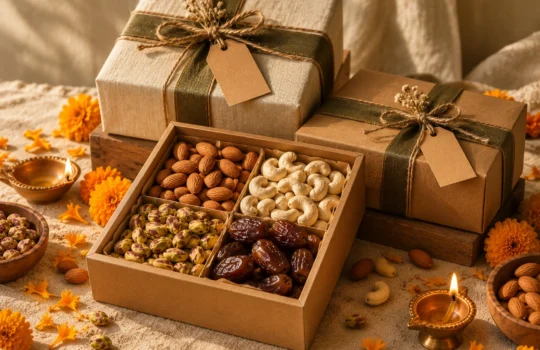
For festive or gifting quantities, Ammari’s Premium Mixed Dry Fruits Pack and Ammari Festive Gift Box combine cashews with other dry fruits in sealed, gift-ready packaging, which keeps freshness intact until the box is opened. Ammari’s dry fruit gifting guide has more on choosing pack sizes for gifting.
What Ammari recommends
For everyday snacking, Ammari recommends the W240 grade in a pack size that finishes within about a month, kept in an airtight container away from the stove. For households that buy in bulk or are stocking up ahead of a festival, move any surplus straight into the fridge or freezer rather than leaving it in an open pack. Free delivery applies on orders over ₹999 where natural. For the deeper science on why cashews go rancid faster than other nuts, see Ammari’s cashew storage and shelf life guide.
Frequently Asked Questions
What does the W240 grade mean for cashews?
W240 means roughly 240 whole cashew kernels make up one pound of nuts. It is a size and count grade, not a separate quality tier, and it is the most common premium whole-kernel grade sold in India, offering a large, evenly sized kernel at a reasonable price point compared to the larger W180 grade.
How can I tell if cashews have gone bad?
The clearest sign is smell: fresh cashews smell mildly sweet and nutty, while rancid ones smell sharp, waxy or like paint. Look also for a yellowish tint, visible oil sheen, or a soft, slightly sticky texture. A bitter or soapy aftertaste on the first bite is a reliable final check if the smell alone is unclear.
How long do cashews last once the pack is opened?
In an airtight container at room temperature, opened cashews stay fresh for about a month. Refrigerated, that extends to three to four months, and frozen, airtight cashews hold their quality for up to a year. The original packaging alone, left loosely folded, is not airtight enough for reliable long-term storage.
Should cashews be stored in the fridge or at room temperature?
Room temperature works fine for a pack that will be finished within a month, as long as it is airtight and kept away from heat and light. For anyone who buys larger quantities or lives in a hot, humid climate, refrigeration extends freshness significantly and is the safer default.
Is W180 always better than W240 cashews?
Not necessarily. W180 kernels are larger and cost more, but grade alone does not guarantee freshness or flavor. A fresh W240 kernel, properly stored, generally tastes better than a W180 kernel that has been sitting too long. For most everyday snacking, W240 offers the better balance of size and price.
Can frozen cashews be eaten straight from the freezer?
Frozen cashews only need about ten minutes at room temperature to soften back to a normal snacking texture. They do not need to be thawed for cooking, and can go straight from the freezer into a pan or blender for recipes.
Why do cashews go rancid faster than almonds or walnuts in some cases?
Cashews carry a higher share of unsaturated fat relative to their size than several other dry fruits, and that fat oxidizes faster once exposed to air, heat or light. That is also why broken kernels, which expose more surface area, spoil quicker than whole ones, and why airtight storage matters more for cashews than for drier fruits like raisins.
Frequently Asked Questions
What does the W240 grade mean for cashews?
W240 means roughly 240 whole cashew kernels make up one pound of nuts. It is a size and count grade, not a separate quality tier, and it is the most common premium whole-kernel grade sold in India, offering a large, evenly sized kernel at a reasonable price point compared to the larger W180 grade.
How can I tell if cashews have gone bad?
The clearest sign is smell: fresh cashews smell mildly sweet and nutty, while rancid ones smell sharp, waxy or like paint. Look also for a yellowish tint, visible oil sheen, or a soft, slightly sticky texture. A bitter or soapy aftertaste on the first bite is a reliable final check if the smell alone is unclear.
How long do cashews last once the pack is opened?
In an airtight container at room temperature, opened cashews stay fresh for about a month. Refrigerated, that extends to three to four months, and frozen, airtight cashews hold their quality for up to a year. The original packaging alone, left loosely folded, is not airtight enough for reliable long-term storage.
Should cashews be stored in the fridge or at room temperature?
Room temperature works fine for a pack that will be finished within a month, as long as it is airtight and kept away from heat and light. For anyone who buys larger quantities or lives in a hot, humid climate, refrigeration extends freshness significantly and is the safer default.
Is W180 always better than W240 cashews?
Not necessarily. W180 kernels are larger and cost more, but grade alone does not guarantee freshness or flavor. A fresh W240 kernel, properly stored, generally tastes better than a W180 kernel that has been sitting too long. For most everyday snacking, W240 offers the better balance of size and price.
Can frozen cashews be eaten straight from the freezer?
Frozen cashews only need about ten minutes at room temperature to soften back to a normal snacking texture. They do not need to be thawed for cooking, and can go straight from the freezer into a pan or blender for recipes.
Why do cashews go rancid faster than almonds or walnuts in some cases?
Cashews carry a higher share of unsaturated fat relative to their size than several other dry fruits, and that fat oxidizes faster once exposed to air, heat or light. That is also why broken kernels, which expose more surface area, spoil quicker than whole ones, and why airtight storage matters more for cashews than for drier fruits like raisins.