The Short Answer
Most healthy adults benefit from 20 to 30 grams of raisins per day – a small handful, roughly 30 to 40 raisins. At this serving you get 90 calories, 0.9 g protein, 1.1 g fiber, 0.56 mg iron, and 225 mg potassium.
Raisins pack more calories and sugar per gram than fresh grapes. Drying removes most of the water but keeps the natural sugar. India’s ICMR-NIN 2024 guidelines treat dried fruits like raisins as a moderate-portion food, similar to nuts – a small daily serving, not an unlimited snack.
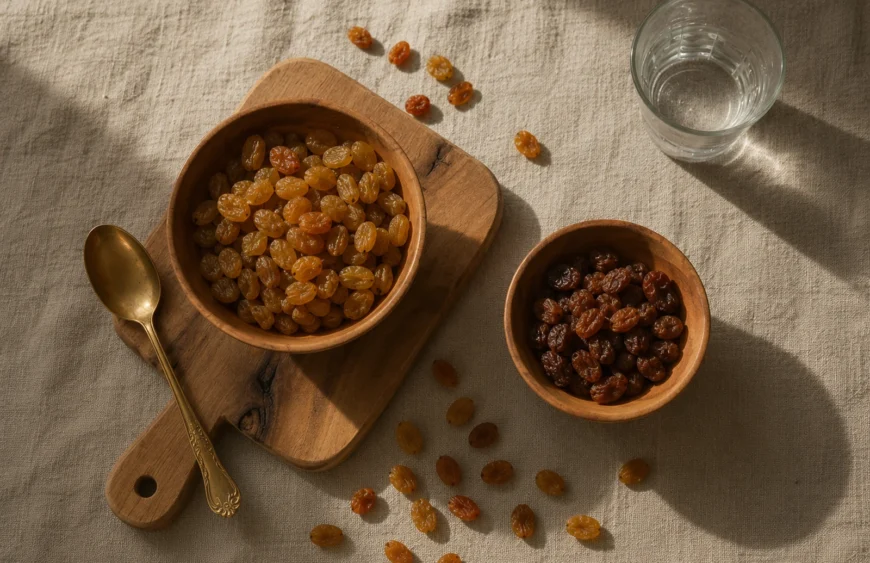
Portion also depends on which raisin you eat. Kishmish (small green or golden raisins) and munakka (large black raisins, sometimes still on the seed) differ a lot in size. So “30 raisins” of one isn’t the same weight as 30 of the other. Weighing to 20 to 30 g works better than counting.
What counts as a serving of raisins
Weigh your raisins instead of counting them. Raisin size varies a lot between varieties. 20 to 30 grams – a small closed handful – is the reference serving in most nutrition guidance. That’s roughly 30 to 40 small kishmish raisins, or fewer if you’re eating the larger munakka.
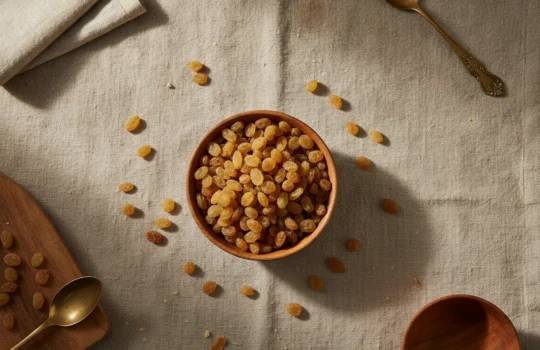
- Kishmish (green/golden raisins) – smaller and lighter, the everyday raisin in Indian kitchens; about 40 to 50 raisins per 30 g
- Munakka (black raisins) – larger, often still with a seed, with a deeper, more concentrated sweetness; about 20 to 25 raisins per 30 g
Munakka raisins are bigger, so a handful of munakka has fewer individual raisins than the same weight of kishmish. That’s why weighing gives a more consistent daily portion than counting.
Recommended daily intake of raisins
The 20 to 30 g benchmark comes from how dried fruits are usually positioned in nutrition guidance:
- General serving guidance – a small handful (20-30 g) is the commonly cited portion for dried fruit in a balanced diet
- ICMR-NIN 2024 (India) – groups dried fruits like raisins with nuts and oilseeds in the moderate-portion category. Drying concentrates sugar along with the nutrients, so small daily amounts are recommended, not large servings.
- Diabetes and weight management – people watching blood sugar or weight often stay near the lower end, 15 to 20 g. Raisins carry concentrated natural sugar.
For most healthy adults in India, a small handful (20-30 g) once a day – plain, in a trail mix, or stirred into poha, oats, or a smoothie – is a sensible daily amount.
Health benefits of eating raisins daily
At a 20 to 30 g daily serving, the benefits include:
Iron and energy. Raisins give you 0.56 mg iron per 30 g serving, a useful plant-based boost for vegetarians. Iron absorption improves when raisins are eaten with a vitamin-C food such as citrus or amla.
Digestion. Raisins contain fiber and tartaric acid, which together support regular bowel movement. This is part of why soaked raisins, eaten on an empty stomach, are a traditional home remedy for mild constipation.
Potassium and blood pressure. At 225 mg potassium per 30 g, raisins help balance sodium and support normal blood pressure. That’s a small but useful counterbalance in a diet heavy in salty snacks and pickles.
Bone health. Raisins contain small amounts of calcium and boron, a trace mineral tied to calcium metabolism. Think of this as a supporting contribution, not a primary calcium source.
Antioxidants. Raisins keep polyphenol antioxidants from grapes through the drying process. These help the body manage everyday stress from sun and pollution.
Raisins by health goal
| Goal | Daily portion | Notes | |—|—|—| | General health | 20-30 g (small handful) | Standard benchmark | | Weight management | 15-20 g | Pair with protein or fiber to stay full | | Iron/energy focus | 25-30 g | Combine with a vitamin-C food for absorption | | Type-2 diabetes | 10-15 g, with a meal | Not as a standalone snack; watch your response | | Constipation relief | 8-10 soaked raisins | Soaked overnight, eaten on an empty stomach |
Soaked vs dry raisins
Soaking raisins in water overnight, then eating them (often with the soaking water) on an empty stomach, is a common Indian morning habit, especially with kishmish.
- Softens the fiber and skin – easier to digest, especially for children and older adults
- A digestive and iron ritual – commonly used for mild constipation and as a gentle iron-rich start to the day
- Minimal nutrient loss – soaking doesn’t meaningfully lower iron, potassium, or fiber; a little natural sugar leaches into the soaking water
Soaked and dry raisins are close in nutrition. The choice comes down to digestibility and habit, not one being clearly healthier.
Best time to eat raisins
Morning, on an empty stomach or with breakfast, is the most common choice in Indian dietary tradition, especially for the soaked-raisin ritual.
- Morning (soaked, empty stomach) – the traditional pick for digestion and iron; drink the soaking water too
- With breakfast – stirred into poha, upma, or oats; an easy way to add iron and fiber to your routine
- Pre-workout – a small handful gives quick natural sugar for energy; pair with nuts for a slower release
- Evening – fine in a small portion (10-15 g), though it’s easy to overeat once the sugar starts working on you late at night
Risks and side effects
Most adults handle 20 to 30 g of raisins daily without trouble. A few things to watch:
- Sugar concentration – raisins pack more calories per gram than fresh grapes; if you’re watching blood sugar or weight, stay toward the lower end of the range
- Dental health – the sticky texture clings to teeth; rinse or brush after eating to cut cavity risk, especially in children
- Oxalates – moderate levels; people prone to kidney stones should eat in moderation
- Sulfite content in some golden raisins – a small share of sulfite-sensitive people may prefer natural, non-sulfured kishmish
Sourcing transparency
- Ingredient: Raisins (kishmish and munakka varieties)
- Packaging: Sealed pouch, no added sugar
- Shelf life: 12 months sealed; refrigerate after opening in humid climates
- Products: Indian Green Raisins (Kishmish) and Afghan Black Raisins (Munakka)
Frequently Asked Questions
How many raisins should I eat per day?
20 to 30 grams – a small handful, roughly 30 to 40 kishmish or 20 to 25 munakka – is a sensible daily portion for most healthy adults. This gives you iron, potassium, and fiber without too much natural sugar.
How many soaked raisins should I eat in the morning?
8 to 10 soaked raisins is the usual amount for the traditional morning ritual, eaten on an empty stomach with the soaking water. This is smaller than the general daily benchmark since it’s usually a standalone habit, not on top of other snacking.
What is the difference between kishmish and munakka portions?
Kishmish are smaller (green or golden), so a 30 g portion is roughly 40 to 50 raisins. Munakka are larger, often seeded, black raisins, so the same 30 g weight is only about 20 to 25 raisins. Weighing gives a more consistent portion than counting.
Can I eat raisins daily without gaining weight?
Yes, if you stick to a 20 to 30 g portion. Raisins are calorie-dense for their size, since drying removes water but keeps the sugar. Eating straight from an open pack without portioning is the most common way people overeat them.
Are raisins good for iron deficiency?
They can help. Raisins give you plant-based iron, which the body absorbs less easily than iron from meat. Pair raisins with a vitamin-C food, like citrus or amla, and absorption improves.
Are raisins safe for diabetics?
In small portions, generally yes, but with care. Raisins carry concentrated natural sugar, so people managing blood sugar are often steered toward 10 to 15 g, eaten with a meal rather than alone, while watching their own response.
Should children eat raisins every day?
Yes, in age-appropriate portions. A small handful (10-15 g for younger children) works well, and soaked raisins are easier for toddlers to chew and digest. Supervise young children while they eat raisins, since the sticky texture and small size carry a mild choking risk.
Sources & references