How To Identify Real Medjool Dates: The Short Answer
Last updated: 19 May 2026
Real Medjool dates pass seven physical tests. Imposter Medjool fails at least three.
- Size: 24 to 30 grams per date – Medjool is the largest commonly-sold date globally
- Texture: plump, semi-soft, slightly sticky to touch – never dry or shrivelled
- Skin: dark mahogany-brown with a glossy sheen and visible deep wrinkles
- Flesh colour: rich golden-amber when split open – not dull brown or grey
- Flavour: intensely sweet with caramel, butterscotch, and faint molasses notes
- Origin label: California (Coachella Valley, USA) or Jordan – explicitly stated on pack
- Price: ₹1,200 to ₹2,400 per kg for verified Medjool. Below ₹600/kg = not Medjool.
For variety-specific guidance, see our premium dates buying guide and Medjool vs Ajwa comparison.
Why fake “Medjool” is everywhere
How to identify real medjool dates – here is what actually matters when you choose. Medjool earned the nickname “the king of dates” centuries ago because of its size, sweetness, and visual impact. It commands a real price premium – ₹1,200 to ₹2,400 per kilogram in India. That premium creates incentive for sellers to relabel cheaper varieties (Deglet Noor, Khalas, Sayer, Mabroom, Kimia) as “Medjool” at midrange pricing.
Real Medjool comes from a constrained supply chain. Almost all premium Medjool sold globally is grown in California’s Coachella Valley or Jordan, with smaller production in Israel, Egypt, and Mexico. The trees produce comparatively low yields, the harvest is hand-picked at peak ripeness, and the dates are sold semi-soft (not fully dried) – a packaging choice that requires careful logistics.
Any “Medjool” pack that sidesteps these costs by selling cheap is, by definition, not real Medjool.
The 7 tests, in order of reliability
Test 1 – Weight per date (most reliable)
Pull out a single date and weigh it (kitchen scale, or use the 250 g pack count math):
- Real Medjool: 24 to 30 grams per date. A 250 g pack contains 8 to 10 dates.
- Deglet Noor relabelled: 8 to 12 grams per date. A 250 g pack contains 20 to 30 dates.
- Khalas, Mabroom relabelled: 12 to 18 grams per date. A 250 g pack contains 14 to 20 dates.
If the pack contains more than 12 dates per 250 g, it is NOT Medjool – full stop. The weight is the most unfakeable test.
Test 2 – Size visual check (no scale needed)
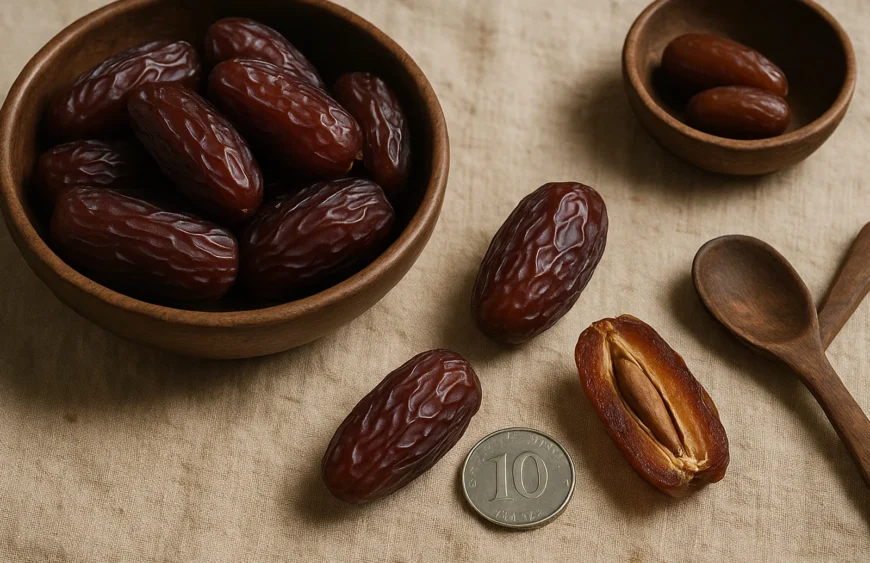
Lay a date alongside a standard Indian Rs.10 coin (diameter 27 mm):
- Real Medjool: longer than the coin diameter by at least 30%. Roughly the length of the long side of a matchbox.
- Smaller varieties: equal to or shorter than the coin diameter.
This visual check works without a scale and is just as reliable.
Test 3 – Texture (tactile)
Squeeze a date gently between thumb and forefinger:
- Real Medjool: plump, semi-soft, gives slightly under pressure with creamy flesh visible if the skin breaks. Slightly sticky surface.
- Imposter: dry, firm, holds shape rigidly. Surface may have a powdery sugar bloom from over-drying.
Medjool is sold semi-soft because of how it’s harvested and packed. Dryness suggests an older or different variety.
Test 4 – Skin appearance (visual)
Look at the skin across multiple dates:
- Real Medjool: dark mahogany-brown with a natural glossy sheen, visible deep wrinkles in regular folds, no chalky white sugar bloom.
- Old Medjool or imposter: dull skin with chalky white film (sugar bloom), uniform smoothness without character, or unnaturally bright colour from added oils.
A small natural sugar bloom is OK; heavy chalky white coating means age.
Test 5 – Flesh colour (after splitting)
Split a date in half along the natural seam:
- Real Medjool: rich golden-amber flesh with a translucent honey-like quality, single elongated seed in the centre.
- Imposter: dull tan or brown flesh, smaller seed, sometimes hollow cavities indicating the date was force-pitted.
The flesh colour is the most distinctive Medjool tell aside from size.
Test 6 – Flavour (sensory)
Bite into a real Medjool:
- Real Medjool: intensely sweet – almost dessert-like – with caramel, butterscotch, and faint molasses notes. The aftertaste lingers buttery for several seconds.
- Deglet Noor: mildly sweet, more honey-like, much shorter aftertaste.
- Khalas, Sukkari relabelled: sweet but with cleaner sugar character, less complexity.
Eating a real Medjool is a near-dessert experience. If it tastes like a regular date, it isn’t Medjool.
Test 7 – Origin label and price honesty
Before any physical test, check the label and price:
- Real Medjool packaging clearly states origin: California (Coachella Valley, USA) or Jordan
- Vague origin (“imported”, “premium dates”, or no origin) = highly suspicious
- Price below ₹600/kg = mathematically impossible to be real Medjool given supply chain costs
- Price ₹600-1,000/kg with vague origin = almost certainly Deglet Noor or Khalas relabelled
- Price ₹1,200-2,400/kg with verified origin = expected range for real Medjool
What to ask the seller
- “What is the country of origin?” – California, Jordan, Israel, Egypt, Mexico are valid. “Imported” is not.
- “What is the harvest year?” – Medjool harvest is September-October. Seller should know.
- “How many dates per 250 g?” – should be 8-10 for real Medjool. More = not Medjool.
- “Can I taste a sample first?” – premium suppliers always allow sampling.
Sourcing transparency
- Variety: Medjool dates
- Primary origin: California (Coachella Valley, USA)
- Secondary origin: Jordan, Israel, Egypt, Mexico
- Harvest: September through October
- Size benchmark: 24-30 grams per date
- Verified retail price band: ₹1,200 to ₹2,400 per kilogram
Related reading
References & further reading
For independent reference points, the USDA FoodData Central – nutrient database is the standardised dataset we cross-check composition against. Clinical work like the PubMed – date palm nutritional review helps separate marketing claims from evidence.
Frequently Asked Questions
How big is a real Medjool date?
24 to 30 grams per date – significantly larger than any other commonly sold date variety. A 250 g pack contains 8 to 10 dates. If your “Medjool” pack contains 15+ dates per 250 g, it is not real Medjool – likely Deglet Noor, Khalas, or Sayer relabelled.
Why do real Medjool dates have white film on them?
A light powdery white film is natural sugar bloom from the dates’ high natural sugar content crystallising on the surface. This is harmless and typical, especially in older packs. Heavy chalky coating, however, suggests the dates are past their prime. The film should be light and uneven, not uniform like dust.
Are California Medjool and Jordanian Medjool the same?
Both are real Medjool variety with subtle differences. California Medjool tends to be slightly larger and sweeter; Jordanian Medjool has a marginally more rustic flavour with stone-fruit notes. Both pass all seven authenticity tests. The choice between them is preference, not authenticity.
Why are some Medjool dates harder than others?
Medjool ripens through stages: Khalal (firm, golden), Rutab (soft, transitional), Tamr (cured, semi-soft). Most Medjool sold globally is in Tamr stage – semi-soft. Hard Medjool indicates either over-drying during storage, a different variety, or improper humidity control. Real Medjool should yield slightly to thumb pressure. When evaluating how to identify real medjool dates, the key is verification not branding.
Can I store Medjool dates at room temperature?
Yes for 4-6 months at Indian room temperature in an airtight container, kept cool and dry. From April to September across most of India, refrigerate after opening to maintain texture. Freezer storage extends shelf life to a year without quality loss; thaw at room temperature before eating.
What’s the difference between Medjool and Mabroom?
Medjool is significantly larger (24-30 g vs 12-18 g per date for Mabroom), has a glossier mahogany skin, and a distinctly sweeter caramel flavour. Mabroom is firmer, drier, more elongated, and has a milder taste. Both are excellent dates, but they are different varieties – and Medjool’s price is roughly double Mabroom’s.
Are Medjool dates pitted or unpitted by default?
Sold both ways. Unpitted (with seed) preserves freshness longer and is the traditional form. Pitted Medjool is convenient but slightly drier from handling. For storage, choose unpitted; for immediate eating or recipes, pitted is fine. The hollow cavity in pitted Medjool should be clean – irregular tearing suggests rough mechanical processing.
Is Medjool the healthiest date?
All major dates have similar macro nutrition (calories, fibre, potassium). Medjool is largest, so each date carries more calories. Ajwa has slightly higher iron and fibre per gram. For everyday daily intake, Medjool’s larger size means 2 dates equals about 4 of most other varieties – adjust your portion math accordingly.