Salted Vs Unsalted Pistachios: At a glance
Last updated: 19 May 2026
Salted pistachios carry meaningful added sodium (about 380 mg per 100 g). Unsalted pistachios contain almost none (1 mg per 100 g). For daily snacking, blood-pressure management, weight loss, and any cooking application, unsalted is the better default.
- Sodium per 100 g: salted ~380 mg; unsalted ~1 mg (USDA FoodData Central).
- Calories, protein, fat, fibre: essentially identical. Only sodium and salt-roast oil change between the two.
- Daily limit: Indian guidelines suggest <2,000 mg sodium per day total. A 30 g salted-pistachio snack delivers ~115 mg, or roughly 6 percent of the daily cap.
- For hypertension or weight loss: unsalted is the only sensible choice for daily intake.
- For cooking: never use salted pistachios in kheer, badam halwa, biryani, or mithai garnish. The salt ruins the dish.
- Ammari stocks both salted (lightly roasted) and unsalted Iranian Akbari pistachios, packed to order in Jaipur.
For grades and origin, see our Iranian pistachios buying guide.
What changes when pistachios are salted
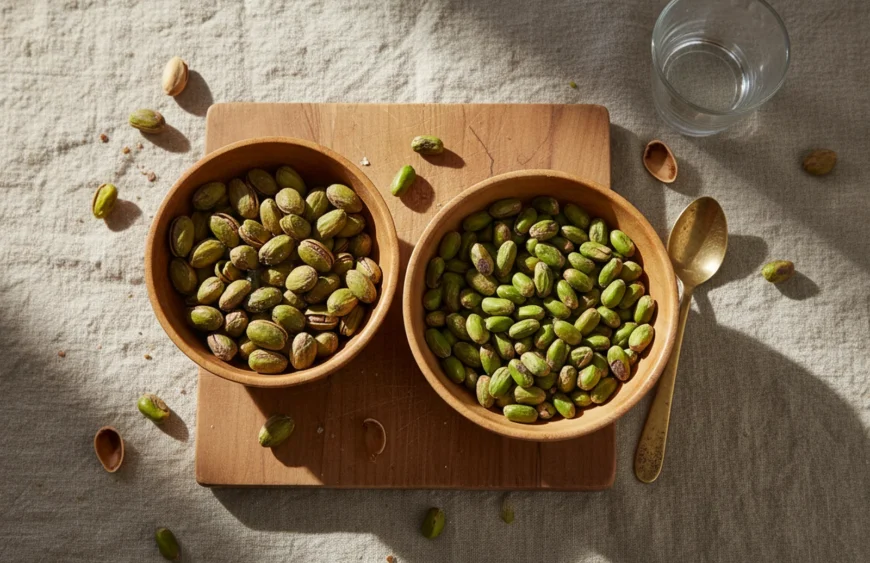
Salted vs unsalted pistachios – here is what actually matters when you choose. The pistachio kernel itself does not change. Salting is a surface treatment applied after harvest and shell-cracking. Most commercial salted pistachios are processed in one of two ways.
Brine-roasted. The kernels are soaked in salt brine, then dry-roasted at around 140 to 160 degrees Celsius for 20 to 25 minutes. The salt penetrates the kernel slightly during the brine soak and crystallises on the surface during roasting. This is the standard method for premium salted Iranian and California pistachios.
Oil-roasted with salt. Kernels are coated in a thin layer of vegetable oil, tossed with fine salt, then dry-roasted. The oil holds the salt in place and adds a slight gloss to the kernel. Cheaper bulk-market salted pistachios often use this method.
Either way, the nutrient profile of the kernel barely shifts. Calories, protein, fat, fibre, and most micronutrients stay essentially the same. The single meaningful change is the added sodium load, which moves from near-zero in raw or unsalted pistachios to roughly 380 mg per 100 g in salted pistachios.
For context, a 30 g snack of salted pistachios (about 20 to 25 kernels) delivers 110 to 120 mg of sodium. The Indian Council of Medical Research recommends keeping total daily sodium below 2,000 mg. A salted pistachio snack is not by itself a problem; combined with chaat, achaar, papad, biscuits, and Indian thali patterns that already run high on sodium, it adds up faster than expected.
When salted pistachios make sense
Salted pistachios are not a health enemy. They have legitimate use cases.
- Occasional indulgence. A small bowl with chai once a week is fine for most adults without blood-pressure concerns.
- Long shelf-life snacking. Salt has mild preservative effects; salted pistachios stay fresh slightly longer than unsalted at room temperature.
- Movie nights and gatherings. The salt and oil register fits the snack-food context better than plain kernels.
- Endurance training contexts. Athletes doing long sweaty workouts need sodium replacement; salted pistachios are a useful natural source paired with hydration.
The risk is normalising salted pistachios as a daily-snack default. The Indian dietary pattern already runs high on sodium from cooked food, pickles, papad, and packaged snacks. Adding 100 to 200 mg per day from pistachios on top of all that pushes some adults into the territory where blood pressure starts climbing.
When unsalted pistachios are the right call
Most of the time, unsalted pistachios are the better choice. Specifically:
- Daily snacking habits. A 20 to 25 kernel daily snack is a healthy pattern. Make it unsalted and the long-term sodium picture stays clean.
- Pregnancy. Sodium and water-retention concerns in trimester two and three make unsalted the default.
- Hypertension and pre-hypertension. Any adult on blood-pressure medication or with elevated BP should switch to unsalted.
- Weight loss. Salt drives water retention and increases appetite in some people. Unsalted is the cleaner choice.
- Cooking. Never use salted pistachios in kheer, halwa, biryani garnish, badam milk, or any Indian sweet preparation. The salt clashes with the sugar and ghee balance. Use unsalted only.
- Children under five. Salt loads on small bodies add up faster. Unsalted is the right default.
For exact daily intake by age and goal, see our how many pistachios per day guide.
Nutrition side by side per 100 g
| Nutrient | Salted Pistachios | Unsalted Pistachios | |-|-|-| | Calories | 569 kcal | 562 kcal | | Protein | 21.0 g | 20.6 g | | Total fat | 45.4 g | 45.3 g | | Carbohydrates | 27.5 g | 27.5 g | | Fibre | 10.3 g | 10.3 g | | Sodium | 380 mg | 1 mg | | Potassium | 1025 mg | 1025 mg | | Magnesium | 121 mg | 121 mg | | Lutein + zeaxanthin | 1,400 mcg | 1,405 mcg |
The only meaningful difference is sodium. Everything else is functionally identical. If a salted pack delivers significantly different macros from the unsalted pack, the issue is roasting oil content (some salted versions add 1 to 2 g extra fat per 100 g) not the salting itself.
Cost and shelf life
In India, salted and unsalted Iranian pistachios usually retail within ₹100 to ₹200 per kg of each other at the same grade. The 2026 reference range:
- Iranian Akbari salted: ₹2,500 to ₹3,700 per kg
- Iranian Akbari unsalted: ₹2,400 to ₹3,600 per kg
Unsalted pistachios keep 8 to 10 months in airtight jars at room temperature. Salted pistachios keep slightly longer at 10 to 12 months because of salt’s mild preservation effect. From April to September in Indian summer, refrigerate both to slow rancidity from the high unsaturated fat content.
For our take on grades, see Akbari vs Kerman pistachios.
A practical pattern for Indian households
Most adults benefit from a simple split.
- Daily 30 g snack (4 to 5 times a week): unsalted Iranian pistachios. Soaked or as-is. Pair with chai or eat between meals.
- Occasional indulgence (once a week): salted pistachios with a movie or social setting.
- All cooking and mithai garnish: unsalted, always. Chop fresh.
- For diabetic and hypertensive members of the household: unsalted only.
- For children and pregnant women: unsalted only.
This pattern keeps the sodium contribution from pistachios at roughly 20 to 40 mg per day on average, which is negligible against the 2,000 mg daily cap.
Sourcing transparency
- Pistachios: Iranian Akbari grade sourced from Rafsanjan-area growers through verified shippers.
- Salt grade (where used): food-grade rock salt or fine sea salt, no anti-caking agents or MSG.
- Roasting: dry-roast process at controlled temperature to preserve the natural green colour.
- Storage: vacuum-packed pouches at our Jaipur facility, humidity-controlled.
- Where we ship from: Ammari Foods, Jaipur. Online-only D2C, all-India shipping.
References & further reading
For independent reference points, the USDA FoodData Central – nutrient database is the standardised dataset we cross-check composition against. Clinical work like the PubMed – pistachios and metabolic health helps separate marketing claims from evidence.
Frequently Asked Questions
Are salted pistachios bad for you?
Not in moderation. A 30 g salted-pistachio snack delivers about 115 mg of sodium, roughly 6 percent of the recommended daily cap. The risk is daily repetition combined with other high-sodium Indian dietary patterns (pickles, papad, chaat, packaged food). For occasional eating, salted is fine. For daily habits, unsalted is the cleaner choice.
Can I cook with salted pistachios?
You should not. Salted pistachios ruin Indian sweet preparations (kheer, halwa, mithai garnish, badam milk) because the salt clashes with sugar, milk, and ghee. For biryani garnish, the salt also throws off the dish’s overall sodium balance. Always use unsalted pistachios in any cooking or garnish context. Keep salted ones strictly for direct snacking.
Do salted pistachios cause high blood pressure?
Eating salted pistachios occasionally will not raise blood pressure in most healthy adults. The risk emerges in two scenarios: daily salted-pistachio snacking added to an already-high-sodium Indian diet, and in adults with hypertension or pre-hypertension where every extra 100 mg counts. For anyone on BP medication or with a family history, switch to unsalted as the default.
Are unsalted pistachios less tasty?
To a salt-trained palate, yes initially. After two to three weeks of eating unsalted, most people find them more flavourful because the natural pistachio resinous-grassy notes come through without the salt distraction. Lightly roasted unsalted pistachios (often labelled “dry-roasted, no-salt”) carry more inherent flavour than raw unsalted and are a good middle ground.
Which is better for weight loss?
Unsalted, slightly. Salt drives water retention and can increase appetite in some people through the “salt-and-fat-snacking loop” common with branded snack foods. Unsalted pistachios deliver the same satiety from fibre and protein without that side effect. For weight management specifically, see pistachios for weight loss.
How much sodium is in a handful of salted pistachios?
A standard 30 g handful (about 20 to 25 kernels) of salted pistachios delivers 110 to 120 mg of sodium. The same handful unsalted gives less than 1 mg. For perspective, one small samosa carries about 250 mg of sodium and one tablespoon of soya sauce carries 900 mg. Salted pistachios are not the heaviest sodium source on an Indian plate, but they add up if eaten daily.
Can children eat salted pistachios?
Unsalted is better for children under five. Their developing kidneys process sodium less efficiently than adult kidneys, and habitual salt-snack exposure can shape long-term taste preferences toward saltier food. From age six onwards, occasional salted pistachios are fine, but daily snacking should remain unsalted.