TL;DR
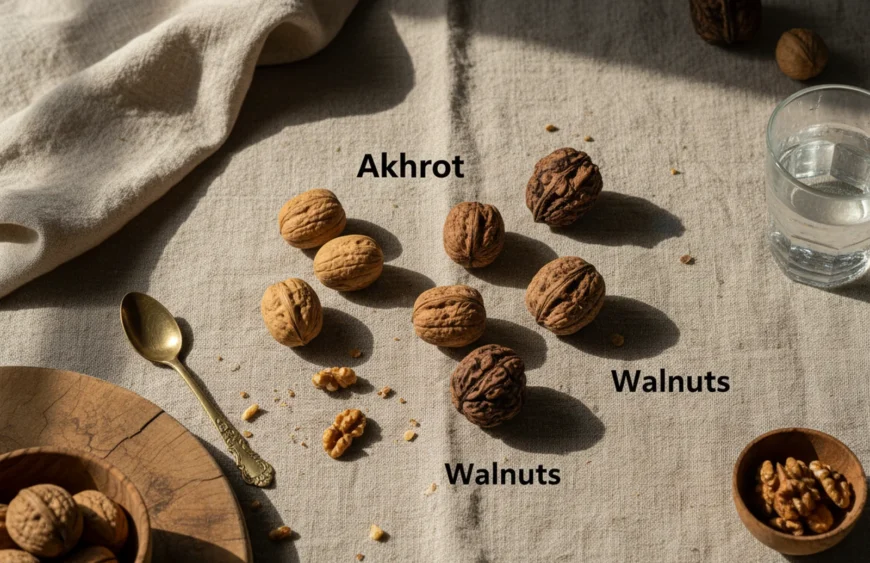
Akhrot vs walnuts is a translation, not a comparison. Both words name the kernel of Juglans regia, the English walnut tree native to Iran and the western Himalayas. “Akhrot” comes from Sanskrit akshota; “walnut” enters Old English from wealhhnutu, meaning foreign nut. Per USDA FoodData Central, a 30 g serving of raw walnuts gives about 185 kcal, 4 g protein, 1.9 g fibre, and 2.5 g of plant omega-3 ALA, values that hold for any akhrot under the same species.
What changes between packets is the variety: Kashmiri (Sopore belt, paper-shell), Chilean, Californian, and Chinese walnuts all sit under the same Hindi label. Ammari Foods ships Kashmiri akhrot from the Sopore belt of north Kashmir, the variety most Indian households mean by asli akhrot. For variety-by-variety detail, see the Kashmiri vs Chilean walnuts buying guide.
Are akhrot and walnuts the same thing?
Yes. They are the same kernel. The split is purely linguistic; the way imli and tamarind describe one fruit.
The botanical name is Juglans regia, also called the Persian walnut or English walnut. The tree is native to a long belt running from the Balkans through Iran, the Hindu Kush, and into Kashmir and the lower Himalayas. The edible part is the brain-shaped kernel inside a hard, ridged shell. Commercial growers in California, Chile, China, France, and Kashmir all grow the same species. There is no separate plant called akhrot; the word names the same fruit in Indian languages.
A small note: the black walnut, Juglans nigra, is a different species native to North America, with a thicker shell, stronger flavour, and limited retail presence in India. Almost all akhrot in any Indian grocery is Juglans regia, the English walnut. For retail purposes, akhrot and walnuts are interchangeable.
Etymology and regional names across India
The Hindi word akhrot descends from Sanskrit akshota (अक्षोट), the classical name for the walnut in Charaka and Sushruta texts. From Sanskrit it travelled into Pali, Prakrit, and modern Indo-Aryan languages. The Persian-origin word char-magz (literally four kernels, after the four chambers of the shelled kernel) also survives in north-Indian usage for the kernel itself.
The English walnut comes from Old English wealhhnutu, where wealh meant foreign or Roman and hnutu meant nut. To Anglo-Saxons, walnuts were the “foreign nuts” coming up from Gaul and the Mediterranean.
A short tour of the Indian map:
- Tamil: akrottu or walnut paruppu
- Telugu: akrotlu or akhrot pappu
- Kannada: akhrota or akhrot beeja
- Malayalam: akrottandi
- Marathi: akhrod
- Gujarati: akhrot
- Bengali / Assamese: akrot
- Punjabi: akhrot
- Kashmiri: doon (the local word in the heart of growing country)
In a Mumbai or Delhi shop, asking for akhrot gets you the kernel by default; asking for sabut akhrot gets you the in-shell nut; char-magz points to the shelled kernel ready for halwa and winter pinnis.
Quick reference: variety, origin, and what each name signals
| Indian shop name | English / variety | Typical origin | Kernel colour |
|---|---|---|---|
| Kashmiri akhrot | Kashmiri paper-shell | Sopore belt, Kashmir | Light, with brown membrane |
| Chilean akhrot | Chilean walnut | Central valley, Chile | Light, mild flavour |
| Californian akhrot | Hartley, Chandler | Central Valley, USA | Light to medium |
| Chinese akhrot | Xinjiang walnut | Xinjiang, China | Medium, larger size |
| Char-magz | Shelled kernel (any origin) | Repackaged | Varies by source |
Variety changes oil content, polyphenol load in the brown membrane, and price. Kashmiri akhrot from the Sopore belt sits at the premium tier in India. For a deeper variety walkthrough, see the Kashmiri vs Chilean walnuts buying guide and the walnut grades India explainer.
Does the name change the nutrition?
No. Per 30 g of raw walnuts, USDA FoodData Central lists about 185 kcal, 4 g protein, 18 g fat, 1.9 g fibre, and roughly 2.5 g of plant omega-3 ALA. A standard Indian portion is 5 to 7 halves per day, in line with both the ICMR-NIN 2024 ceiling for mixed nuts and the dose used in cognitive trials.
The differences between varieties sit at the cosmetic and trace level: Kashmiri akhrot holds a deeper brown membrane (where most of the polyphenols sit), Chilean walnuts run a touch lighter and milder, and Chinese walnuts are usually larger and lower priced. None of this changes the calorie or fat profile in a way that matters at typical portions. The PREDIMED-NAVARRA sub-study linked daily mixed-nut intake, walnuts included, to slower cognitive decline in older adults. For portion guidance by age and condition, see how many walnuts per day.
When the word akhrot shifts meaning slightly
Two everyday cases:
- Akhrot ki gutli. In some north-Indian dialects, akhrot ki gutli names the in-shell whole nut, while akhrot ki giri or char-magz names the shelled kernel. The split helps shoppers ask for the format they want.
- Hot vs cold body framing. In Ayurvedic and Unani classification, akhrot is described as garam tasir (warming). Some families therefore eat fewer akhrot in summer and more in winter, with no botanical implication. This is dietary tradition, not a separate variety.
In any grocery, packaged, or D2C setting, akhrot on the bag means Juglans regia. The cases above are dialect and tradition, not retail labels.
Sourcing transparency
- Ingredient: Walnuts
- Origin (Kashmiri): Sopore belt, Kashmir
- Varieties: Kashmiri Akhrot (paper-shell)
- Origin (Chilean): Chile
Ammari Foods ships Kashmiri walnuts as light-coloured halves with the brown membrane intact, the membrane that holds most of the polyphenols. For a milder, lower-priced option fit for baking, our premium Chilean walnuts come from the central valley harvest. For variety-by-variety detail with prices and use cases, see the Kashmiri vs Chilean walnuts buying guide.
Frequently Asked Questions
Is akhrot the same as walnut?
Yes. Akhrot is the Hindi-Urdu name and walnut is the English name for the same kernel, Juglans regia. There is no nutritional or botanical difference. The split is linguistic, the same way anjeer and fig describe one fruit. Variety differences (Kashmiri, Chilean, Californian, Chinese) sit under both names.
Why is Kashmiri akhrot priced higher than Chilean or Chinese walnuts?
Kashmiri walnuts grow on small orchards at higher altitude, with limited yield, hand-cracking, and a thin, paper-like shell that protects a kernel with deeper brown-membrane polyphenols. Chilean and Chinese walnuts run at much larger volume on irrigated land. Genuine Kashmiri akhrot can cost two to three times the price of imported walnuts for the same weight.
Which akhrot is best for daily eating?
For most Indian adults, 5 to 7 walnut halves per day is the practical anchor across all varieties. Chilean walnuts are the most cost-friendly daily option. Kashmiri is best kept for older adults, pregnancy, and anyone who wants the deeper-membrane polyphenols. See how many walnuts per day for portion detail by group.
Does akhrot mean the in-shell nut or the kernel?
In modern Indian usage, akhrot covers both, with context giving the answer. Sabut akhrot names the in-shell nut; akhrot ki giri or char-magz names the shelled kernel. Most retail packets today sell shelled halves, ready to eat.
Is char-magz the same as akhrot?
Yes, with a small shift. Char-magz is a Persian-origin word literally meaning four kernels, after the four-chambered shape of the shelled walnut. In north-Indian usage it almost always points to the shelled walnut kernel. Akhrot is the broader Hindi word covering both in-shell and shelled formats.
Are Kashmiri walnuts better for the brain than imported walnuts?
Both varieties are close on omega-3 ALA, polyphenols, and vitamin E content. Kashmiri akhrot tends to carry a deeper brown membrane, where polyphenols sit, and a touch more kernel oil. For cognitive benefit, what matters most is steady daily intake of the membrane-on kernel, regardless of origin. See Kashmiri walnuts benefits for detail.
Should I soak akhrot before eating?
Soaking is optional and tradition-led. Some people soak 5 to 7 halves overnight, especially during winter or pregnancy, because soaking softens the membrane and reduces tannin bitterness. Most published nutrition work shows no large change in absorbed nutrients for healthy adults from soaking. The choice is dietary tradition rather than evidence-driven advice.