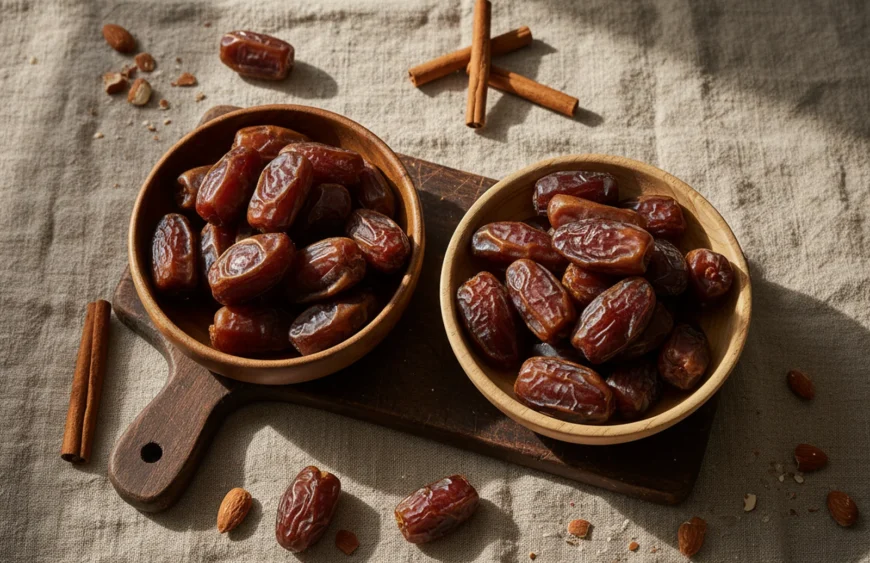
Dates For Diabetics: At a glance
Last updated: 19 May 2026
Dates for diabetics are not automatically off-limits. Most varieties sit in the low-to-medium glycemic index range of 42 to 55, well below white bread (75) or watermelon (76). The carbohydrate load is the real constraint: 2 medium Medjool dates weigh about 24 g and carry roughly 30 g of carbs, of which 27 g are sugars. ICMR-NIN guidelines treat dates as an occasional sweetener for type 2 diabetics, eaten with protein or fat, never on an empty stomach. Clinical work on Ajwa dates has shown a smaller post-meal glucose rise than refined sweets at matched carb portions. Ammari Foods sources Medjool from the Jordan Valley and Ajwa from Madinah, with each batch sugar-tested before pack. For variety selection and grade tiers, read our premium dates buying guide. Always confirm portions with your endocrinologist.
Are dates safe for diabetics? The short answer
For most people with well-controlled type 2 diabetes, two medium dates per day, taken with protein or fat, fit inside a balanced diabetic meal plan. Treating dates as “pure sugar” misses how the fruit behaves: intact fibre (1.6 g per date), polyphenols, and a low glycemic index combine to slow glucose release.
This is general guidance, not a personalised prescription. Tolerance varies sharply between a newly diagnosed type 2 diabetic on metformin and a type 1 patient on insulin. Before adding dates to a daily routine, speak with your endocrinologist or registered dietitian and verify the portion against your CGM or fasting profile. Diabetics with kidney complications need extra caution: dates carry around 696 mg of potassium per 100 g, which matters under renal restriction.
What the glycemic index actually tells you about dates
The glycemic index (GI) ranks a food by how quickly 50 g of its carbohydrate raises blood glucose against pure glucose at 100. Under 55 is classed as low. Most date varieties land between 42 and 55:
- Ajwa: GI 42 to 47
- Khalas: GI 46
- Sukkari: GI 50
- Medjool: GI 49 to 55
- Deglet Noor: GI 49
Dates for diabetics – here is what actually matters when you choose. By contrast, white bread sits at 75, cornflakes at 81, watermelon at 76. Intact fibre and polyphenols in dates blunt absorption more than the sweet taste suggests.
The number you actually feel is the glycemic load (GL), which adjusts for portion. Two Medjool dates give a GL of about 14 (moderate). Six in one sitting pushes it above 40 (high), where most diabetic readers get into trouble. Portion, not the food, is the lever.
10 evidence-based rules for diabetics eating dates
- Cap intake at 2 medium dates daily. Aligns with ICMR-NIN’s “occasional sweet” framing and keeps the carb load under 35 g. See our how many dates per day breakdown.
- Never eat dates on an empty stomach. Without protein or fat as a buffer, the GI advantage disappears and you get the sharpest spike. The “morning soaked dates” habit is risky for fasting glucose management.
- Pair every date with a nut. Five almonds or two walnut halves alongside two dates slows gastric emptying and adds magnesium for insulin sensitivity. The simplest rule.
- Choose smaller varieties. Sukkari weighs 8 g, Medjool 12 to 14 g, Ajwa 8 to 9 g. Smaller piece, less carbohydrate per date.
- Time dates around exercise. Two dates 30 to 45 minutes before a walk or workout puts the carbs to work as muscle fuel. Post-exercise is the safest window.
- Skip dates if morning fasting glucose is above 130 mg/dL. Not the right tool on a high-baseline day.
- Replace, never add. If you eat two dates, take out one biscuit, half a chapati, or two teaspoons of sugar elsewhere. Stacking dates on top of an existing carb total is the most common mistake.
- Avoid syrup-coated or stuffed-mithai dates. Glucose syrup or jaggery turns a low-GI fruit into a confection. Buy unprocessed grade-A fruit only.
- Watch the soak. Soaking softens texture but does not change the carb load. Soaked dates do not “release sugar slowly.”
- Track your response for two weeks. Glucose response is personal. Check fasting and 90-minute postprandial readings after a two-date serving, and let your numbers set the ceiling.
Best date varieties for diabetics: Ajwa, Medjool, Sukkari ranked
Based on published GI data and fibre content:
1. Ajwa (best studied for diabetics). GI 42 to 47, around 73 calories per piece, dense in polyphenols. Ajwa carries religious significance in Islamic tradition and is the variety most often appearing in diabetes-and-dates clinical work. Firmer and less sticky-sweet than Medjool, which helps portion discipline. Order our Ajwa dates.
2. Sukkari. GI around 50, softer and crystalline-sweet. A good middle-ground when Ajwa is unavailable. The 8 g piece size makes two-date portions easier.
3. Medjool. GI 49 to 55, the most sugar-dense per piece. Still low-GI, but two Medjools deliver more carbs than two Ajwas. Halve them, or read Medjool vs Ajwa dates. Browse our premium Medjool dates.
Deglet Noor and Khalas are acceptable backups but less studied. Avoid any variety sold without origin or grade information.
What to pair dates with to flatten blood-sugar response
Pairing is the highest-impact habit a diabetic reader can adopt. It turns a 30 g carb hit into a slower release. Strongest to weakest:
- Almonds (5 to 7 kernels per 2 dates). Fat and protein flatten the curve by 25 to 30 percent. Most reliable.
- Walnuts (2 halves per date). Adds omega-3 ALA alongside the GI buffer.
- Paneer cube or full-fat yogurt (50 g). Protein-led, useful at breakfast.
- Pumpkin or sunflower seeds (1 tablespoon). Magnesium-rich, helpful for insulin sensitivity over weeks.
- Plain water with lemon. Slows gastric emptying mildly; not a substitute for a real pairing.
A practical Indian template: two Ajwa dates, five soaked almonds, warm water, after a savoury breakfast, not instead of it. Women managing gestational diabetes should add clinician guidance; we cover that in our dates for pregnancy guide.
For variety selection and storage, the premium dates buying guide is the parent resource.
Sourcing transparency
- Ingredient: Dates
- Origin (medjool): Jordan Valley
- Origin (ajwa): Madinah region, Saudi Arabia
- Note: Religious significance: al-Ajwa traditional
Each Ammari Foods batch is sugar-tested before pack, with no glucose syrup, jaggery wash, or sweetener coating added. Free delivery on orders over ₹999.
References & further reading
For independent reference points, the PubMed – glycemic indices of dates is the standardised dataset we cross-check composition against. Clinical work like the NIN-Hyderabad Dietary Guidelines for Indians helps separate marketing claims from evidence.
Frequently Asked Questions
Can a diabetic eat dates every day?
Yes, most people with well-controlled type 2 diabetes can safely eat two medium dates per day, paired with a protein or fat source and counted inside their daily carbohydrate budget. The low glycemic index (42 to 55 across major varieties) keeps the blood-sugar response moderate. Diabetics on insulin, those with kidney complications, or anyone with fasting glucose above 130 mg/dL should confirm portions with their endocrinologist first.
Which dates have the lowest glycemic index?
Ajwa dates carry the lowest tested glycemic index, at 42 to 47. Khalas follows at 46, Deglet Noor at 49, Sukkari at 50, Medjool at 49 to 55. All five sit under the low-GI threshold of 55. Ajwa also has the most peer-reviewed diabetes-specific research and is firmer and less sugar-dense per gram than Medjool.
How many dates per day for type 2 diabetics?
Two medium dates per day is the safe upper limit for most type 2 diabetics, aligned with ICMR-NIN’s occasional-sweetener framing. This delivers roughly 30 g of carbs, counted inside the daily total, not added on top. People with gestational diabetes or HbA1c above 7.5 percent should start at one date, paired with five almonds, and increase only after two weeks of stable readings.
Are Ajwa dates better for diabetics than Medjool?
For diabetics, Ajwa has a slight edge. It carries a lower glycemic index (42 to 47 versus Medjool’s 49 to 55), weighs less per piece (8 g versus 12 to 14 g), and has the strongest diabetes-specific clinical base. Medjool is not unsafe; it simply delivers more carbs per date, so the same two-date portion gives a larger glucose load. When both are available, Ajwa is the more cautious choice.