TL;DR
Almonds nutrition per 100 g is well anchored by USDA FoodData Central: raw almonds give 579 kcal, 21.2 g protein, 49.9 g fat, 12.5 g fibre, 25.6 mg vitamin E, and 269 mg magnesium. A standard Indian mutthi of 30 g, roughly 8 to 10 almonds, supplies about 174 kcal and 6.4 g protein.
These values describe the kernel of Prunus dulcis, the sweet almond, whether sold as California, Mamra, or Gurbandi badam. Roasting barely shifts the numbers; salt and oil change the sodium and calorie load. For portion guidance by age and condition, see how many almonds per day. Ammari Foods ships Mamra almonds and California almonds from the complete almonds buying guide India range.
Almonds nutrition per 100 g: the USDA card
The single most-cited dataset for almonds is USDA FoodData Central entry 170567 (Nuts, almonds, raw). Per 100 g of raw, whole almond kernels:
| Nutrient | Per 100 g | Per 30 g (mutthi) | Per 8–10 almonds (~12 g) |
|---|---|---|---|
| Energy | 579 kcal | 174 kcal | 69 kcal |
| Protein | 21.2 g | 6.4 g | 2.5 g |
| Total fat | 49.9 g | 15.0 g | 6.0 g |
| Monounsaturated fat | 31.6 g | 9.5 g | 3.8 g |
| Polyunsaturated fat | 12.3 g | 3.7 g | 1.5 g |
| Saturated fat | 3.8 g | 1.1 g | 0.5 g |
| Carbohydrates (total) | 21.6 g | 6.5 g | 2.6 g |
| Dietary fibre | 12.5 g | 3.8 g | 1.5 g |
| Sugars (natural) | 4.4 g | 1.3 g | 0.5 g |
| Vitamin E (alpha-tocopherol) | 25.6 mg | 7.7 mg | 3.1 mg |
| Magnesium | 269 mg | 81 mg | 32 mg |
| Calcium | 269 mg | 81 mg | 32 mg |
| Potassium | 733 mg | 220 mg | 88 mg |
| Iron | 3.7 mg | 1.1 mg | 0.4 mg |
| Sodium (raw) | 1 mg | ~0 mg | ~0 mg |
The most useful single line for Indian readers: *one mutthi of about 30 g, or 8 to 10 whole almonds, supplies a touch over 6 g of protein and almost half the day’s vitamin E recommended intake*, at the cost of about 174 kcal. For portion fit by age, see how many almonds per day.
What 100 g of almonds looks like in Indian portions
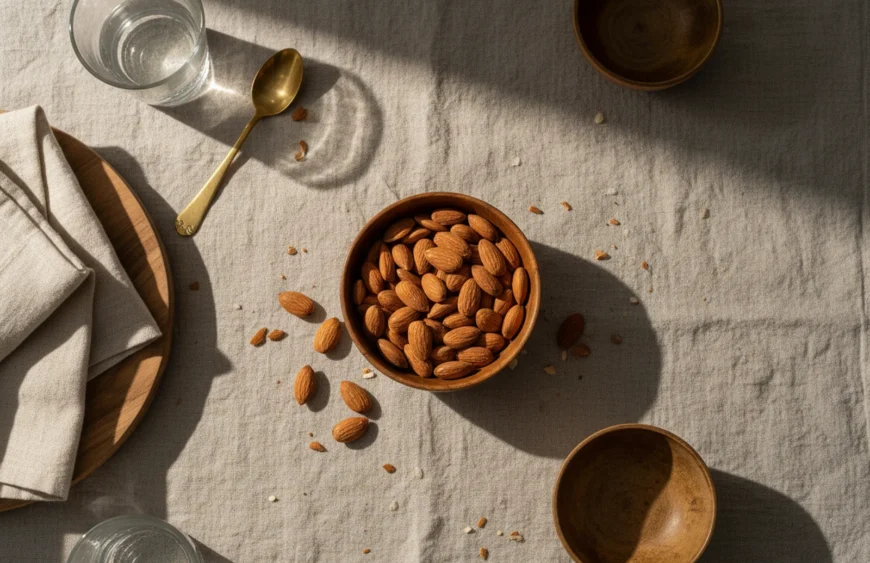
A 100 g portion of almonds is much larger than people picture. By kernel count:
- California almonds: roughly 80 to 90 kernels per 100 g (average 1.2 g per kernel)
- Mamra almonds: roughly 100 to 110 kernels per 100 g (smaller, denser)
- Gurbandi almonds: roughly 120 to 140 kernels per 100 g (smallest variety)
So 100 g is closer to *three full mutthis** than a single snacking handful. Most published portion guidance for healthy Indian adults sits at one mutthi, about 30 g or 8 to 10 almonds, in line with the ICMR-NIN 2024 ceiling for nuts and seeds. The Indian Council of Medical Research recommends a daily mixed-nut intake of 25 to 30 g for adults, which lines up well with a one-mutthi* habit. For soaking trade-offs at this portion, see soaked vs raw almonds.
How variety, roasting, and salt change the numbers
The species is the same across labels, but post-harvest treatment shifts a few numbers worth knowing:
Variety differences (raw). Mamra runs a touch higher in oil content, with monounsaturated fat in the 33 to 35 g per 100 g range versus 31 g for California. Gurbandi runs slightly higher in iron. None of these is large enough to change clinical advice.
Dry-roasting (no oil, no salt). Light dry-roasting drops moisture, so calorie density rises by 3 to 5 percent per 100 g. Vitamin E drops modestly under sustained heat, by 5 to 10 percent.
Roasted and salted. Salted almonds carry 200 to 400 mg of sodium per 100 g, against 1 mg for raw. Important for anyone managing blood pressure.
Oil-roasted. Adds 30 to 50 kcal per 100 g over raw, mostly from cooking oil. For daily snacking, raw or dry-roasted unsalted carries the cleanest profile. See soaked vs raw almonds.
Vitamin E and magnesium: why almonds stand out
Almonds are unusual for vitamin E density. A 30 g mutthi covers about half the adult ICMR recommended daily intake of vitamin E (15 mg per day). The form is alpha-tocopherol, the most bioactive of the four tocopherol isomers. Most Indian diets, heavy in refined grains and low in nuts, fall short on vitamin E. A daily mutthi closes a real gap.
For magnesium, a 30 g portion supplies about 81 mg, around 20 percent of the adult requirement. Magnesium pairs with calcium and potassium for muscle function and blood-pressure regulation. Almonds also carry modest calcium (81 mg per 30 g) and iron (1.1 mg per 30 g), useful background for vegetarian Indian diets.
Sourcing transparency
- Ingredient: Almonds
- Origin (California): Central Valley, USA
- Harvest: Aug–Oct
- Varieties: California, Sonora, Carmel
- Origin (Mamra): Aleppo Province, Iran (and parts of eastern Afghanistan)
- Harvest: Sep–Oct
- Varieties: Mamra (small-batch)
- Note: Stony-soil cultivation, hand-cracked tradition
- Origin (Gurbandi): Indian Kashmir
- Varieties: Gurbandi (Choti Giri)
Ammari Foods sources Mamra almonds from the Aleppo belt of Iran and California almonds from the Central Valley harvest. For variety-by-variety detail with prices and use cases, see the complete almonds buying guide India.
Frequently Asked Questions
How many calories in 100 g of almonds?
Raw almonds carry 579 kcal per 100 g per USDA FoodData Central[1]. A standard Indian mutthi of 30 g comes to about 174 kcal, and 8 to 10 almonds (the most common snacking portion) is roughly 69 kcal. Dry-roasted almonds run a touch higher per 100 g because roasting drops moisture and concentrates the dry weight.
How much protein is in 100 g of almonds?
100 g of raw almonds gives 21.2 g of protein. A 30 g mutthi supplies about 6.4 g, comparable to a single egg. Almond protein has a modest amino-acid score, lower in lysine than dairy or legumes, so almonds work best as a daily complement to mixed protein sources, not a stand-alone source.
Is 100 g almonds too much per day?
For most Indian adults, 100 g per day is well above the recommended portion. The ICMR-NIN 2024 guideline puts daily mixed-nut intake at 25 to 30 g for adults. 100 g of almonds gives almost 580 kcal, which is more than a quarter of the average adult energy requirement. The everyday habit should sit at one mutthi. See how many almonds per day.
Are roasted almonds less nutritious than raw?
Mostly no. Light dry-roasting preserves protein, fibre, and minerals; vitamin E drops 5 to 10 percent under sustained heat. Salted and oil-roasted almonds are a different story; they add 200 to 400 mg of sodium per 100 g and 30 to 50 kcal in cooking oil. For daily eating, raw or dry-roasted unsalted is the cleanest choice.
How much vitamin E do almonds provide?
100 g of raw almonds delivers 25.6 mg of vitamin E as alpha-tocopherol[1], which is well above the adult ICMR recommendation of 15 mg per day. A 30 g mutthi covers about half the daily requirement at one sitting. Almonds sit among the richest practical vitamin E sources in any Indian kitchen.
How does Mamra almond nutrition compare to California?
Mamra and California almonds are the same species, Prunus dulcis, with small variety-level differences. Mamra tends to carry a touch more monounsaturated fat per 100 g (33 to 35 g vs 31 g for California) and slightly higher kernel oil. Protein, fibre, and most minerals are within a few percent of each other.
Does soaking change the nutrition values?
Soaking does not change protein, fat, or mineral content in any measurable way. It softens the brown skin, reduces tannins for sensitive stomachs, and may slightly improve absorption of some minerals by lowering phytate. Calorie count per kernel is unchanged. For detail, see soaked vs raw almonds.