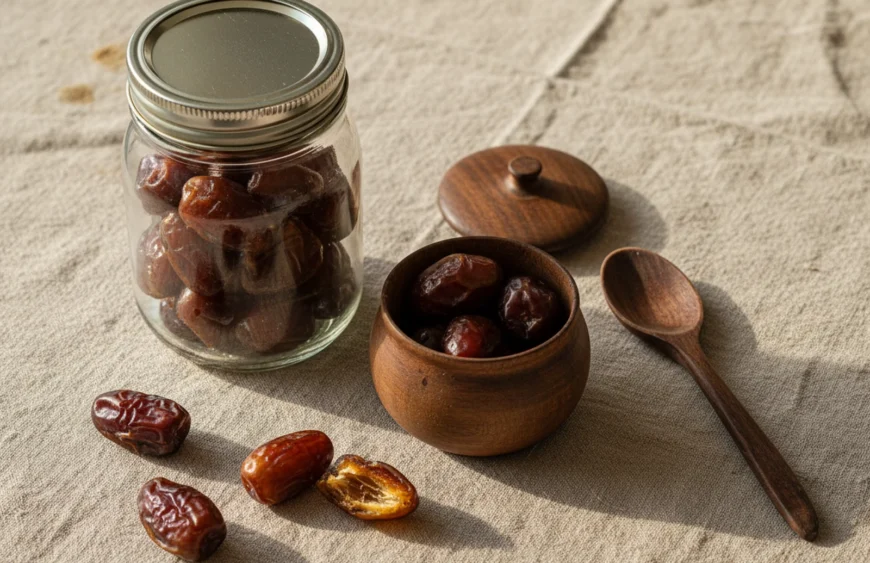
Dates Shelf Life: Dates Storage Shelf Life: The Short Answer
Last updated: 19 May 2026
Dates store remarkably well compared to nuts – they’re naturally preserved by their high sugar content. But Indian climate brings specific challenges.
- Pantry, airtight (cooler months): 4 to 6 months at room temperature below 25°C
- Refrigerator (default for summer): 6 to 9 months – firms up slightly but stays fresh
- Freezer (long-term): up to 12 months with no quality loss; thaw at room temperature
- Variety difference: Medjool (semi-soft) keeps 4-6 months; Ajwa (firmer) keeps 6-9 months; Sukkari (soft golden) keeps 4-5 months
- Indian summer (April–September): always refrigerate – humidity and ants both increase risk
- Sugar bloom (white powder): natural sugar crystallising on the surface; harmless, doesn’t mean spoiled
- Real spoilage signs: mould patches, sour fermented smell, slime – discard
For variety-specific guidance, see our premium dates buying guide and Medjool vs Ajwa comparison.
Why dates are easier to store than nuts
Dates have roughly 60-70% sugar by weight, which acts as a natural preservative. The high osmotic pressure inhibits bacterial and mould growth, which is why dates have been a long-keeping food for thousands of years. Compare this to nuts (which have 45-65% fat that oxidises) – dates simply don’t go rancid.
Dates storage shelf life – here is what actually matters when you choose. That said, dates have their own storage challenges:
- Sugar bloom – moisture migration brings sugar to the surface, where it crystallises as a chalky white film. Looks alarming but is harmless.
- Stickiness – dates attract dust, ants, and other pests if not sealed
- Humidity absorption – Indian monsoon (June-September) raises humidity; dates absorb it and become softer or even fermented
- Texture changes over time – Medjool dries from semi-soft toward firm if stored too long; Ajwa hardens further
Storage methods ranked by shelf life
- Freezer (long-term) – up to 12 months with no quality loss. Use freezer-safe glass jars or sealed bags. Frozen dates thaw to original texture at room temperature in 1 hour. Best for stocking up before festivals (Eid, Ramadan, Diwali).
- Refrigerator (default for India) – 6 to 9 months in a sealed container. The cold reduces ant attraction and slows the rare spoilage modes (mould, fermentation). Dates firm up slightly in fridge – bring to room temperature for the original texture.
- Pantry, airtight (cooler months only) – 4 to 6 months at 20-25°C. Glass or food-grade steel; never plastic for long-term (absorbs the natural sugar oils).
- Open original pack – 2 to 3 months max. Pack openings let in ants and humidity rapidly.
Variety-specific shelf life
Different date varieties have different moisture levels and therefore different shelf lives:
- Medjool dates (semi-soft, 28% moisture content) – pantry 4-6 months; fridge 6-9 months; freezer 12 months. The semi-soft texture is what makes Medjool special, but also makes it more humidity-sensitive than Ajwa.
- Ajwa dates (firmer, 17% moisture) – pantry 6-9 months; fridge 9-12 months; freezer 12+ months. The drier texture means longer shelf life and less risk of monsoon-fermentation.
- Sukkari dates (soft, golden, ~26% moisture) – pantry 4-5 months; fridge 6-8 months; freezer 12 months. Similar to Medjool storage profile.
- Mabroom, Safawi, Kimia (mid-firm, varied) – pantry 5-7 months; fridge 8-10 months; freezer 12 months.
For festival stocks (Eid Ajwa, Diwali Medjool boxes), freezer storage 6 months ahead is the practical default.
What’s that white powder? – sugar bloom vs mould
A common confusion. Distinguishing tells:
- Sugar bloom (harmless) – chalky, dry, fine, evenly distributed. Tastes sweet if you scratch off a bit. Forms naturally as moisture moves through the date and the surface sugar crystallises. Warm the date briefly in your hand and the bloom redissolves. Dates with sugar bloom are perfectly edible.
- Mould (discard) – fuzzy texture, off-colour patches (green, black, white-fuzz), often with a sour or musty smell. Patchy distribution, not uniform. Doesn’t redissolve when warmed. Discard the entire pack.
Indian-summer-specific storage tips
April-September across India presents three challenges:
- Ants – kitchen ants are attracted to date sugar. Seal in glass jars with tight lids; lift containers off the floor and counter. Refrigerator storage eliminates ant access entirely.
- Humidity – monsoon humidity above 70% causes dates to absorb moisture, soften, and risk fermentation. Refrigerator storage maintains the original moisture level.
- Heat above 30°C – accelerates sugar bloom (cosmetic) and increases the rare risk of fermentation (real). Refrigerator solves both.
Bottom line: from April through September, every Indian household should refrigerate dates after opening.
Signs dates have actually gone bad
Genuine spoilage is rare for dates but does happen:
- Mould patches – fuzzy white, green, or black spots. Discard the whole pack.
- Sour fermented smell – like wine or vinegar. Indicates sugar fermentation due to high humidity exposure. Discard.
- Slime or oozing liquid – usually from extreme heat exposure. Discard.
- Off-taste – sharp, alcoholic, or metallic flavour beyond natural date sweetness. Discard.
A single mouldy date can compromise the others in the same container – discard the whole pack rather than picking out the bad one.
Practical storage routine for Indian households
- Buy in 250-200 g vacuum-sealed packs – better than larger boxes for freshness rotation
- Transfer to glass jar with tight lid as soon as you open
- Pantry storage during October-March below 25°C
- Refrigerator storage April-September – non-negotiable in Indian climate
- For Ramadan/Eid Ajwa stocks – freeze in 100-200 g portions, thaw as needed
- For premium Medjool gifting boxes – fridge storage year-round given the price
For variety-specific guidance, see our premium dates buying guide, Medjool vs Ajwa comparison, and how to identify real Medjool.
Sourcing transparency
- Ingredient: Dates (Medjool, Ajwa, Sukkari, Mabroom, Safawi varieties)
- Pack format: 250 g vacuum-sealed for freshness rotation
- Recommended storage: airtight glass; refrigerate April-September
- Shelf-life benchmarks: pantry 4-6 months · fridge 6-9 months · freezer 12 months
- Spoilage indicator: mould patches or sour fermented smell
References & further reading
For independent reference points, the FSSAI Food Safety & Standards Authority of India is the standardised dataset we cross-check composition against. Clinical work like the USDA FoodData Central – nutrient database helps separate marketing claims from evidence.
Frequently Asked Questions
How long do dates last once opened?
In an airtight container, opened dates stay fresh 2 to 3 months at room temperature (below 25°C), 6 to 9 months refrigerated, and up to 12 months frozen. Indian summer reduces pantry shelf life by roughly 40% – refrigeration becomes mandatory from April onwards.
Can dates go bad?
Yes, but rarely compared to nuts. The high natural sugar acts as a preservative, so traditional fat-based rancidity doesn’t apply. Real spoilage is mould (fuzzy patches), fermentation (sour smell), or extreme heat damage (slime). Dates with white sugar bloom are NOT spoiled – that’s harmless surface crystallisation.
Should I refrigerate dates in Indian summer?
Yes – non-negotiable from April through September. Indian summer brings 30°C+ temperatures and 70%+ humidity (especially during monsoon), both of which encourage rare spoilage modes. Refrigeration also keeps ants away. Dates firm up slightly in fridge – bring to room temperature for original texture before serving.
What’s the white powder on my dates?
Sugar bloom – natural sugar crystallising on the surface as moisture moves through the date. Harmless, doesn’t mean spoiled. Distinguishing: bloom is dry, fine, evenly distributed, and redissolves when warmed in hand. Mould is fuzzy, patchy, off-coloured, and doesn’t redissolve. When in doubt, smell-test.
Do Medjool and Ajwa dates store the same?
No – Ajwa stores significantly longer because of lower moisture content (17% vs 28% for Medjool). Pantry shelf life: Medjool 4-6 months, Ajwa 6-9 months. Refrigerated: Medjool 6-9 months, Ajwa 9-12 months. For long-term storage, Ajwa is the more forgiving variety. When evaluating dates storage shelf life, the key is verification not branding.
Can I freeze dates?
Absolutely – freezer is the longest-shelf-life option (12 months with no quality loss). Use freezer-safe glass jars or sealed bags. Dates thaw to original texture at room temperature in 1 hour. Best for buying festival stocks (Eid Ajwa, Diwali Medjool) months ahead.
How do I keep ants away from dates?
Three layers of defence: (1) airtight glass jar with tight-screw lid, (2) lift containers off floor and counter onto a shelf, (3) refrigerator storage during ant-active months (April-October across most of India). Sticky residue from past spillage attracts ants – clean storage areas regularly.
Can pregnant women eat stored dates?
Yes, as long as the dates haven’t spoiled. The same 4-7 dates daily recommendation applies regardless of how long the pack has been stored. For pregnancy specifically, pick vacuum-sealed origin-labelled packs rather than loose dates from open bins (which have higher contamination risk). Sulphite-free is also worth checking – some imported pre-packs use SO2 as preservative.