TL;DR
Last updated: 19 May 2026
Most healthy adults benefit from 30 grams of pistachios per day – about 49 kernels, or roughly two closed handfuls of shelled pistachios. At this serving size:
- 159 calories
- 5.7 g plant protein
- 2.9 g fiber
- 285 mg potassium (more than a banana per gram)
- The highest lutein and zeaxanthin content of any common nut – supports eye health
India’s ICMR-NIN 2024 dietary guidelines recommend 25 to 30 grams of mixed nuts daily as part of a balanced plate, and pistachios fit that range cleanly. Pregnant women, growing children, and adults over sixty benefit from adjusted portions covered below. People with kidney disease or oxalate-stone history should speak with a clinician before adopting daily pistachio intake.
For variety-specific guidance – Akbari, Kerman, Ahmad Aghaei, Fandoghi – see our Iranian pistachios buying guide.
Recommended daily intake of pistachios
The serving size most commonly cited in nutrition research is 28 to 30 grams, which translates to roughly 47 to 49 shelled pistachios depending on variety. Three different bodies converge on similar portions with subtle differences:
- US Food and Drug Administration heart-health claim – 1.5 oz (~42 g, ≈ 65 pistachios) per day. This is the threshold where the FDA permits the cardiovascular claim. Most studies show meaningful benefit starting at 28 g.
- ICMR-NIN dietary guidelines for India (2024) – 25 to 30 grams of mixed nuts daily as part of a balanced plate. By count this lands at 40 to 49 pistachios if pistachios are your primary nut.
- Indian Ayurvedic tradition – pistachios were less common in classical North Indian texts than almonds; 15 to 20 soaked and peeled pistachios per day appears in modern Ayurvedic adaptations as a moderate winter portion.
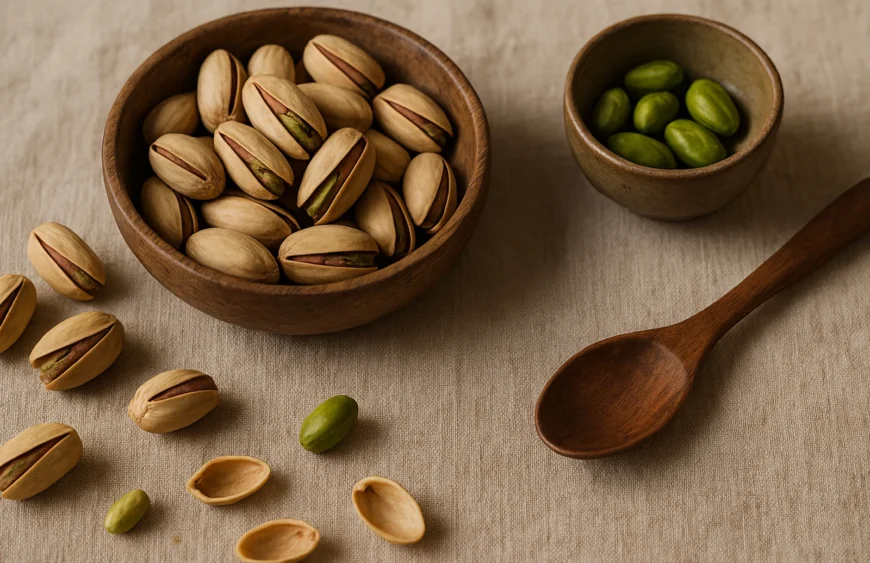
A practical anchor for Indian adults: 49 pistachios is the cleanest reference number. It is one closed handful (when shelled) plus a small top-up. The shell adds the visual deception that you are eating more than you actually are – most people overestimate their pistachio count by 30 to 50 percent.
How many pistachios per day – here is what actually matters when you choose. For Akbari (the largest Iranian variety), 30 to 35 kernels equals roughly the same serving by weight as 49 Kerman or Fandoghi pistachios. Adjust your count by variety.
Health benefits of eating pistachios daily
Daily pistachio intake supports multiple measurable health outcomes from one 30 g serving:
- Heart health – pistachios lower LDL cholesterol by 4 to 6 percent on average when they replace refined-carb snacks, per multiple AHA-published studies. The benefit is strongest in people with elevated baseline cholesterol.
- Eye health – pistachios contain the highest lutein and zeaxanthin of any common nut (1.4 mg per 30 g serving). These carotenoids accumulate in the retina and reduce age-related macular degeneration risk in long-running cohort studies.
- Blood sugar control – pistachios have a low glycemic load and pairing them with carbohydrate-rich meals flattens the post-meal glucose spike. Studies show 28 g pistachios paired with white rice cuts the glucose peak by roughly 20 percent.
- Weight management – multiple Indian and US studies report neutral-to-positive weight outcomes when pistachios replace ultra-processed snacks. The kernel’s fat is partly absorbed; in-shell pistachios slow eating speed by ~40 percent.
- Plant protein and minerals – 5.7 g protein and 285 mg potassium per serving makes pistachios useful for vegetarians and people managing blood pressure (potassium supports sodium balance).
Almonds cover slightly different benefits. For a head-to-head, see how almonds compare in our 10 health benefits of eating almonds deep dive.
Pistachios for different age groups
Daily portions shift across the lifespan. The shells make pistachios fundamentally different for children – the choking-and-swallowing risk is real:
- Children 3 to 5 – 8 to 10 pre-shelled pistachios daily, served chopped. Never give whole in-shell pistachios to children under 3 – the shell is a real choking hazard.
- Children 6 to 12 – 15 to 20 shelled pistachios per day, fine to eat in-shell once they handle the cracking habit safely.
- Pregnant women – 25 to 30 shelled pistachios daily, especially in the second and third trimester. The folate (~50 µg per serving) and magnesium support fetal development; the iron content modestly supports the anaemia risk that rises with pregnancy.
- Healthy adults (19 to 60) – the standard 49 pistachios is the daily reference. Athletes and active adults can raise to 60 to 70 on training days.
- Adults 60 and older – 25 to 30 shelled pistachios; chewing capacity decreases with age and dental concerns make whole shells less practical. Soaked-and-shelled pistachios are gentler.
- Type-2 diabetics – stay at 30 to 49 pistachios daily, paired with protein (paneer, yogurt, or eggs) for the steadiest blood sugar response.
Always favour unsalted, fresh-batch pistachios over commercial roasted-salted varieties – the salt content adds up fast at 49-kernel daily portions.
Risks and side effects
Most healthy adults handle 30 to 50 pistachios daily without issue. But specific groups should watch portion size:
- Kidney stones – pistachios are moderate in oxalates (49 mg per 30 g), lower than almonds (122 mg) but enough to matter. People prone to calcium-oxalate stones should cap intake at 15 to 20 daily.
- Tree-nut allergies – pistachios are in the same allergen family as cashews. Full avoidance required if cashew allergy is known; cross-reactivity is common.
- Aflatoxin risk – improperly stored or pre-rancid pistachios can develop aflatoxin contamination. Buy from origin-labelled, vacuum-packed sources. The standard tells: pale white shell film, fishy or paint-like smell, mouldy spots – discard.
- Sodium load (salted varieties) – a 49-kernel serving of salted roasted pistachios delivers roughly 250 mg sodium, meaningful for blood-pressure management. Pick unsalted versions for daily snacking.
- Calorie density – eating 100 pistachios daily (twice the standard) adds roughly 200 surplus calories per day – gradual weight gain over weeks if not balanced elsewhere.
- Fructose-malabsorption – pistachios contain modest fructose; people with severe fructose malabsorption should limit to 15 kernels daily.
Stick with the 49 daily benchmark unless a clinician advises otherwise. If a serving causes new digestive discomfort, drop to 20 and reassess after a week.
Best time to eat pistachios
With a carbohydrate meal is the practical Indian recommendation – pistachios pair particularly well with white rice and roti dishes for glucose-curve flattening. Modern research finds similar benefits across the day, with one consistent finding: pre-meal or with-meal timing improves blood sugar response.
When to eat them:
- 30 minutes before lunch – flattens the post-meal glucose curve. Useful for pre-diabetes or insulin resistance.
- As an evening snack – 30 g of pistachios in shell makes a satisfying low-stress snack. The shell-cracking action slows eating and improves satiety.
- Pre-workout – pistachios paired with a date deliver steady energy across a 60 to 90 minute training session.
- As part of breakfast – sprinkled on yogurt, oats, or smoothies.
Most Indian households split the serving across two intakes – 25 in the morning, 25 in the evening – for a steady satiety pattern across the day. Consistency matters more than timing precision.
Sourcing transparency
- Ingredient: Pistachios
- Origin (Akbari, Ahmad Aghaei, Kerman): Iran (Kerman and Rafsanjan provinces, Khorasan)
- Harvest: September through October
- Varieties available: Akbari (largest, premium), Ahmad Aghaei (slightly smaller, similar flavour), Kerman/Round (smallest, daily-use), Fandoghi (round-mid-tier)
- Oil content: 45 to 55 percent (varies by variety; Akbari highest)
- Shell-to-kernel ratio: roughly 50:50 by weight in Iranian varieties
Related reading
References & further reading
For independent reference points, the USDA FoodData Central – nutrient database is the standardised dataset we cross-check composition against. Clinical work like the PubMed – pistachios and metabolic health helps separate marketing claims from evidence.
Frequently Asked Questions
How many pistachios should an Indian adult eat daily?
For healthy Indian adults, 30 grams (roughly 49 pistachios) daily is the consensus serving. ICMR-NIN dietary guidelines suggest 25 to 30 grams of mixed nuts daily as part of a balanced plate. Adults over sixty or with sensitive digestion should drop to 25 to 30 shelled pistachios, ideally soaked or pre-shelled.
Are 100 pistachios per day too many?
One hundred pistachios doubles the standard serving and adds roughly 200 calories without proportional benefit. For most healthy adults this leads to gradual weight gain over weeks if not balanced elsewhere. Athletes on training days, growing teenagers, and people recovering from illness can safely consume 70 to 100 pistachios daily, but most should stay between 30 and 49.
Should I soak pistachios before eating?
Soaking is optional for pistachios – the shell-and-skin already has lower phytic acid than almonds, so the digestive benefit is smaller. Indian households who soak typically do so for the texture: soaked pistachios become softer and more child-friendly. For most adults, eating pistachios whole (in or out of shell) is fine.
Can pistachios help with diabetes management?
Pistachios modestly improve postprandial blood glucose response when paired with carbohydrate-heavy meals. A 28-gram serving paired with breakfast or lunch can flatten the glucose curve, supporting insulin sensitivity in pre-diabetic individuals. People with type-2 diabetes should still limit to 49 daily and pair pistachios with paneer, yogurt, or another protein source for steadier results.
Are pistachios safe for daily consumption during pregnancy?
Yes. 25 to 30 shelled pistachios daily is the recommended portion during pregnancy, particularly in the second and third trimester. The serving provides folate, magnesium for muscle and nerve function, vitamin E for fetal brain development, and modest iron support. Pick unsalted, fresh-batch pistachios from a known supplier.
How many pistachios should I give my child?
Children aged 3 to 5 do well with 8 to 10 pre-shelled pistachios daily, served chopped to reduce choking risk. School-age kids (6 to 12) handle 15 to 20 shelled pistachios. Whole in-shell pistachios are not recommended below age 3 – the shells are a real choking hazard.
Do salted pistachios have the same benefits?
Most of the nutrition is preserved (protein, fiber, vitamin E, lutein), but the added sodium (roughly 250 mg per 49 kernels of salted) shifts the balance for blood-pressure management. For daily consumption, unsalted is the right default. Salted is fine as an occasional snack but not at 49-kernel daily portions.
Can I eat pistachio shells?
No. The hard outer shell is not digestible and can cause dental damage or intestinal irritation if swallowed. Only the green-yellow kernel inside is food-safe. The shell-cracking action is a feature, not a bug – it slows eating and improves satiety naturally.