TL;DR
Last updated: 20 May 2026
Mamra almonds are the Iranian-Afghan premium variety used in Indian festival cooking, not for daily snacking. Worth the price when flavour is the point – daily-snack value comes from California.
- Origin: Aleppo Province (Iran) and eastern Afghanistan, with smaller pockets in Khorasan
- Oil content: 55 to 60 percent (versus 49 to 52 percent in California ) – the kernel feels heavier in the hand
- Price: ₹2,800 to ₹4,500 per kg (against ₹800 to ₹1,100 for California)
- Best for: badam halwa, sheer khurma, premium gifting, kheer; anywhere flavour matters more than cost
- Daily portion: 8 to 10 soaked Mamra almonds, taken first thing in the morning – half the count of California given the higher fat density
- Avoid: “Mamra” packs that cost less than ₹2,000/kg – almost certainly mislabelled California at a Mamra premium
For variety-specific portion notes, see our complete almonds buying guide.
Where Mamra almonds actually come from
Mamra almonds benefits – here is what actually matters when you choose. Mamra is not a brand, it is a varietal designation. The name traces back to Aleppo Province in northwest Iran, where small-batch growers have raised this almond variety for over a thousand years. Eastern Afghanistan – particularly the Kunduz, Samangan, and Baghlan regions – produces the second-largest Mamra crop, with stone-soil terraces giving the kernels a slightly different aromatic profile. A small premium pocket grows around Khorasan in northeastern Iran.
The trees are nearly identical to other almond cultivars at first glance, but Mamra orchards run roughly half the yield per hectare of a California operation. Two reasons: stony, mineral-rich slopes that limit irrigation, and traditional dry-farming methods that the Iranian growers have not industrialised. Lower yield concentrates the oils. Higher oils mean richer flavour, longer aftertaste, and the perfumed quality that distinguishes a Mamra kernel when you crack one open.
The supply chain from rural Iran and Afghanistan is also constrained. Sanctions, transit instability, and small-batch logistics mean only a fraction of the world’s Mamra production reaches India through formal channels. That scarcity is real – and it is a major part of why the price holds up.
Mamra vs California – the real differences
The two varieties look similar in a bowl but behave differently in cooking and on the palate:
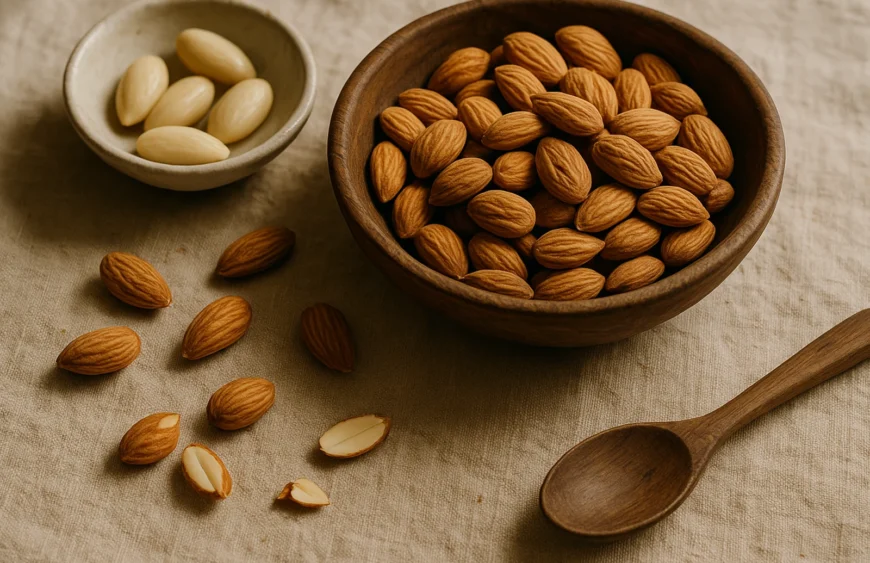
- Size and shape: Mamra kernels are smaller, plumper, and rounder; California is flatter, longer, and uniform.
- Colour: Mamra has a deeper, richer beige with darker tonal variation between kernels; California is uniformly pale beige.
- Oil content: 55 to 60 percent for Mamra versus 49 to 52 percent for California . You can feel this in the kernel weight and the slight oil sheen on a cracked open Mamra.
- Aroma: Mamra carries a clear nutty perfume when cracked, with a faint woody-floral note from the high oil. California is mild by comparison.
- Flavour: Mamra finishes longer on the palate with a buttery aftertaste. California is clean and short.
- Cooking behaviour: Mamra grinds into a creamier paste for halwa and kheer, holds richness when cooked in ghee, and adds visible oiliness to gravies. California is the workhorse for everyday recipes and slicing/slivering.
A blind test most Indian cooks will recognise: take 10 Mamra and 10 California, soak both overnight, peel both, taste both. The Mamra leaves a noticeable lingering richness; the California is gentler.
Health benefits backed by the higher oil content
The benefits of Mamra almonds overlap heavily with almonds in general – heart, blood sugar, skin, vitamin E, magnesium. The differences come from concentration:
Even with Mamra’s richer oil profile, stick to the recommended daily almonds intake of 20-23 almonds (28g, ~164 kcal) so the fats work for you and not against you.
- Heart health (richer fat profile): the higher monounsaturated fat content in Mamra translates to a slightly larger LDL-cholesterol benefit per kernel than California. Practically, 10 Mamra almonds deliver heart-fat support roughly equivalent to 18 California almonds.
- Energy density: ~12 calories per Mamra almond versus ~7 for a California . This is why elders, postpartum mothers, and athletes often keep a small jar of Mamra specifically – fewer kernels, similar nutrition.
- Vitamin E concentration: roughly 1.2× the vitamin E per kernel from Mamra versus California, supporting skin elasticity and antioxidant defence.
- Mineral profile: comparable magnesium and calcium per gram, modestly higher per kernel due to size variance.
- Glycemic response: slightly lower glycemic load than California in some Iranian and Indian comparison studies – the higher fat slows carbohydrate absorption marginally.
- Traditional Unani use: Mamra is the variety specified in classical Unani texts for cognitive support and as a tonic for elderly patients, particularly during winter months.
For a deeper breakdown of each benefit area, see our 10 health benefits of eating almonds covering the full evidence base.
Festival and Indian-cooking use cases – where Mamra earns its price
Mamra is the variety of choice for occasions where the flavour is the point and the kernel does the heavy lifting:
- Badam halwa – Mamra grinds into a richer paste; the higher fat means less ghee added, more natural creaminess.
- Sheer khurma for Eid – the perfumed flavour layers cleanly with cardamom, saffron, and dates.
- Kheer – Mamra slivers add a richer mouthfeel and visible oil sheen to a slow-cooked rice or vermicelli base.
- Gifting boxes – Mamra reads as the premium tier in any mixed-nut hamper; pairs naturally with Medjool dates and Iranian saffron.
- Festival prasad – many North Indian and Kashmiri families specifically use Mamra for ceremonial sweet preparations because of its traditional association with Iranian-origin ingredients.
- Postpartum nutrition – soaked, peeled Mamra is a long-standing recommendation for new mothers; the higher calorie and fat density is genuinely supportive in the first months after delivery.
A practical Indian household pattern: keep 1 kg of California for daily soaked-almond habits and a 250 g jar of Mamra for festival cooking and gifting. This covers most occasions without overspending.
How to spot real Mamra (and avoid the fakes)
Indian markets are full of “Mamra” packs that are repackaged California at a 3× markup. Six tells that separate real from fake:
- Size and shape: real Mamra is smaller, rounder, and plumper than California – never long-and-flat.
- Colour variation: genuine Mamra batches show natural tonal variation between kernels (some lighter, some darker amber). Uniformly pale = California.
- Oil sheen: crack a kernel open. Real Mamra leaves a faint oil mark on a tissue; California stays mostly dry.
- Aroma test: real Mamra has a perceptible nutty perfume when freshly cracked; California is comparatively neutral.
- Snap and texture: Mamra breaks with slightly more give due to higher oil; California snaps cleaner.
- Price honesty: real Mamra rarely retails below ₹2,500/kg even from direct importers. Anything labelled “Mamra” at ₹1,200/kg is mislabelled California, period.
Always ask the seller for the country of origin (Iran, Afghanistan, or Khorasan) and harvest year. If the answer is vague, walk away. Premium Mamra suppliers will name the village or province and the harvest window – that is the standard for verified origin.
Sourcing transparency
- Variety: Mamra (small-batch, hand-cracked tradition)
- Primary origin: Aleppo Province, Iran
- Secondary origin: Eastern Afghanistan (Kunduz, Samangan, Baghlan)
- Tertiary pocket: Khorasan, northeastern Iran
- Harvest: September through October
- Yield characteristics: roughly half the per-hectare yield of California cultivars
- Oil content: 55 to 60 percent (verified per batch)
References & further reading
For independent reference points, the USDA FoodData Central – nutrient database is the standardised dataset we cross-check composition against. Clinical work like the PubMed – almonds and cardiovascular risk review helps separate marketing claims from evidence.
Frequently Asked Questions
Are Mamra almonds worth the higher price?
Yes, when the flavour is the point – festival sweets, gifting, premium cooking. For daily snacking, soaked-almond habits, or general nutrition, California at ₹800 to ₹1,100 per kg is the better value. Most Indian households who use Mamra keep a smaller 250 g jar specifically for festival cooking and a larger California pack for daily use.
What is the daily portion of Mamra almonds?
Eight to ten soaked Mamra almonds per day, taken first thing in the morning, is the traditional Ayurvedic recommendation. This is roughly half the count of California because of the higher oil and calorie density per kernel. For pregnant women, postpartum mothers, and elderly people, 10 to 15 soaked Mamra is a common upper portion.
Can Mamra almonds replace California in any recipe?
Yes for kheer, halwa, and any preparation where richness and aroma matter. Less ideal for slicing/slivering or for recipes that need a neutral background (granola, baking) – Mamra’s flavour can overpower delicate dishes. For standard daily snacking, the cost difference is hard to justify.
How can I tell if my Mamra is real or fake?
Six tells: size (Mamra is smaller and rounder than California), tonal colour variation between kernels, faint oil sheen when cracked, perceptible nutty perfume, slightly softer snap, and price honesty (real Mamra rarely retails below ₹2,500/kg). If any of these check out wrong, the pack is almost certainly relabelled California.
Are Mamra almonds good for diabetics?
Mamra has a slightly lower glycemic load than California per gram because the higher fat slows carbohydrate absorption. People with type-2 diabetes can include 8 to 10 soaked Mamra almonds daily as part of a balanced diet, ideally paired with protein (paneer, yogurt) for the steadiest blood sugar response. Always confirm exact daily quantity with your physician.
How long do Mamra almonds stay fresh?
Mamra has a shorter shelf life than California due to the higher oil – six to eight months at room temperature in an airtight container, up to 10 months refrigerated. The higher oil oxidises faster, so refrigeration after opening is strongly recommended in Indian humidity. Vacuum-sealed Mamra in cool storage can hold quality for up to a year.
Is Mamra the same as Iranian almonds?
Mamra is one Iranian variety – the most expensive – but Iran also exports Sangak and Rabbi cultivars at lower price points. When an Indian seller advertises “Iranian almonds” generically without naming Mamra, they typically mean a mixed origin pack at a midrange price. True Mamra will be specifically labelled and priced ₹2,500 to ₹4,500 per kg.
Looking for more? premium dry fruits in India at Ammari Foods – almonds, pistachios, dates, walnuts and curated gift boxes.