Premium Dates Guide: Medjool, Ajwa, Sukkari & Best Dates for Every Occasion (India 2026)
Buy Dates Online India: Premium Dates Buying Guide India: The Short Answer
Last updated: 19 May 2026
Pick by occasion, not just price. Medjool for indulgence; Ajwa for tradition; Sukkari for daily snacking.
- Medjool (₹1,200–2,400/kg) – large, plump, intensely caramel-sweet; the gifting + dessert variety.
- Ajwa (₹2,400–4,500/kg) – smaller, softer, milder; deep cultural significance, Ramadan staple.
- Sukkari (₹800–1,400/kg) – Saudi origin, golden flesh, melt-in-mouth; everyday snacking.
- Mabroom / Safawi / Kimia – mid-tier varieties; semi-dry to soft, more affordable.
- Look for: plump, glossy, no white sugar bloom (means age, not always bad), no mould, no sour fermented smell.
- Daily intake: 2–4 medium dates (~30–50 g) for healthy adults; pair with almonds or walnuts to slow sugar absorption.
- Storage: airtight container in fridge during Indian summer (Apr–Sep); pantry the rest of the year.
Dates (Khajoor) are the fruit of Phoenix dactylifera, the date palm, a tree cultivated in arid regions of the Middle East and North Africa for over 6,000 years. The premium dates sold in India today come from a small set of named varieties, each tied to a specific origin, texture and sweetness profile. This guide walks through the varieties worth knowing, how Ajwa and Medjool earned their reputations, what to buy for iftar, Diwali gifting and everyday snacking, and how to store dates so they stay soft through an Indian summer.
Date varieties – a global tour
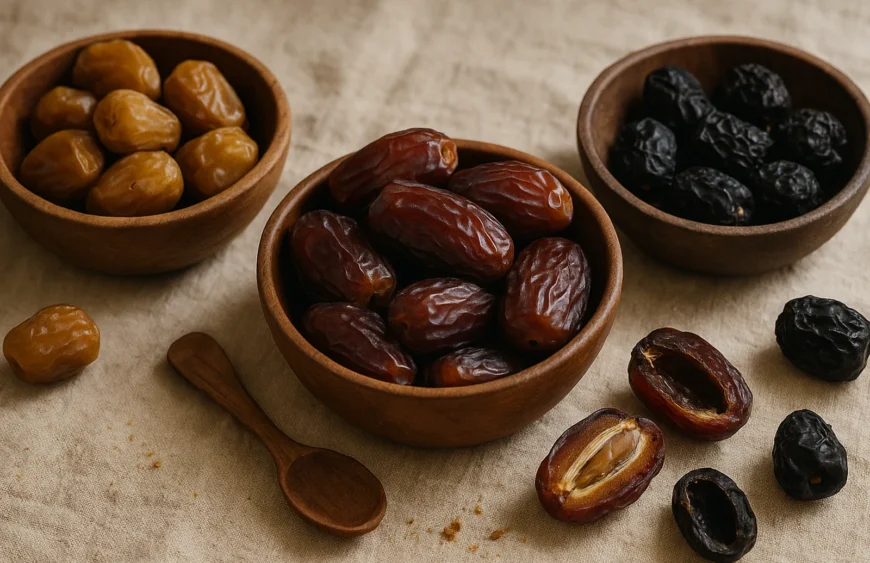
Premium dates buying guide india – here is what actually matters when you choose. Of the hundreds of cultivars grown worldwide, only a handful are regularly imported into India as premium produce. They differ in three things that matter on the plate: moisture (soft to semi-dry to dry), sugar profile (caramel-deep to mild-honeyed) and origin (which sets price as much as quality does). The table below covers the varieties most often stocked by serious Indian dry-fruit retailers.
| Variety | Origin | Texture | Sweetness | Price tier | Best use |
|---|---|---|---|---|---|
| Medjool | Morocco origin; now Bard Valley California, Jordan | Soft, fleshy | Deep caramel | Premium | Iftar, gifting, stuffing |
| Ajwa | Madinah, Saudi Arabia (only) | Soft, fine | Mild, raisin-like | Top premium | Iftar, religious occasions |
| Sukkari | Al-Qassim, Saudi Arabia | Soft, slightly crumbly | Golden, very sweet | Premium | Daily snacking, with coffee |
| Mabroom | Madinah, Saudi Arabia | Semi-soft, chewy | Balanced, woody | Premium | Long-keeping snack |
| Khalas | Saudi Arabia and UAE | Soft, smooth | Caramel-toffee | Mid-premium | Daily snacking, kheer |
| Deglet Noor | Tunisia, Algeria | Semi-dry, firm | Mild, nutty | Mid | Baking, chopping |
| Kimia (Mazafati) | Bam, Iran | Very soft, juicy | Dark, syrupy | Mid-premium | Wedding sweets, smoothies |
| Safawi | Madinah, Saudi Arabia | Soft, dense | Mild, prune-like | Mid-premium | Daily intake, iftar |
Names like Ajwa, Mabroom and Safawi are sometimes used loosely in Indian markets. The honest test is always the same: ask for the named variety, the country of origin, and the harvest year before you ask for the price.
The date palm – biology and harvest
A date palm is a long-lived tree. Once a young palm reaches fruiting age, around four to seven years, it can keep producing for fifty years or more, with peak yields between years fifteen and forty. The trees are dioecious, which means male and female palms are separate; in commercial groves, female trees are hand-pollinated by farmers who climb the trunks during a short pollination window each spring. This labour is one reason premium dates remain expensive even at scale.
The fruit ripens through four classic stages, named in Arabic and still used by growers today: kimri (small, green, unripe), khalal (full size, yellow or red, crisp), rutab (partially soft, translucent, very perishable) and tamr (fully ripe, brown, lower moisture, storable). Most dates exported to India are in the tamr stage, which is why moisture and softness on arrival depend heavily on how recently they were harvested.
The main harvest season runs from September to October across most growing regions, with smaller pickings into November. “Fresh-pack” dates from the current year’s harvest are visibly plumper and slower to crystallise than stocks held over from the previous year, and this is the single biggest quality variable that retailers rarely talk about openly.
Medjool – the king of dates
Medjool is the largest and softest of the widely traded premium varieties, with a deep caramel-toffee sweetness that has made it the default “luxury date” worldwide. The variety originates in Morocco, where it was historically grown around the Tafilalt oasis. In the early twentieth century, a fungal disease known as Bayoud nearly wiped out Moroccan Medjool stock. In 1927, a United States Department of Agriculture mission carried eleven surviving offshoots to Nevada, then onward to the Bard Valley in southeastern California, where the cultivar was rebuilt and now produces some of the finest Medjool in the world. Jordan and Israel are the other two important modern origins.
Medjool is graded by size: jumbo, large and medium, with jumbo fruit weighing 23 grams or more each. Size is not vanity; larger Medjool tends to be moister and softer because the flesh-to-seed ratio is higher. Each date contains a single elongated seed, and the flesh should peel away cleanly when split. A genuinely fresh Medjool is glossy without being sticky, gives slightly under finger pressure, and has a faint honey-cinnamon aroma. Medjool dates from a recent harvest are the most reliable iftar and gifting choice for households new to premium dates.
Ajwa – the dates of Madinah
Ajwa holds a place in the Muslim tradition that no other date variety occupies. The Prophet Muhammad’s recommendation of seven Ajwa dates in the morning is recorded in Sahih hadith collections, and for that reason Ajwa is closely associated with the holy city of Madinah, where the variety has been cultivated for centuries. Authentic Ajwa is geographically protected in practice: it grows only in and around Madinah, Saudi Arabia, and the entire annual yield is small. Anything labelled “Ajwa” sourced from Iran, Egypt or Tunisia is, by definition, not true Ajwa.
The fruit itself is distinct. True Ajwa is a small to medium date with a deep mahogany-to-near-black colour, a fine wrinkled skin that is matte rather than glossy, and a soft, almost cake-like flesh. The sweetness is gentle and raisin-like, very different from the heavy caramel of Medjool. The aftertaste is clean, with light notes of liquorice and date sugar.
Counterfeit Ajwa is widespread. The most common fakes are dyed or syrup-glazed Saudi or Iranian dates sold under the Ajwa name. Three checks help: real Ajwa is uniformly dark but not jet-black or shiny; it has a dry-feeling, lightly powdered surface rather than a sticky one; and the price reflects its rarity, not the discount-bin rate of common imports. We source Ajwa dates directly through Madinah-based exporters and pack to order, which keeps the bloom intact.
Best dates for every occasion
The point of knowing the varieties is to match them to the moment. Below are the practical recommendations we give Ammari customers across Jaipur and the rest of India, with rough price tiers in rupees per kilogram for context.
- Iftar during Ramadan: Ajwa or Medjool, eaten in odd numbers (traditionally three or seven) with water. Ajwa for the religious significance, Medjool when the household prefers a sweeter, plumper bite. Tier: Rs 1,800 to Rs 3,500 per kg.
- Diwali and corporate gifting: A mixed premium hamper is more thoughtful than a single variety. Pair Medjool, Ajwa, Sukkari and Mabroom in a wooden box; the visual contrast alone elevates the gift. The Ammari festive gift box range is built around this principle.
- Pre-workout or pre-run fuel: One or two Medjool dates, slit and stuffed with a whole almond, eaten 30 minutes before activity. Natural sugar plus a slow-burning fat for steady energy.
- Daily snacking: Sukkari or Khalas. Both are softer and less intense than Medjool, which makes a small handful satisfying without feeling heavy. Tier: Rs 900 to Rs 1,400 per kg.
- Wedding sweets, kheer and pulao: Kimia (Iranian Mazafati). It is very soft and almost melts when warmed, which is exactly what you want for sheer khurma, sweet pulao and date payasam.
- Children’s tiffin: Mabroom, halved and pitted. Long-keeping, mild, and chewy enough to feel like a treat without being sticky.
For households exploring premium dates for the first time, a small dates sampler across two or three varieties is a more useful first purchase than a single bulk pack of one type.
How to eat and store dates
Premium dates reward a little effort. Slit lengthwise and stuff with a whole almond, walnut half or a small piece of soft cheese for a fast, photogenic snack. Blend pitted Medjool with cocoa, oats and a spoon of nut butter to make energy balls that hold up in lunchboxes. Soak two or three dates overnight in warm milk with a crushed cardamom pod for a traditional restorative drink given to children and to new mothers across north India. Pureed dates make an excellent natural sweetener for sweet chutney, payasam topping and overnight oats, and they replace refined sugar one-for-one in most kheer and halwa recipes.
Storage is straightforward but specific. At Indian room temperature, premium dates keep for around six months in an airtight glass or steel container, away from direct sunlight. From April through September, when Jaipur and most of the plains push past 35 degrees Celsius, refrigeration is sensible: the dates firm up slightly but stay safe and fresh for up to a year. For very long storage, freeze them in a sealed bag for up to twelve months and bring back to room temperature before eating. One important rule: do not wash dates before storing. Surface moisture is the main trigger for sugar crystallisation and mould. Wipe with a dry cloth if needed, and rinse only the portion you are about to eat.
Date nutrition
A 30 gram serving, roughly two medium Medjool dates, provides about 80 calories, 16 grams of natural sugars (predominantly glucose and fructose), 2 grams of dietary fibre, around 250 milligrams of potassium, useful magnesium, and small amounts of B-vitamins including B6 and niacin. The fibre content matters: it slows the absorption of the natural sugars, which is why dates have a moderate glycemic index of roughly 42 to 55 across studies, lower than many people assume from the taste. They are also fat-free and naturally sodium-free, which makes them a clean source of quick energy compared to most processed sweets.
Common mistakes when buying dates
- Falling for “Ajwa” at suspiciously low prices: dyed and syrup-glazed Iranian or Egyptian dates are routinely sold as Ajwa. True Ajwa is matte, mildly sweet and never bargain-priced.
- Trusting over-glossy, oiled dates: a thick shine usually means a glucose-syrup or oil glaze added to mask older stock. Premium dates have only a natural light bloom.
- Buying by kg-rate without a variety name: “imported dates Rs 600 per kg” tells you nothing. Always insist on variety, origin and harvest year before comparing prices.
- Buying at peak festival weeks: the last fortnight before Ramadan and Diwali is when retailers clear older stock at marked-up prices. Order at least two to three weeks ahead.
- Mislabelled origin: “Saudi dates” is not a variety; Sukkari, Khalas, Mabroom and Safawi are. Treat any pack without a specific cultivar name as commodity-grade.
References & further reading
For independent reference points, the FSSAI Food Safety & Standards Authority of India is the standardised dataset we cross-check composition against. Clinical work like the USDA FoodData Central – nutrient database helps separate marketing claims from evidence.
Frequently Asked Questions
Medjool vs Ajwa – which is better?
Neither is universally better; they are different fruit. Medjool is large, plump and intensely caramel-sweet, ideal when you want a single date to feel indulgent. Ajwa is smaller, softer and milder, with a clean, raisin-like sweetness and deep cultural significance for Muslim households, especially during Ramadan. For pure flavour and visual impact in gifting, Medjool wins. For tradition, daily intake and the gentlest sweetness, Ajwa is the considered choice. Many Ammari customers keep both.
Are dates good for diabetics?
Dates contain natural sugars, but their fibre and polyphenol content give them a moderate glycemic index of roughly 42 to 55, lower than white bread or most Indian sweets. Small studies suggest two to three dates per day, eaten with nuts or yoghurt to slow absorption further, can fit into a controlled diabetic diet. They are not, however, a free food. Anyone with diabetes or insulin resistance should clear an exact daily quantity with their physician or registered dietitian, especially during Ramadan.
How many dates should I eat per day?
For a healthy adult, two to four medium dates per day, around 30 to 50 grams, is a sensible everyday amount. That delivers fibre, potassium and magnesium without overshooting on sugar. Athletes and pregnant women in the third trimester often eat more, sometimes six to seven a day, on medical advice. Children under five do well with one or two soft, well-pitted dates. As with most dry fruits, the upper limit is set by your overall calorie and sugar intake, not by the dates themselves.
How to store dates in Indian summer?
From April to September across most of India, move dates from the pantry to the refrigerator. Pack them in an airtight glass or steel container, ideally in a single layer or two, and keep them in the main fridge compartment, not the door. They will firm up slightly but stay soft enough to enjoy and will keep for up to a year. Do not wash before storing; surface moisture causes sugar crystallisation and mould. For long stockpiles, the freezer extends life to about twelve months.
Why are Ajwa dates so expensive?
Ajwa is grown commercially only in and around Madinah, Saudi Arabia, on a relatively small total acreage, with a single annual harvest. The supply is naturally limited, demand spikes globally during Ramadan and Hajj, and authentic Ajwa is hand-graded rather than machine-sorted because the soft fruit damages easily. Add air freight, customs and the cost of verifying provenance through Madinah-based exporters, and the landed price in India is genuinely several times that of common Iranian or Tunisian dates. Prices below roughly Rs 1,500 per kilogram almost always indicate a counterfeit.
Looking for more? premium dry fruits online India at Ammari Foods – almonds, pistachios, dates, walnuts and curated gift boxes.