Medjool Vs Ajwa Dates: The Short Answer
Last updated: 19 May 2026
Medjool and Ajwa are not interchangeable – they are different fruits with different roles.
- Medjool (₹1,200–2,400/kg) – large, plump, intensely caramel-sweet; California or Jordan origin; the gifting and dessert variety. Best when one date should feel indulgent.
- Ajwa (₹2,400–4,500/kg) – smaller, softer, milder; exclusively from Madinah, Saudi Arabia; the religious-and-traditional variety. Best for daily Ramadan iftar, blessings, and gentle sweetness.
- Common ground: both are pitted-or-with-pit, both work in halwa or kheer, both pair with milk and almonds beautifully.
- Pick Medjool if: you want maximum visual impact, indulgent sweetness, or a single-date dessert moment.
- Pick Ajwa if: you want religious/cultural significance, daily iftar use, or the gentlest sweetness with deepest texture.
- Many Indian households keep both – Medjool for gifting and dessert, Ajwa for daily Ramadan and traditional offerings.
For the full date-variety landscape, see our premium dates buying guide.
Origin and tradition – where each comes from
Medjool originated in Morocco, where it earned the nickname “the king of dates” centuries ago. Today, almost all premium Medjool sold globally is grown in California (Coachella Valley) and Jordan, with smaller production in Israel, Egypt, and Mexico. The variety is the largest commonly sold date in the world – a single Medjool can weigh 24 to 30 grams. Modern Medjool is typically sold semi-soft (not fully dried), which is why it has the plump, caramel quality that distinguishes it.
Ajwa comes exclusively from Madinah, Saudi Arabia – specifically from the date palms grown in and around the city. Ajwa cannot be authentically grown elsewhere; the variety has cultural and religious significance in Islamic tradition that ties it specifically to that geographic origin. The date is mentioned in hadith (sayings of Prophet Muhammad), making it deeply meaningful for Muslim households. Ajwa is fully ripened on the tree and sun-dried slightly, giving it the firmer texture and milder sweetness that distinguishes it from Medjool.
Medjool vs ajwa dates – here is what actually matters when you choose. The supply chain for Ajwa is more constrained than Medjool – it comes from a smaller geographic area, and verified-origin Ajwa carries certification from Madinah-area producers. The price reflects this: real Ajwa rarely retails below ₹2,400 per kg in India.
Visual and sensory comparison
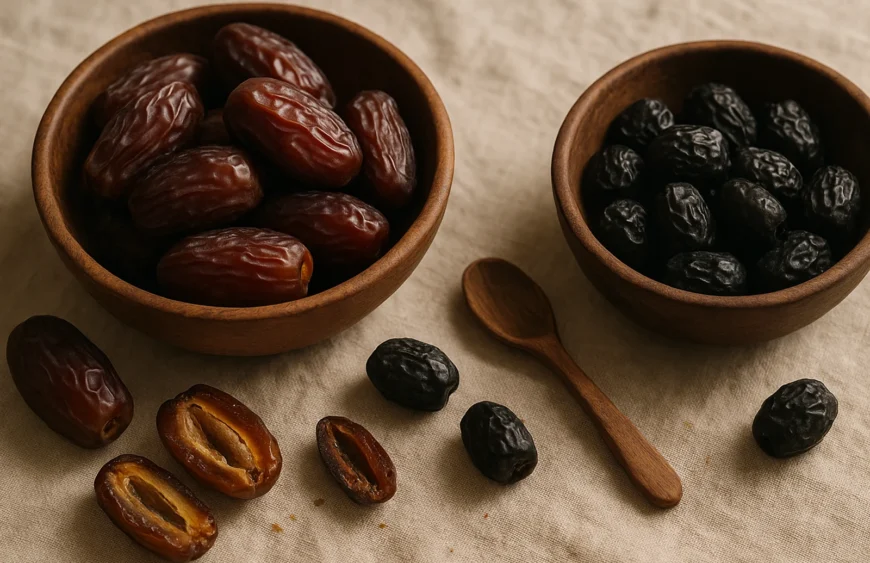
Set the two side by side and the differences are obvious:
- Size: Medjool is significantly larger (24–30 g per date) versus Ajwa (8–12 g per date).
- Colour: Medjool is dark mahogany-brown with a glossy sheen; Ajwa is much darker – almost black – with a velvety matte surface.
- Texture: Medjool is plump and slightly sticky, with semi-soft flesh that yields easily to the bite; Ajwa is firmer, drier, and chewier with a denser bite.
- Skin: Medjool has visibly wrinkled skin showing rich folds; Ajwa has smoother, tighter skin with characteristic surface striations.
- Flesh colour: Medjool flesh is rich golden-amber; Ajwa flesh is darker brown with hints of caramel.
- Aroma: Medjool carries a strong caramel-honey note; Ajwa is more subtle, with a clean date-fruit aroma without the toffee top notes.
Flavour profile and use cases
The flavour difference drives most of the choice between the two:
- Medjool flavour is intensely sweet – almost dessert-like – with caramel, butterscotch, and faint molasses notes. Eating one Medjool date feels like eating candy. This makes Medjool exceptional for: gifting hampers (visual impact), single-date desserts (stuffed with almonds and a drop of saffron), kheer-khurma topping, energy balls, or paired with cheese. Less ideal where you want subtlety – Medjool can dominate.
- Ajwa flavour is softer, gentler, with a clean date sweetness and faint hints of caramel and vanilla. Ajwa does not dominate; it complements. This makes Ajwa exceptional for: daily Ramadan iftar (traditionally three Ajwa with water, per hadith), traditional Indian milk-based sweets, gentle date-and-milk drinks for children and elderly, and any preparation where you want date character without overpowering sweetness.
A practical Indian household pattern: keep a 250 g jar of Medjool for gifting boxes and dessert moments; keep a 200 g pack of Ajwa for daily eating and Ramadan use. Both have their place.
Nutritional comparison per 100 g
The two dates are similar at the macro level but differ slightly in micronutrients:
- Calories: Medjool 277 kcal; Ajwa 283 kcal – comparable, both are calorie-dense
- Sugars: Medjool 66 g; Ajwa 64 g – similar, both 60-70% natural sugar by weight
- Fibre: Medjool 6.7 g; Ajwa 8 g – Ajwa slightly higher
- Protein: Medjool 1.8 g; Ajwa 2.5 g – Ajwa slightly higher
- Potassium: Medjool 696 mg; Ajwa 656 mg – both excellent sources
- Magnesium: Medjool 54 mg; Ajwa 50 mg – comparable
- Iron: Medjool 0.9 mg; Ajwa 1.5 mg – Ajwa notably higher
- Calcium: Medjool 64 mg; Ajwa 39 mg – Medjool higher
For pregnancy nutrition (where iron matters most), Ajwa has a modest edge. For everyday potassium and magnesium support, both work equally well. Both have a moderate glycemic index of 42 to 55, lower than white bread or most Indian sweets, making them acceptable for diabetics in moderation paired with protein.
Religious and cultural significance
This is where Ajwa diverges from any other premium date:
Ajwa carries deep religious significance in Islamic tradition. Hadith (recorded sayings of Prophet Muhammad) specifically mention Ajwa, including the well-known reference to eating seven Ajwa dates each morning as a daily protective practice. This makes Ajwa not just a fruit but a meaningful religious item for many Muslim households worldwide. Indian Muslim families particularly seek out verified-origin Ajwa for daily Ramadan iftar and for sahur preparations.
Medjool has no comparable religious significance. It is appreciated as a luxury fruit, used in Mediterranean and Middle Eastern cuisines, and central to high-end gifting in India during Diwali, weddings, and corporate occasions. The luxury positioning is purely culinary and aesthetic, not religious.
If you are buying dates for daily Ramadan use, Ajwa is the right choice. If you are buying dates for a Diwali hamper, Medjool is the right choice.
How to spot real Medjool and authentic Ajwa
Both varieties get faked at lower price points. The tells differ:
Real Medjool checklist:
- Large size (24–30 g per date is the standard; smaller “Medjool” is often Deglet Noor or Khalas mislabelled)
- Plump, semi-soft texture – not dry or shrivelled
- Rich mahogany-brown skin with a natural glossy sheen
- California or Jordan origin labelled clearly
- Pricing: ₹1,200 to ₹2,400 per kg for verified origin
Real Ajwa checklist:
- Smaller size (8–12 g per date) – Ajwa is never large
- Distinctly darker, near-black colour with velvety surface
- Madinah, Saudi Arabia origin certificate or label
- Firmer, chewier texture (not soft like Medjool)
- Pricing: ₹2,400 to ₹4,500 per kg for verified origin
- Often sold in cardboard boxes with origin certificates from Madinah-area producers
Both fakes typically cost suspiciously less than the genuine article. If a “Medjool” pack costs ₹600 per kg, it is not Medjool. If an “Ajwa” pack costs ₹900 per kg, it is not Ajwa.
Sourcing transparency
- Medjool origin: California (Coachella Valley, USA) and Jordan
- Medjool harvest: September through October
- Medjool size: 24–30 g per date (large)
- Ajwa origin: Madinah, Saudi Arabia (verified)
- Ajwa harvest: August through September
- Ajwa size: 8–12 g per date (small)
References & further reading
For independent reference points, the USDA FoodData Central – nutrient database is the standardised dataset we cross-check composition against. Clinical work like the PubMed – date palm nutritional review helps separate marketing claims from evidence.
Frequently Asked Questions
Which is healthier – Medjool or Ajwa?
Both are similarly healthy at the macro level (calories, sugar, potassium), but Ajwa has a modest edge on fibre, protein, and iron per 100 g. Ajwa’s slightly lower glycemic load makes it marginally better for diabetics in moderation. Medjool has more calcium. For pregnancy, Ajwa’s iron content is more useful. For daily nutrition, either works.
Why is Ajwa more expensive than Medjool?
Three reasons: tighter geographic origin (Madinah only), smaller global production, and significant religious and cultural demand from Muslim households worldwide. Medjool can be grown in California, Jordan, Israel, Egypt – Ajwa cannot. The constrained supply plus high cultural demand keeps Ajwa pricing 1.5–2× higher than Medjool.
Are Medjool dates better for diabetics than Ajwa?
Both have similar glycemic index (42 to 55) and both are acceptable in moderation paired with protein for diabetics. Ajwa’s slightly higher fibre content gives it a marginal edge for slower sugar absorption. Either can be included at 2–3 dates daily under medical supervision; the bigger factor is total dietary sugar across all sources.
Can I substitute Medjool for Ajwa in Ramadan?
Religiously, no – Ajwa carries specific significance in Islamic tradition that Medjool does not have. For practical iftar nutrition (breaking the fast), either works since both deliver quick natural sugars and potassium for rehydration. Many Muslim households keep both: Ajwa for the traditional 3-date opening, Medjool for variety throughout the meal.
How do I store Medjool and Ajwa dates?
Both store best in airtight glass or food-grade steel jars, kept cool, dry, and out of direct sunlight. At Indian room temperature, Medjool keeps 4 to 6 months; Ajwa keeps 6 to 9 months due to its drier texture. From April to September, refrigerate both to extend freshness – they will firm up slightly but remain edible. For long storage, freezer keeps both up to a year without quality loss.
Which date is best for stuffing?
Medjool is the clear winner for stuffing – its size and semi-soft flesh hold a stuffing well (one Medjool can hold 2 almonds, a piece of walnut, or cheese). Ajwa is too small and firm for typical stuffing applications. For Eid presentations specifically, stuffed Medjool dates are now a popular addition alongside traditional Ajwa.
How many Ajwa dates should I eat daily?
The traditional Islamic recommendation is seven Ajwa dates daily, particularly in the morning. Nutritionally, this delivers about 70 to 85 calories – well within sensible daily fruit intake. For Ramadan, three Ajwa with water at iftar is the traditional opening. For non-Muslim use, 3 to 5 Ajwa dates per day is a reasonable everyday portion.
Looking for more? premium dry fruits in India at Ammari Foods – almonds, pistachios, dates, walnuts and curated gift boxes.