Pistachios For Weight Loss: At a glance
Last updated: 19 May 2026
Pistachios for weight loss are one of the few snack nuts with published trial evidence behind them. The Honselman in-shell study found that participants who ate pistachios with the shells on consumed roughly 41% fewer calories than those eating shelled kernels, because the empty shells slowed the pace and made portion size visible. The wider “pistachio principle” research also shows that calories absorbed from tree nuts run about 5% lower than the label, because some of the fat stays locked in the cell wall and passes through undigested.
A standard 30 g serving (roughly 49 kernels) delivers 159 kcal, 6 g protein, and 3 g fibre, enough protein-plus-fibre to blunt mid-afternoon hunger.
Ammari Foods sources its pistachios from Kerman Province in Iran, with Akbari and Kerman varieties hand-graded before vacuum packing. For sourcing detail see our Iranian pistachios buying guide.
Can pistachios actually help with weight loss?
Pistachios for weight loss – here is what actually matters when you choose. Yes, when they replace a worse snack. No, when they are added on top of an existing diet. A 30 g portion is around 159 kcal, and four such handfuls quietly push 640 kcal across a day.
What pistachios offer is a favourable trade. Compared with namkeen, biscuits, or chips at the same calorie load, they deliver more protein, more fibre, and a far lower glycaemic response. A 2010 randomised UCLA study found that overweight adults eating 240 kcal of pistachios as their afternoon snack for 12 weeks lost more weight than those eating 220 kcal of salted pretzels, even though the pretzel group was technically eating fewer calories.
Pistachios are not a magic weight-loss food. They are a useful swap for the 4 PM biscuit habit or the post-dinner sweet. For daily intake, our how many pistachios per day guide covers it.
5 mechanisms behind pistachios and satiety
1. Protein-plus-fibre satiety. A 30 g serving carries 6 g of plant protein and 3 g of fibre. The combination slows gastric emptying and pushes satiety hormones GLP-1 and PYY upward. Against a same-calorie portion of biscuits, the post-snack hunger curve flattens within 90 minutes.
2. The shell-as-pacing-cue, or “pistachio principle”. The Honselman 2011 study found participants given in-shell pistachios ate 41% fewer calories than those given shelled kernels, while reporting equal satisfaction. Cracking each shell forces a slower eating rate, and the pile of empty shells is a visible portion cue.
3. Low glycaemic index and steadier blood sugar. Pistachios sit at a GI of around 15, one of the lowest among tree nuts. Eaten alongside or before a carbohydrate-heavy meal (a roti-and-sabzi lunch, for instance), they flatten the post-meal glucose spike. Steadier blood sugar means fewer mid-afternoon cravings.
4. Partial fat absorption. USDA Beltsville research from Painter, Baer, and Novotny estimated that roughly 5% of the calories in whole pistachios pass through undigested, locked inside the cell-wall matrix. Real metabolisable energy of 30 g is closer to 150 kcal than the label’s 159 kcal.
5. The replacement effect. When pistachios are substituted for a high-glycaemic snack, body weight and waist circumference improve modestly in trials. When added on top, both rise. The benefit comes from what they replace.
5 rules for eating pistachios on a weight-loss plan
1. Stick to a 30 g portion. Roughly 49 kernels, or one closed mutthi. Weigh it once, note the volume in your preferred bowl, and use the bowl as a reference. Eyeballing from a large pouch is the most reliable way to overshoot.
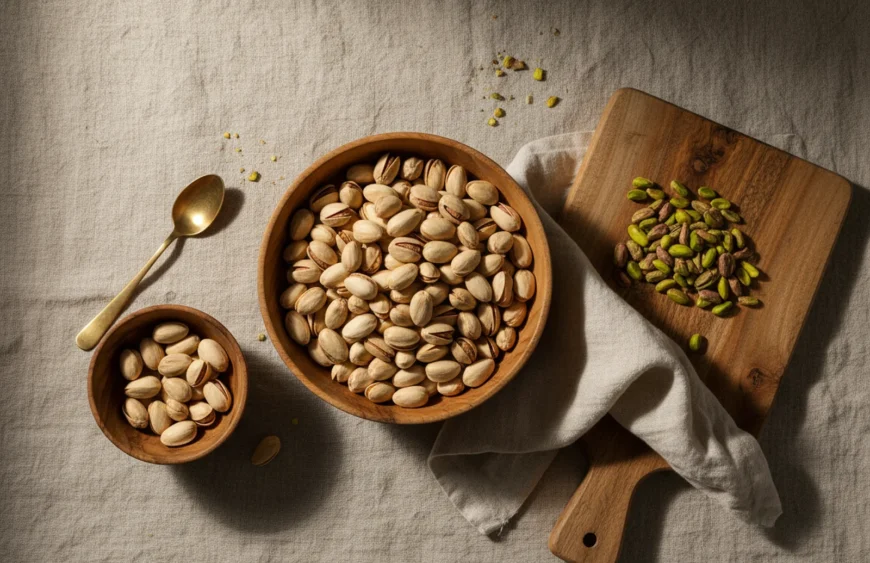
2. Prefer in-shell pistachios when you can. The shell slows your eating rate, provides a portion cue, and consistently lowers total intake in controlled trials. For desk snacking, an in-shell pouch beats a shelled tub.
3. Eat them before, not after, a carbohydrate-heavy meal. A pre-meal serving of 15 to 20 pistachios blunts the glucose spike from rice, roti, or pasta. Eaten after, the same kernels are added calories.
4. Avoid heavily salted and flavoured pistachios. Roasted-and-salted is fine in moderation, but masala or honey-coated pistachios carry added oils, sugar, and higher palatability (research-speak for “easier to overeat”). Plain raw or lightly roasted unsalted is the cleaner daily choice. Our pistachios health benefits guide has more.
5. Do not combine them with high-calorie pairings. A 30 g portion on its own is a useful snack. The same portion alongside a sweetened cold coffee, a slice of cake, or a second handful of cashews loses its edge. Pistachios are a substitute, not a side.
What 30 grams of pistachios actually looks like
A 30 g serving of shelled pistachios is 49 kernels, fitting in a closed adult mutthi or filling a 60 ml shot glass. In-shell, the same kernels come inside about 60 g of total weight, roughly half a small katori.
Larger Akbari kernels count fewer pieces per 30 g than Kerman; our Akbari vs Kerman pistachios comparison has the detail. Anchor: one closed handful per snack, once a day.
When pistachios sabotage weight loss
Three patterns turn pistachios into a weight-gain trigger.
The first is grazing from an open pouch. Without a portion cue, hand-to-mouth eating reaches 80 to 100 g in an afternoon, close to 530 kcal before lunch is digested. Pre-portion into 30 g bowls, or buy in-shell.
The second is replacement-effect failure: keeping the biscuit habit and adding pistachios on top. Both snacks land, and the extra 159 kcal is net surplus.
The third is sweetened or chocolate-coated pistachios marketed as “healthy”. Coatings add 40 to 70 kcal per 30 g and shift the macro balance toward refined sugar. The trial evidence is on plain kernels, not coated ones. See the Iranian pistachios buying guide for pack selection, or compare with the how many almonds per day framing.
Sourcing transparency
- Ingredient: Pistachios
- Origin (Iranian): Kerman Province, Iran
- Harvest: September to October
- Varieties: Akbari, Kerman, Ahmad Aghaei
Ammari pistachios are hand-graded after harvest, vacuum-packed in 250 g pouches (roughly 8 servings at the 30 g benchmark), and shipped from Jaipur. Free delivery on orders over ₹999. See our premium Iranian pistachios listing.
References & further reading
For independent reference points, the USDA FoodData Central – nutrient database is the standardised dataset we cross-check composition against. Clinical work like the PubMed – pistachios and metabolic health helps separate marketing claims from evidence.
Frequently Asked Questions
How many pistachios per day for weight loss?
Stick to a 30 g portion, about 49 shelled kernels, once a day. This is the serving used in most weight-management trials, delivering 159 kcal, 6 g protein, and 3 g fibre [1]. Doubling to 60 g pushes the daily nut load above 300 kcal, which usually cancels the benefit of swapping pistachios for a refined snack.
Are roasted salted pistachios bad for weight loss?
In moderation, no. The calorie and protein profile is nearly identical to raw. The concern is sodium and overeating. A 30 g serving of salted pistachios carries 150 to 250 mg of sodium, which adds up alongside namkeen or pickles. Salt also raises palatability, making the second handful more likely. Choose unsalted or lightly roasted plain kernels.
Can pistachios make you gain weight?
Yes, if eaten without portion control or on top of an existing diet. Pistachios are calorie-dense at roughly 530 kcal per 100 g, and grazing from an open 250 g pouch reaches 700 kcal in an afternoon. The trial evidence assumes pistachios replace a worse snack. Pre-portion to 30 g bowls and the risk disappears.
Are pistachios better than almonds for weight loss?
Both perform well in controlled trials. Pistachios edge ahead on satiety-per-calorie thanks to the in-shell pacing effect [2]; almonds carry more vitamin E and slightly higher protein per gram. For mixed-nut snacking, alternating works. For the almond side, our how many almonds per day guide covers it.