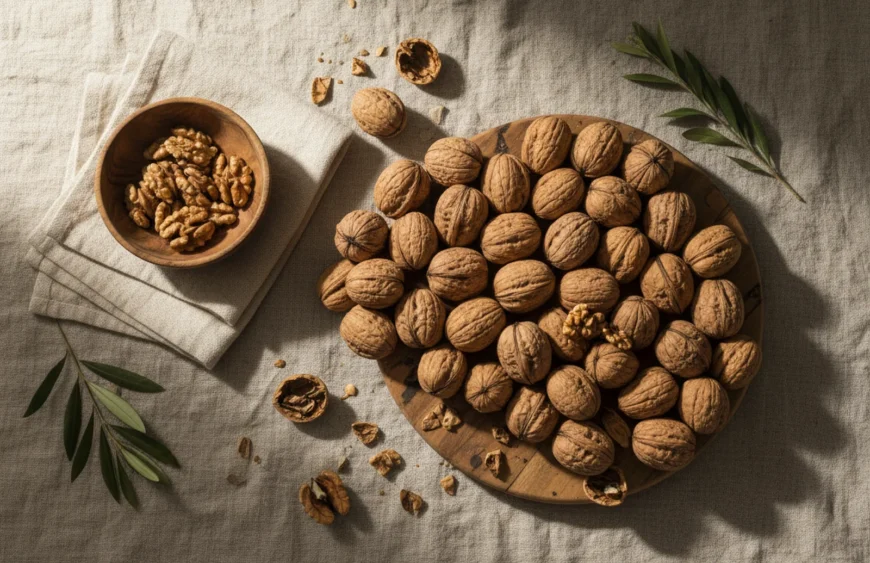
Walnuts Brain Health: At a glance
Last updated: 19 May 2026
Walnuts for brain support cognitive function through omega-3 ALA, polyphenols, and vitamin E, not because the kernel resembles the brain. A 30 g serving (around 7 halves) delivers roughly 2.5 g of ALA omega-3 per USDA FoodData Central. ALA-to-DHA conversion in the human body is limited to around 5 to 10 percent, so walnuts complement, not replace, marine omega-3 sources.
The PREDIMED-NAVARRA walnut sub-study (JAMA Internal Medicine, 2015) found older Spanish adults eating a Mediterranean diet enriched with mixed nuts (walnuts included) showed measurably better memory and frontal-cognition scores than the low-fat control group. The walnut-shape idea is a memorable coincidence, not the mechanism.
Ammari Foods sources thin-shell Kashmiri akhrot from the Sopore belt in north Kashmir. For variety differences and what to ask any walnut supplier, see our Kashmiri vs Chilean walnuts buying guide.
Do walnuts actually help your brain? What the evidence says
Walnuts brain health – here is what actually matters when you choose. Yes, modestly, as part of a wider dietary pattern. Walnuts do not cure or prevent dementia on their own.
The strongest signal comes from the PREDIMED trial, a Spanish randomised study of about 7,500 older adults at high cardiovascular risk. Participants ate a Mediterranean diet with added mixed nuts (15 g walnuts, 7.5 g almonds, 7.5 g hazelnuts per day). They did better than the low-fat control on memory and frontal-cognition tests after four years.
Smaller studies show walnuts cut markers of oxidative stress and inflammation. Both are linked to age-related decline. These are biomarker findings, not clinical endpoints. There is no randomised evidence that daily walnuts prevent Alzheimer’s disease in healthy adults. The evidence supports walnuts as a food-first part of a brain-supportive diet, not a memory booster on their own.
The shape-of-the-brain myth – and why it doesn’t matter
The viral claim is that walnuts help the brain because the kernel looks like one: two halves, a ridged surface, a soft membrane. This belongs to the pre-scientific doctrine of signatures. In that idea, a food’s look was thought to show its function. It’s a cute coincidence, useful for getting children to try akhrot, but not the reason walnuts work.
The actual reasons sit at the nutrient level. Walnuts are among the few common nuts with real amounts of alpha-linolenic acid (ALA), a plant omega-3. They also carry polyphenols (mainly ellagitannins and urolithins), gamma-tocopherol vitamin E, and useful amounts of folate, B6, and magnesium. None of these show up in the kernel’s shape.
5 ways walnuts support cognitive function
- Omega-3 ALA (~2.5 g per 30 g serving). ALA is the plant precursor to EPA and DHA, the omega-3 fats packed in neuronal membranes. The body converts ALA to DHA at about 5 to 10 percent. Useful, but not a swap for marine omega-3 in fully plant-based diets.
- Polyphenols and urolithins. Walnuts are rich in ellagitannins. Gut bacteria turn these into urolithins A and B. Early human trials link urolithins to mitochondrial efficiency. Polyphenols sit in the brown membrane, so eat walnuts skin-on when you can.
- Vitamin E (gamma-tocopherol form). Walnuts lead in gamma-tocopherol, an isomer linked in observational studies to lower inflammatory markers.
- Vitamin B6. A 30 g portion gives about 8 percent of the adult RDA. B6 is a co-factor for making serotonin, dopamine, and GABA.
- Folate and magnesium synergy. Walnuts pair folate (~28 mcg per 30 g) with magnesium (~45 mg). Folate aids DNA methylation in neurons; magnesium shapes synaptic plasticity. Both are under-eaten in Indian diets heavy in refined grains.
For the practical portion, see our how many walnuts per day guide.
What the PREDIMED and walnut-cognition studies actually found
PREDIMED-NAVARRA walnut sub-study (Valls-Pedret et al., 2015, JAMA Internal Medicine). This work followed 447 older adults for four years. The Mediterranean-diet-plus-nuts group showed clearly better memory scores than the low-fat control. The olive-oil group showed better frontal- and global-cognition scores. The effect size was modest, in line with slowing decline rather than reversing damage.
WAHA trial (2020). A two-year study of about 700 older adults tested 30 to 60 g of walnuts daily. It did not improve cognition overall. The Barcelona sub-group with higher baseline cardiovascular risk did show real benefit.
In short: walnuts likely slow cognitive decline by a small amount when they replace ultra-processed snacks. Observational cohorts also link nut intake to lower dementia risk. Those designs cannot split the walnut effect from the wider lifestyle.
How many walnuts per day for brain health
The portion most often used in cognitive studies is 30 g, about 7 walnut halves. PREDIMED used about 30 g of mixed nuts daily; WAHA tested 30 to 60 g of walnuts.
For most Indian adults, 5 to 7 halves per day is the practical anchor. This sits inside the ICMR-NIN 2024 ceiling of 25 to 30 g of mixed nuts.
A simple routine: soak 5 walnut halves overnight. Eat them on an empty stomach with 2 soaked almonds. Portions for older adults, pregnancy, and children are in our how many walnuts per day guide.
Pairing walnuts with other brain-supportive foods
Walnuts work best inside a wider dietary pattern. Practical Indian-kitchen pairings:
- Walnuts + leafy greens (palak, methi, sarson). Greens give folate and vitamin K; walnut fat helps you absorb fat-soluble vitamins.
- Walnuts + dates. Folate, magnesium, and slow-release glucose for steady cognitive work. Also useful in the second and third trimesters; see our dates for pregnancy guide.
- Walnuts + flaxseed or chia. Stacking ALA sources lifts total plant-omega-3 intake.
- Walnuts + turmeric milk at night. A gentle evening routine with its own anti-inflammatory evidence base.
For variety choice, see Kashmiri walnuts benefits and our walnut grades India explainer.
Sourcing transparency
- Ingredient: Walnuts
- Origin (Kashmiri): Sopore belt, Kashmir
- Varieties: Kashmiri Akhrot (paper-shell)
- Origin (Chilean): Chile
Our Kashmiri walnuts ship as light-coloured halves with the brown membrane intact. The membrane holds most of the polyphenols. For a milder, lower-priced option fit for baking, our premium Chilean walnuts come from the central valley harvest. Variety details: Kashmiri vs Chilean walnuts buying guide.
References & further reading
For independent reference points, the USDA FoodData Central – nutrient database is the standardised dataset we cross-check composition against. Clinical work like the PubMed – walnuts and cognitive function helps separate marketing claims from evidence.
Frequently Asked Questions
How many walnuts should I eat daily for brain health?
For most healthy Indian adults, 5 to 7 walnut halves (about 30 g) per day is the portion most in line with the cognitive studies. This gives about 2.5 g of plant omega-3 ALA, useful polyphenols, and about 200 kcal. Soak overnight if you have sensitive digestion or follow Ayurvedic norms. Older adults and children do better with smaller portions, covered in our how many walnuts per day guide.
Are walnuts really good for memory?
Walnuts modestly support memory as part of a Mediterranean-style diet, based on the PREDIMED-NAVARRA trial[2]. The effect is small and most visible in older adults with existing cardiovascular risk. Healthy young adults are unlikely to notice a memory change from walnuts alone over weeks. They add one piece (omega-3, polyphenols, B6) to a wider pattern that, over years, may slow age-related decline.
Do walnuts help with Alzheimer’s prevention?
Current evidence does not support the claim that walnuts prevent Alzheimer’s disease. Observational studies link higher nut intake to lower dementia rates, but those designs cannot prove cause. Randomised trials show modest cognitive benefit from Mediterranean diets with walnuts in higher-risk older adults. Walnuts are a fair part of a brain-supportive diet, not a preventive treatment. Anyone with family history of dementia should speak with a clinician. When evaluating walnuts brain health, the key is verification not branding.
Are Kashmiri walnuts better for the brain than Chilean walnuts?
Both varieties are close on omega-3 ALA, polyphenols, and vitamin E. Kashmiri akhrot tends to carry higher kernel oil and a deeper brown membrane, where polyphenols sit. Chilean walnuts are usually larger, milder, and lower priced. For cognitive benefit, what matters most is steady daily intake of the membrane-on kernel, no matter the origin.