Buy Almonds Online India: Complete Almonds Buying Guide India: The Short Answer
Last updated: 20 May 2026
Buy by variety, not just brand.
- California (₹800–1,100/kg) – daily-snack workhorse; mild, consistent, slices clean.
- Mamra (₹2,800–4,500/kg) – Iran/Afghanistan; 3-4× pricier; 55–60% oil vs 49–52% for California; festival/gifting choice.
- Gurbandi (₹1,400–2,200/kg) – Kashmiri; dense, earthy, traditional Unani favourite.
- Look for: uniform deep beige (not bleached pale), tight skin, fresh nutty smell, no rancid notes.
- Storage: airtight in cool dry place; refrigerate after opening in Indian humidity. 6–9 months pantry, up to 12 in fridge.
- Daily intake: 8–10 soaked almonds (Ayurvedic) or 20–23 raw (FDA serving) – see our how many almonds per day guide.
Almonds (badam) are the seeds of Prunus dulcis, a deciduous tree native to the Mediterranean basin and the Middle East and now grown most intensively in California’s Central Valley, which produces roughly 80 percent of the world’s commercial supply. Botanically a drupe rather than a true nut, the almond kernel sits inside a fibrous hull and a hard shell, harvested between August and October once the hulls split open on the tree. In India, where almonds are a daily Ayurvedic staple and a fixture of festival sweets, choosing well comes down to three things: variety, origin, and freshness of crop.
Almond varieties – a global comparison
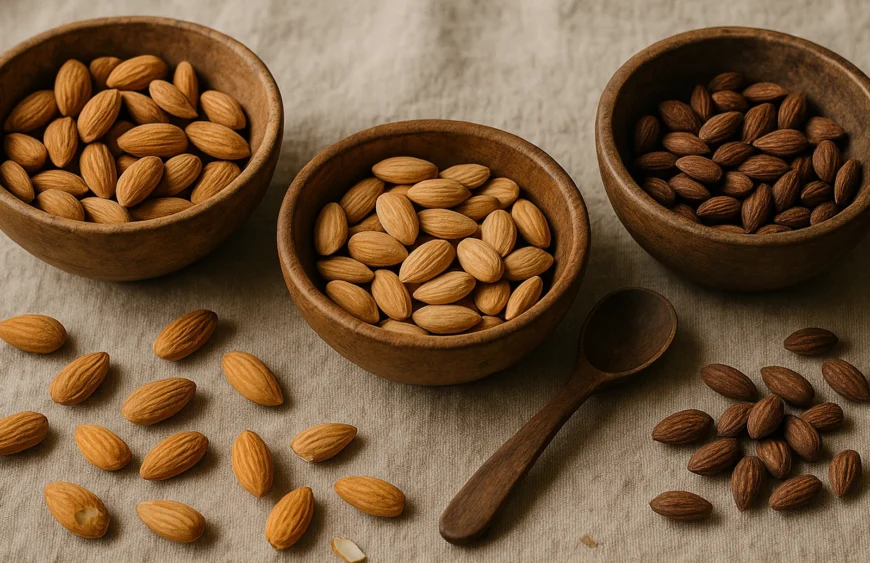
Most Indian shoppers see only two labels – “California” and “Mamra” – but the almond world is far broader, and the differences between varieties are real enough to change how a kheer tastes. California is the smooth, flat, blonde-skinned almond most of us recognise: thin-skinned, mild, easy to slice, and the workhorse of the global trade. Mamra almonds, grown across stony soils in Iran’s Aleppo Province and parts of eastern Afghanistan, are smaller, plumper, and notably oilier – they release a perfume when cracked that California almonds simply do not have. Gurbandi (sometimes called Choti Giri) is the indigenous Indian and Kashmiri variety: small, dark, dense, and prized in traditional Unani medicine. Sonora is a longer, paler California cultivar often used for blanching, and Carmel is a softer-shelled California variety that ships well but bruises faster.
| Variety | Origin | Appearance | Flavor & oil | Price tier (₹/kg) |
|---|---|---|---|---|
| California | Central Valley, USA | Flat, smooth, light beige | Mild, balanced, medium oil | ₹800–1,100 |
| Mamra | Iran & Afghanistan | Small, plump, dark beige | Rich, aromatic, very high oil | ₹2,800–4,500 |
| Gurbandi | Kashmir & Afghanistan | Small, dark, irregular | Earthy, dense, high oil | ₹1,400–2,200 |
| Sonora | California, USA | Long, narrow, pale | Sweet, mild, lower oil | ₹750–950 |
| Carmel | California, USA | Medium, soft-shelled | Mild, slightly sweet | ₹700–900 |
How almonds are grown and harvested
Complete almonds buying guide india – here is what actually matters when you choose. The almond tree blooms early – late January in Bakersfield, mid-February further north around Modesto – covering Central Valley orchards in a pale pink and white canopy that depends on commercial bee pollination on a scale unmatched by any other crop. After bloom, small green hulls form and slowly swell through summer; by late July the hulls begin to dry and split, exposing the shell beneath. Harvest runs from mid-August through October. Mechanical shakers grip each trunk and dislodge the nuts onto the orchard floor, where they cure for a week or two in the dry valley sun before being swept up, hulled, and shelled.
California dominates global supply for three concrete reasons: a Mediterranean climate with warm days and cool nights, the deep alluvial soils of the San Joaquin and Sacramento valleys, and a century of irrigation infrastructure that turned a semi-arid basin into the world’s most productive nut belt. Mamra almonds tell a different story. Grown on stony, mineral-rich slopes around Iran’s Aleppo Province and across eastern Afghanistan, Mamra trees yield roughly half what a California orchard does per hectare, but the kernels carry far more oil – typically 55 to 60 percent fat versus 49 to 52 percent in California – which is what gives Mamra its longer aftertaste. If you want to taste the contrast, our Mamra almonds sit alongside the California almonds in the same range.
How to spot quality almonds
Pick up an almond before you buy it. Premium kernels are uniform in size, smooth-skinned without deep wrinkles, and a deep, even beige to warm brown – pale, ash-white almonds usually mean bleach treatment or old crop that has been “freshened up” cosmetically. The skin should look tight and dry, never papery or shrivelled. Snap one in half: a fresh almond breaks with a clean crack and the kernel inside is creamy white, not yellow or grey. Smell matters more than most shoppers realise. A rancid, painty, or cardboard-like smell means the oils have oxidised and the batch is past its prime, even if the date on the packet says otherwise.
Fresh-crop almonds – meaning kernels harvested in the most recent August-to-October window – taste markedly better than year-old stock. Ask your seller when the batch was harvested and packed, not just when it was packaged. At a retail store, look for cool, low-light displays and sealed packs; bins that sit in warm sunlight or under bright halogens accelerate rancidity. Vacuum-packed and nitrogen-flushed packs hold quality longer, but they are not a substitute for fresh sourcing. The California almonds in our range are sealed in small, season-dated batches for exactly this reason.
California vs Mamra vs Indian almonds
For most Indian households, California remains the sensible default: at ₹800 to ₹1,100 per kg, it offers consistent size, mild flavor, and excellent versatility for everything from a soaked-almond morning habit to badam halwa. It slices and slivers cleanly for garnishes, and its lower oil content means a longer shelf life in Jaipur or Mumbai humidity. This is the variety we recommend if you eat almonds daily.
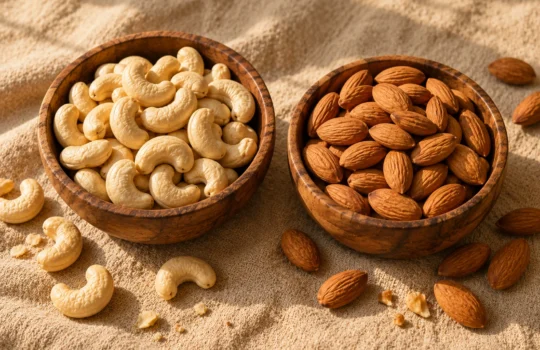
Mamra commands roughly three to four times that price – ₹2,800 to ₹4,500 per kg – because the yield per tree is genuinely lower, the oil content is genuinely higher, and the supply chain from rural Afghanistan and Iran is genuinely more constrained. Mamra makes sense when flavor is the point: festival kheer, premium sheer khurma, gifting boxes, or for someone whose elders specifically request the Iranian variety they grew up with. It is not “better” for daily snacking; it is different, and worth paying for only when the dish or occasion deserves it. Gurbandi sits between the two at ₹1,400 to ₹2,200 per kg – denser and earthier than California, more accessible than Mamra, and a quiet favourite for traditional Unani preparations. Browse the full almonds collection to compare side by side, or see how almonds stack up against cashews in our cashew vs almond comparison.
How to eat almonds – daily habits and recipes
The Ayurvedic standard is eight to ten almonds, soaked overnight in plain water, eaten first thing in the morning with the skins slipped off. The soaking matters: it softens the seed coat (which contains tannins that can irritate digestion in some people), reduces phytic acid, and makes the proteins and fats easier to absorb. Most families in northern India still follow this habit, and there is decent nutritional logic behind it even if the older texts framed it differently.
Beyond the daily soaked habit, almonds anchor a long list of Indian preparations: badam milk thickened with a touch of saffron and green cardamom; badam halwa stirred slowly in ghee until it darkens; almond kheer for Diwali; sheer khurma for Eid; and the ground-almond pastes that bind richer Mughlai gravies. For a savoury snack, a handful of almonds toasted in a dry pan with a pinch of sea salt and a few curry leaves is closer to a south-Indian flavour than the imported “honey roasted” packets. If you keep California almonds for daily use and a smaller jar of Mamra almonds for festival cooking, you have most occasions covered.
Almonds nutrition snapshot
A 30g serving – roughly 23 almonds, the standard handful – gives you a dense package of nutrients without much fuss.
- Calories: 164 kcal
- Protein: 6g (one of the highest among tree nuts)
- Healthy fats: 14g, mostly monounsaturated, with negligible saturated fat
- Fiber: 3.5g, supporting gut health and satiety
- Vitamin E: 7.3mg – about 50 percent of the daily reference intake, more than any other common nut
- Magnesium: 76mg, roughly 18 percent of the daily reference intake
- Calcium: 76mg, useful for vegetarian Indian diets
Almonds are also naturally cholesterol-free and have a low glycaemic load, which is part of why they have featured in cardiovascular and diabetes nutrition research for over two decades. For a deeper look at those findings, see our 10 health benefits of eating almonds.
Common mistakes when buying almonds
Most almond purchases in India go wrong in five predictable ways. Watch for these before you pay.
- Buying bleached kernels. Pale, ashy, uniformly light almonds have usually been chemically lightened to mask age. Real almonds are a deep, slightly uneven beige.
- Old-crop “discounts”. A heavy per-kg discount on a non-vacuum pack is almost always last season’s stock approaching rancidity. Ask for the harvest year.
- Buying only by display, not by smell. Loose-bin almonds in open shops oxidise fast in Indian heat. Always sniff before you buy.
- Falling for kg-rate traps. A ₹699/kg “premium” almond is not premium – it is most likely a Carmel or Sonora blend with a marketing label.
- Ignoring origin labels. If a packet says “premium” but does not name the origin (California, Iran, Afghanistan, Kashmir), assume it is the cheapest blend the brand could source that month.
References & further reading
For independent reference points, the USDA FoodData Central – nutrient database is the standardised dataset we cross-check composition against. Clinical work like the PubMed – almonds and cardiovascular risk review helps separate marketing claims from evidence.
Frequently Asked Questions
How many almonds should I eat per day?
The traditional Ayurvedic recommendation in India is eight to ten almonds per day, soaked overnight and peeled. Modern nutrition research broadly agrees: a 30g serving (roughly 23 kernels) fits easily into a balanced adult diet and delivers about 164 kcal, 6g of protein, and half your daily vitamin E. If you are eating almonds alongside other dry fruits, ten to twelve is a sensible ceiling for daily intake. Children typically do well with four to six soaked almonds.
Are soaked almonds better than raw?
For most Indian households, yes. Soaking softens the brown seed coat and reduces tannins and phytic acid, which can interfere with mineral absorption in some people. The peel slips off easily after eight to ten hours in plain water, and the kernel becomes slightly creamy and sweeter. Raw, unpeeled almonds are perfectly safe and retain a touch more fiber, but they are harder on sensitive digestion. Roasted almonds taste excellent but lose a small amount of their vitamin E.
California almonds vs Mamra – which is better?
Neither is universally better. California is the right choice for daily snacking, soaked-almond routines, and most everyday cooking – consistent in size, mildly flavored, and priced around ₹800 to ₹1,100 per kg. Mamra, sourced from Iran and Afghanistan, costs three to four times as much because of lower yields and notably higher oil content (55 to 60 percent fat versus 49 to 52 percent). Mamra is the right choice for festival sweets, gifting, and anyone who specifically values its richer aroma and aftertaste.
How to store almonds in Indian humidity?
Almonds keep best in an airtight glass or food-grade steel jar, in a cool, dry, dark cupboard away from the stove. At Indian room temperature, expect six to nine months of good quality from a fresh-crop batch. In humid coastal cities like Mumbai or Chennai, refrigerate the jar after opening to push that out to ten to twelve months and prevent the oils from turning rancid. For long-term storage, the freezer keeps almonds well for up to a year with no loss of texture; thaw at room temperature before eating.
Are almonds good for weight loss?
Almonds are calorie-dense – about 164 kcal per 30g – but the combination of protein, fiber, and healthy fats makes them strongly satiating, which is why they appear in many weight-management diets. Several controlled studies have found that swapping refined-carb snacks for a measured handful of almonds supports steady weight loss over time, partly because some of the kernel’s fat is poorly absorbed by the body. The key is portion control: a measured 23-almond serving, not an open packet.
Looking for more? premium dry fruits online in India at Ammari Foods – almonds, pistachios, dates, walnuts and curated gift boxes.