Kashmiri Walnuts Vs Chilean: Kashmiri Vs Chilean Walnuts Buying Guide: The Short Answer
Last updated: 19 May 2026
Kashmiri walnuts are nutty, intensely-flavoured, and 2-3× pricier than Chilean. Use Kashmiri for festival prasad and gifts; Chilean for daily snacking and baking.
- Kashmiri (₹1,400–2,800/kg) – small-to-medium kernels, deep flavour, dark amber colour, traditional Indian provenance, dwindling supply.
- Chilean (₹700–1,400/kg) – larger uniform kernels, milder flavour, paler colour, consistent quality, year-round availability.
- Californian (₹650–1,200/kg) – biggest kernels, mildest flavour, USA origin, used in commercial baking.
- Look for: kernels still attached to shell halves, pale-amber colour (not bleached white), no rancid smell, no shrivelling.
- Daily intake: 4–6 halves (28 g) – the highest plant source of omega-3 ALA at 2.5 g per serving.
- Storage: refrigerate after opening – walnuts oxidise faster than almonds; up to 6 months in fridge, 12 in freezer.
Walnuts (Akhrot) are the seeds of Juglans regia, the Persian walnut tree, native to a belt stretching from the Balkans to the Himalayas. The same species that has grown wild in Kashmir for centuries is now cultivated commercially in California, Chile and parts of Eastern Europe. For Indian buyers the practical question is rarely botanical and almost always about origin, grade and freshness: a Kashmiri Mamra walnut, a Chilean half and a Californian piece behave very differently in your halwa, your banana bread or your morning soak bowl.
Walnut varieties: Kashmiri vs Chilean vs Californian
Kashmiri walnuts vs chilean – here is what actually matters. Kashmiri vs chilean walnuts buying guide – here is what actually matters when you choose. Most walnuts sold in India fall into three origin buckets, and within each there are real grade differences worth understanding before you pay.
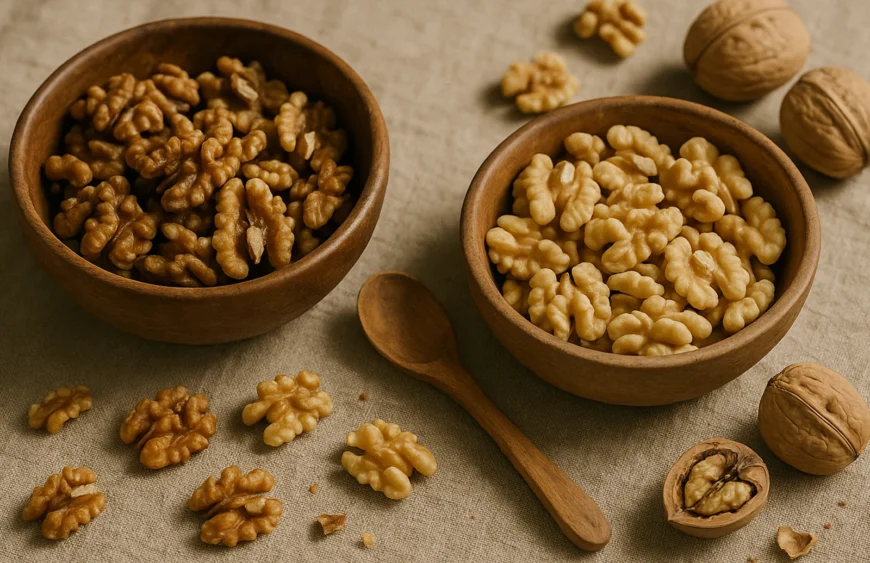
Kashmiri Akhrot is the indigenous Indian walnut, grown in Pulwama, Shopian, Anantnag and Baramulla districts of Jammu and Kashmir. Three traditional grades dominate. Mamra is the smallest and hardest-shelled, with a tight, oily, deeply flavoured kernel that Ayurvedic practitioners have long preferred. Kagzi is the paper-shell premium grade, prized because the shell breaks under finger pressure and the kernel emerges almost whole. Wonth is the hard-shelled traditional grade, larger and lower priced, the everyday cooking walnut of Kashmiri households. Across all three, Kashmiri kernels tend to be smaller, slightly darker gold, sweeter and richer in oil than imported alternatives.
Chilean walnuts are usually sold in India as halves and quarter pieces, light cream in colour with a mild flavour. They come from the Maule and O’Higgins valleys. Because the Chilean harvest runs March to May, the counter-season crop often reaches Indian distributors fresher than a Californian crop that may have spent a year in cold storage.
Californian walnuts are the volume player worldwide, grown across California’s Central Valley. They are lighter in colour, larger on average, and frequently confused with Chilean stock at retail.
| Variety | Origin | Kernel colour | Flavour | Oil content | Price tier |
|---|---|---|---|---|---|
| Kashmiri Mamra | Pulwama, Shopian (J&K) | Deep golden | Rich, slightly bitter finish | ~68% | Premium |
| Kashmiri Kagzi | Anantnag, Baramulla (J&K) | Light gold | Sweet, buttery | ~65% | Premium |
| Kashmiri Wonth | J&K orchards | Mid gold | Robust, traditional | ~63% | Mid |
| Chilean halves | Maule, O’Higgins (Chile) | Light cream | Mild, neutral | ~60% | Mid |
| Californian halves | Central Valley (USA) | Pale cream | Mild | ~60% | Volume |
Kashmir’s walnut orchards: a dying tradition?
Kashmir was once the only meaningful source of walnuts in the Indian subcontinent, and a generation ago its orchards supplied not just kernels but also the celebrated walnut wood used in Srinagar’s carved furniture. Today the picture is more fragile. Urban expansion has eaten into orchard land in Pulwama and around Srinagar. Erratic spring weather, late frosts and reduced snowfall have stressed flowering. Farmgate prices have struggled to keep pace with input costs, pushing some growers to convert orchards to apple, which yields cash returns sooner.
Output of Kashmiri walnuts has slipped over the last two decades even as imported volumes have climbed, which is why a generic supermarket bag often contains Chilean or Californian kernels rather than the Akhrot the label seems to imply. At Ammari Foods we work directly with grower cooperatives in Pulwama and Shopian, paying for grade at the farm gate rather than buying anonymous mixed lots from a wholesale mandi. That is the only realistic way to keep Mamra, Kagzi and Wonth distinct in the bag rather than blended into a single “kashmiri walnut” SKU. Walnut wood, incidentally, comes from the same tree but a different supply chain: a productive nut-bearing orchard is rarely felled, and the carved Kashmiri walnut wood you see in heritage furniture is typically a by-product of trees that have aged out of yield.
How to spot quality walnuts
Walnuts are higher in oil than almost any other commercial nut, which is exactly why they go rancid faster. Quality assessment is mostly a freshness test.
For whole walnuts in shell, weight is the most useful signal. A good in-shell walnut feels heavy for its size because the kernel fills the cavity. Lift two walnuts of similar shell size and the heavier one almost always wins. Look for clean, undamaged shells with no fine cracks. Then shake the walnut next to your ear: a fresh kernel sits tight against the shell wall and makes almost no sound, while a shrunken old kernel rattles loosely.
For halves and pieces, judge by colour first. Fresh kernels are light cream to warm golden; the moment they slide toward grey, brown or dull olive at the edges, oxidation is advanced and the oils are turning. Smell the bag at the seal: fresh walnuts smell faintly sweet and woody, rancid walnuts smell sharply of paint thinner or old crayons. The papery brown membrane wrapping each half should be intact and not flaking off in dust at the bottom of the pack. Sizing should be reasonably uniform within a grade. Walnuts suffer more from poor storage than almonds or pistachios, so sealed current-crop packs beat loose kernels sitting in an open bin under shop lights.
Kashmiri vs Chilean: when to choose what
Both are legitimate buys; they simply do different jobs. Reach for Kashmiri walnuts when flavour is the headline of the dish. Doon chetin, the Kashmiri walnut chutney, leans entirely on the kernel’s depth and oiliness, and a Mamra grade Akhrot will out-perform any imported half here. The same is true of walnut halwa, sheer khurma garnish, kheer and any sweet where the walnut is in close conversation with ghee, milk and cardamom. The faintly tannic finish of a good Kashmiri kernel rounds out the sugar in a way Chilean kernels do not.
Reach for Chilean walnuts when shape and mildness matter. Banana bread, brownies, walnut cake, walnut-studded cookies, salads and granola benefit from larger, lighter, neutral-tasting halves that fold cleanly into batter and toast evenly without taking over the dish. Chilean halves are also typically more uniform in size, which matters more for visual baking than you might think.
The lazy answer “Kashmiri is always better” is wrong. The honest answer is that Kashmiri Akhrot is a flavour ingredient and Chilean walnut is a structural one.
How to use walnuts: recipes and daily habits
The Indian walnut repertoire is broader than most home cooks realise. Doon chetin, the Kashmiri walnut chutney pounded with green chilli, salt and yogurt, is the everyday accompaniment to rice and meat in Kashmiri Pandit and Muslim households alike. Walnut halwa, slow-cooked with ghee, milk and saffron, is a winter sweet across north India. Sheer khurma uses chopped walnuts alongside dates and vermicelli for Eid mornings. Walnuts crumble into kheer, fold into laddoos and sit on top of a Diwali barfi.
Beyond the festival kitchen, walnuts work hard in everyday food. Banana bread and walnut brownies are the obvious bakes. Toasted halves transform a salad of rocket, beetroot and feta. Granola and breakfast bowls gain texture from a coarse chop. The Ayurvedic morning ritual of soaking 4 to 6 walnut halves overnight, peeling the loosened skin and eating them on an empty stomach treats walnuts as a medhya rasayana, a class of substances believed to support cognition. The brain-shape symbolism of the kernel is not coincidence: classical texts noted it centuries ago and modern dietary guidance happens to agree. A daily handful of 4 to 6 halves, roughly 30 grams, is a sensible portion for an adult.
Walnut nutrition
Per 30 gram serving (about 4 to 6 halves), walnuts deliver roughly 190 calories, 4 grams of plant protein and 18 to 19 grams of mostly unsaturated fat. The standout nutrient is alpha-linolenic acid (ALA), a plant-based omega-3. Walnuts are the only common tree nut genuinely high in ALA, the single most cited reason cardiologists and dietitians flag them out from the rest of the nut shelf. The same handful contributes meaningful magnesium, phosphorus, manganese, copper, B6, folate and polyphenol antioxidants concentrated in the papery brown membrane, which is why peeling soaked walnuts removes some antioxidant value along with the bitterness.
Common mistakes when buying walnuts
- Trusting open-bin stock at room temperature. Walnuts oxidise quickly in heat and light; sealed packs from current crop are worth the small premium.
- Accepting mixed-grade in a halves pack. A bag labelled “halves” should not be 40% pieces and crumbs; check the back of the pack against the front.
- Buying without an origin label. “Premium walnuts” with no country or region declared usually means whatever was cheapest at the wholesale level that month.
- Falling for kg-rate dumping. A suspiciously low per-kilo price almost always signals last season’s stock being cleared before it turns, especially in late summer.
- Ignoring kernel colour. Grey, dull brown or oily-looking kernels are oxidising; fresh walnuts read as light cream to warm gold.
References & further reading
For independent reference points, the USDA FoodData Central – nutrient database is the standardised dataset we cross-check composition against. Clinical work like the PubMed – walnuts and cognitive function helps separate marketing claims from evidence.
Frequently Asked Questions
Are Kashmiri walnuts better than Chilean?
Better at different jobs. Kashmiri Akhrot, especially Mamra and Kagzi grades from Pulwama and Shopian, are denser in oil and deeper in flavour, which makes them the right choice for chutneys like doon chetin, halwa, sheer khurma and any Indian sweet where the walnut leads the dish. Chilean walnuts arrive as larger, paler, milder halves that hold their shape in baking, which makes them better for banana bread, brownies, walnut cake and salads. Both can be excellent if the crop is fresh; the variety matters less than the freshness.
How many walnuts should I eat per day?
A daily portion of 4 to 6 walnut halves, roughly 30 grams, suits most adults. That delivers around 190 calories, useful plant-based omega-3 ALA, magnesium and antioxidants without overshooting on fat or calories. Many Ayurvedic practitioners recommend soaking the same quantity overnight, peeling off the loosened brown skin in the morning and eating the kernels on an empty stomach. If you are on a calorie-restricted plan or have specific medical guidance, treat walnuts as part of your total nut allowance rather than an extra.
How to tell if walnuts are rancid?
Rancid walnuts smell unmistakably sharp, like old paint, crayons or stale cooking oil; fresh walnuts smell faintly sweet and woody. Visually, the kernel slides from light cream or warm gold toward grey, dull brown or oily-looking. The papery brown membrane often flakes off as dust at the bottom of the pack. The taste, if you bite a small piece, is bitter and acrid in a way that lingers, not pleasantly tannic. Any one of these signs is enough to discard the batch; rancid oils are not just unpleasant but inflammatory.
Are walnuts good for the brain?
The evidence is genuinely encouraging, although nuance matters. Walnuts are the only common tree nut that is high in alpha-linolenic acid, a plant-based omega-3 fatty acid linked to cardiovascular and cognitive health. They also carry polyphenol antioxidants and B-vitamins relevant to brain function. Long-term observational studies associate regular walnut intake with better memory scores in older adults. Ayurveda has classified walnuts as a medhya rasayana, a cognitive-supporting substance, for centuries. None of this makes walnuts a cure for anything, but a daily handful is one of the better small habits for long-term brain health.
How to store walnuts in summer?
Walnuts are the most heat-sensitive nut in the Indian pantry because of their high oil content. In summer, transfer the pack to an airtight glass or steel container and keep it in the refrigerator, where they will stay fresh for three to four months. For longer storage, especially if you bought a kilo at a time, freeze the same airtight container; walnuts hold quality in the freezer for up to a year with no loss of texture. Bring out only the week’s portion at a time. Avoid leaving walnuts in clear plastic bags on a kitchen counter, which is the single fastest route to rancidity.