Kashmiri Walnuts Benefits: At a glance
Last updated: 19 May 2026
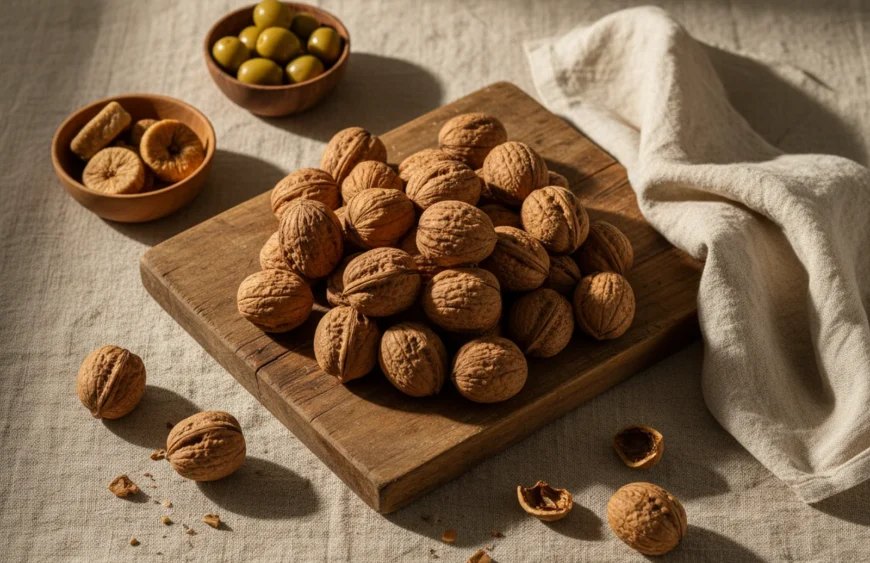
Kashmiri walnuts are India’s premium akhrot variety. They are prized for higher omega-3 ALA, deeper polyphenol content, and a long Ayurvedic role in winter food. A 28 g serving (about 7 walnut halves) gives 2.5 g of plant-based omega-3 ALA and 4 g of protein, per USDA FoodData Central data. That meets the AHA reference serving for plant omega-3. The cool Sopore-belt climate slows the kernel as it grows. Slow growth raises lipid density and pellicle polyphenols, set against Chilean commodity walnuts. A 2013 PREDIMED sub-trial in Spain linked daily walnut intake to a 30 percent lower rate of major heart events. Ammari Foods sources Kashmiri walnuts (akhrot) straight from the Sopore belt, packed in our Jaipur facility. For full variety context, see our Kashmiri vs Chilean walnuts buying guide.
Why cool-climate walnuts pack more omega-3
Kashmiri walnuts benefits – here is what actually matters when you choose. The Sopore belt of Kashmir sits at 1,500 to 2,000 metres. Winters run cold. Springs run late. The growing season starts at April flowering and ends in October harvest. That six-month window is six to eight weeks longer than walnut groves in Chile or California. Warm climates there compress the cycle.
Slow growth matters for one reason. The walnut kernel builds its lipid stores in the last weeks before husk-split. Cool nights also push the tree to make more polyunsaturated fat, mainly alpha-linolenic acid (ALA), as a frost-tolerance trait. Cold-climate walnut studies on PubMed show ALA levels of 9 to 14 percent of total fat in mountain kernels. Low-elevation commodity walnuts sit at 7 to 10 percent.
Yields per hectare drop in cooler climates. That is part of why Kashmiri akhrot costs more. The trade is density. Lower tonnage gives a richer nutrition profile per kernel. Old-style dry-on-tree harvesting helps too. Husks split on the branch before hand-collection. The kernel oils stay intact in ways that industrial early-harvest can damage.
Brain health and the cognitive evidence
Walnuts are the only common tree nut with a real share of omega-3 as ALA. ALA is the plant form. The body turns it into EPA and DHA. Conversion rates are modest. ICMR-NIN data puts ALA-to-EPA at 5 to 10 percent. ALA-to-DHA sits under 1 percent. Daily intake still raises serum omega-3 in vegetarian and lacto-ovo eaters.
The brain evidence is stronger than the math suggests. The PREDIMED-NAVARRA sub-trial, published in 2015, gave older Spanish adults a Mediterranean diet with mixed nuts. The plan included 15 g of walnuts daily. The team tracked thinking skills for four years. The walnut arm gained in working memory and global cognition versus the control group. A 2020 cohort in the American Journal of Clinical Nutrition reported that women who ate five or more walnut servings a week kept cognitive scores on par with non-consumers two years younger.
For Indian homes, this matches the old Ayurvedic plan. Soaked akhrot in winter has long been prized for students and elders. Modern science describes healthy fats that support brain cell walls. Classical practice taught the same habit.
Heart health and cholesterol
The heart case for walnuts is the strongest pillar of the evidence base. A 2018 meta-analysis of 26 trials in the American Journal of Clinical Nutrition found that walnut-rich diets cut total cholesterol by 6.99 mg/dL on average. LDL fell by 5.51 mg/dL versus control diets. The effect held across age groups and starting lipid profiles.
The Yale Prevention Research Center ran a 2017 trial led by Dr David Katz. Adults with raised heart risk ate a daily 56 g walnut serving for six months. The walnut arm showed better blood vessel function. Markers of inflammation fell. Belly fat dropped a little, with no overall weight gain. In real diets, walnut calories tend to crowd out less healthy snacks.
The American Heart Association advises two oily-fish servings a week. For vegetarian eaters, the body suggests daily plant ALA sources. Seven Kashmiri walnut halves at 28 g give 2.5 g of ALA. That clears the AHA’s 1.1 to 1.6 g daily ALA target for adults. For daily-portion specifics, see our how many walnuts per day guide.
Polyphenols and the anti-inflammatory side
Beyond fats, the walnut pellicle holds the bulk of the polyphenols. The pellicle is the papery brown skin around the kernel. Ellagitannins dominate the profile. In the gut, they convert to urolithin A. In 2016, a team at the Université de Lausanne linked urolithin A to better cell-energy function in muscle. The 2022 follow-up in Nature Metabolism reported real mitochondrial gains in middle-aged adults given urolithin A precursors.
Kashmiri walnuts have a darker amber pellicle. They taste more bitter than the pale, milder Chilean variety. The bitterness many Indian buyers notice is the tannin signature behind the anti-inflammatory effect. Soaking overnight softens the bitter note. The polyphenols stay. Classic prep aligns well with the active chemistry.
ICMR-NIN’s 2024 dietary guidelines list tree nuts, walnuts included, as protective foods for adults with metabolic syndrome. The body cites the joint effect of healthy fats and polyphenol antioxidants on markers like C-reactive protein.
Daily intake and Indian preparation
The standard daily serving is 28 g, about seven Kashmiri walnut halves. Take them first thing in the morning after an overnight soak in plain water. Soaking has three known effects. It lowers phytic acid. It softens the tannic pellicle. It eases the digestion that raw kernels can strain in sensitive stomachs.
Kashmiri families have prepared akhrot for centuries in seasonal rhythms. The Ayurvedic idea of warming foods sits at the core. Walnut is classically the most warming tree nut. Winter dishes include:
- Akhrot ke laddoo, walnut and jaggery balls bound with ghee and cardamom. Common in Kashmiri homes from Diwali through Lohri.
- Akhrot halwa, ground walnut paste slow-cooked with milk, ghee, and sugar. Served on cold mornings.
- Soaked walnuts with honey, the simplest prep. Two to three soaked halves with a teaspoon of raw honey at sunrise.
- Walnut and saffron kheer, slow-cooked rice pudding finished with crushed walnut and a pinch of Kashmiri saffron. A festival favourite.
Modern homes add walnut halves to morning oats, curd, or fruit bowls. The old guidance to eat walnuts in cooler months still holds. The rich lipid profile supports body warmth and skin barrier health in dry winter air. For checks before purchase, our how to identify real Kashmiri walnuts guide covers the physical and pricing tells.
Sourcing transparency
- Ingredient: Walnuts (akhrot)
- Origin (Kashmiri): Sopore belt, Kashmir Valley, India
- Varieties: Kashmiri Akhrot (paper-shell)
- Harvest: September through October
- Origin (Chilean, for comparison): Chile
- Packing facility: Ammari Foods, Jaipur
- Storage: airtight, cool storage; refrigerate after opening to slow oxidation
References & further reading
For independent reference points, the USDA FoodData Central – nutrient database is the standardised dataset we cross-check composition against. Clinical work like the PubMed – walnuts and cognitive function helps separate marketing claims from evidence.
Frequently Asked Questions
What are the main Kashmiri walnuts benefits versus other varieties?
Kashmiri walnuts benefits rest on three pillars. The first is higher omega-3 ALA from cool-climate growth. The second is denser polyphenol content in the darker pellicle. The third is the long Ayurvedic role in winter food. A 28 g serving gives 2.5 g of plant-based omega-3, 4 g of protein, and useful magnesium per USDA FoodData Central data. Compared to Chilean commodity walnuts, the Sopore-belt kernels carry a richer flavour, a stronger bitter note, and a tighter direct-source chain through trusted Indian suppliers.
How many Kashmiri walnuts should I eat daily for health benefits?
Seven walnut halves, about 28 g, is the standard daily serving. It lines up with the American Heart Association omega-3 reference and the FDA heart-health serving. ICMR-NIN’s 2024 dietary guidelines suggest 25 to 30 g of mixed nuts daily as part of a balanced plate. Most Indian families soak the walnuts overnight in plain water. They eat them on an empty stomach in the morning. Adults over sixty or those with sensitive digestion typically drop to four or five soaked halves a day.
Are Kashmiri walnuts better for brain health than Chilean walnuts?
Both varieties supply ALA, the plant omega-3 precursor. The PREDIMED-NAVARRA trial and later cohort studies linked it to better thinking skills in older adults. Kashmiri walnuts carry a higher ALA fraction thanks to cool-climate growth. They also pack heavier polyphenol content in the darker pellicle. That means denser nutrition per kernel. For daily-snack volume where cost matters more than density, Chilean walnuts are fine. For brain-focused Ayurvedic plans or postpartum food, the Kashmiri variety is the traditional and richer choice.
When is the best time to eat Kashmiri walnuts in the Indian context?
Soaked Kashmiri walnuts taken first thing in the morning on an empty stomach is the Ayurvedic standard. The pattern fits winter months in particular. The warming nature of akhrot suits the season. Soaking overnight in plain water softens the tannic pellicle and helps digestion. Many North Indian and Kashmiri families pair morning walnuts with soaked almonds, two dates, and a few raisins for a balanced winter nut intake. Evening intake suits people who tolerate richer foods later in the day.