How Many Walnuts Per Day: The Short Answer
Last updated: 19 May 2026
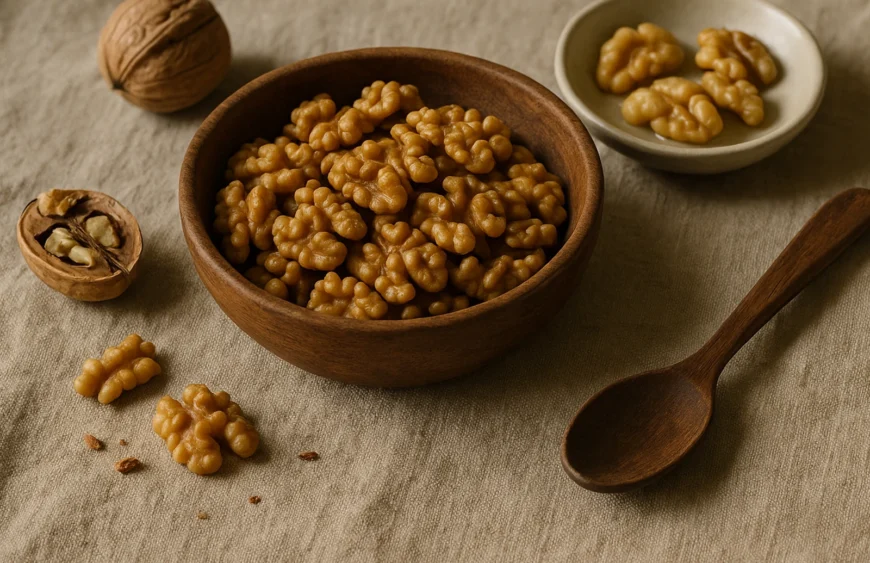
Most healthy adults benefit from 4 to 6 walnut halves per day (28 grams or one ounce). At this serving size:
- 185 calories
- 4.3 g plant protein
- 1.9 g fiber
- 2.5 g omega-3 ALA – the highest plant source of this brain-and-heart-protective fat
- 0.7 mg vitamin E + 45 mg magnesium
India’s ICMR-NIN 2024 dietary guidelines recommend 25 to 30 grams of mixed nuts daily as part of a balanced plate. Walnuts deliver omega-3 and antioxidant polyphenols that other nuts mostly lack.
For variety-specific notes (Kashmiri vs Chilean vs Californian akhrot), see our Kashmiri vs Chilean walnuts buying guide.
Recommended daily intake of walnuts
The serving size most often cited in nutrition research is 28 grams, which translates to 4 to 6 walnut halves depending on size. Three different bodies converge on similar portions:
- US FDA heart-health claim – 1.5 oz (~42 g, ≈ 8 halves) per day. The FDA permits the cardiovascular claim at this threshold based on omega-3 ALA content. Most studies show meaningful benefit starting at 28 g.
- ICMR-NIN dietary guidelines for India (2024) – 25 to 30 g of mixed nuts daily as part of a balanced plate. By count this lands at 4 to 6 walnut halves if walnuts are your primary nut, fewer if you mix with almonds or pistachios.
- Indian Ayurvedic tradition – soaked walnuts are part of the classical winter regimen for cognitive support, particularly in Kashmiri and North Indian households. The traditional portion is 4 to 8 soaked halves.
For most adult readers in India, the 6-halves benchmark is the cleanest reference point. It is one closed handful of walnut halves (broken from cracked whole walnuts), aligns with the FDA threshold, and stays inside ICMR-NIN’s range comfortably. Note that “walnut” here means kernel – not the whole shell. If you weigh out 28 g of in-shell walnuts, you’ll get only 12 to 14 g of edible kernel.
Health benefits of eating walnuts daily
How many walnuts per day – here is what actually matters when you choose. Daily walnut intake supports the brain, heart, and inflammatory system in measurable ways. Key effects from one 28 g serving:
- Omega-3 ALA – highest plant source. 2.5 g per serving is more than chia seeds or flax per gram of nut. Critical for vegetarian Indian diets where fish-derived omega-3 is absent. Long-term cohort studies link higher ALA intake to reduced cardiovascular and inflammatory disease risk.
- Brain health. Walnuts’ shape – resembling a small brain – has been folk-associated with cognitive support for centuries. Modern research backs this loosely: omega-3 ALA + polyphenols + vitamin E supports brain-cell membrane integrity and reduces oxidative stress in neuronal tissue. Aging populations consuming walnuts daily show measurably slower cognitive decline in Mediterranean-diet studies.
- Heart health. The omega-3 + monounsaturated fat profile lowers LDL cholesterol modestly when walnuts replace refined-carb snacks. The FDA permits a heart-health claim at the 1.5 oz daily threshold.
- Inflammation reduction. Walnut-derived ALA converts (slowly) to the longer-chain omega-3s EPA and DHA in the body, contributing to reduced systemic inflammation markers like CRP.
- Plant protein and antioxidants. 4.3 g protein per serving plus a unique polyphenol – pedunculagin – that walnuts have in higher concentrations than most other foods.
For a head-to-head with almonds, see our 10 health benefits of eating almonds deep dive.
Walnuts for different age groups
Different life stages have different walnut portions and preparations:
- Children 3 to 5 – 1 to 2 soaked, peeled walnut halves per day. Always served chopped to reduce choking risk. Avoid whole un-soaked walnuts below age 3.
- Children 6 to 12 – 2 to 4 soaked or shelled walnut halves daily. School-age children handle the firmer texture once skins are removed.
- Pregnant women – 4 to 6 walnut halves daily. The omega-3 ALA supports fetal brain development; folate (~30 µg per serving) and magnesium contribute through pregnancy.
- Healthy adults – the standard 4 to 6 walnut halves daily is the reference. Active adults can raise to 8 to 10 halves on training days.
- Adults 60+ – 4 to 6 halves; soaked is gentler on chewing capacity. Walnut meal stirred into porridge or daliya is a softer alternative for those who prefer it.
- Type-2 diabetics – 4 to 6 halves daily, paired with protein (paneer, yogurt) for steadiest glucose response. Walnuts have a low glycemic load and a 28 g serving with a meal flattens post-meal sugar spikes by ~15 to 20%.
Always favour unsalted, fresh-batch walnuts over commercial varieties. Walnut shelf life is shorter than almonds – go for vacuum-sealed, season-dated packs.
Risks and side effects
Most healthy adults handle 4 to 8 walnut halves daily without issue. But specific groups should watch:
- Tree-nut allergies – walnuts share allergen patterns with cashews and pistachios; full avoidance required if a tree-nut allergy is known.
- Higher-fat content – walnuts are 65% fat by weight (almost all healthy mono- and polyunsaturated). For people on strict low-fat medical diets, walnuts may exceed the daily fat allowance at 8+ halves daily.
- Faster oxidation – walnuts go rancid faster than almonds due to higher polyunsaturated fat. A 6-month-old open pack often tastes off. Smell test before eating. Refrigerate after opening.
- Throat irritation in rare cases – the tannins in walnut skins can cause mild throat scratching for sensitive individuals. Soaking and peeling reduces this entirely.
- Blood thinners interaction – walnut omega-3 can mildly amplify anticoagulant medications. People on warfarin should mention regular walnut intake to their doctor.
Best time to eat walnuts
Morning, soaked overnight, is the Ayurvedic winter standard – particularly in Kashmiri and North Indian households where walnuts are traditional cold-weather food. Modern research finds similar benefits across the day, with one consistent finding: pairing walnuts with carbohydrate meals flattens the post-meal glucose curve.
When to eat them:
- Morning, soaked overnight – gentle on digestion, traditional for cognitive support.
- With breakfast oatmeal or yogurt – sprinkle 2–3 chopped halves; adds healthy fats and texture.
- Mid-afternoon snack – 4–6 halves replaces tea-time biscuits with vastly better nutrition.
- Pre-workout – 2 walnut halves + 1 date is a classic Indian energy combination.
- Evening (with caution) – high fat content can feel heavy for some; if you have reflux, move walnuts to morning.
Sourcing transparency
- Ingredient: Walnuts (kernel)
- Origin (Kashmiri): Kashmir Valley, India – traditional Indian provenance
- Origin (Chilean): Chile, particularly central regions
- Origin (Californian): Central Valley, USA
- Harvest: September through October
- Oil content: 65% (highest among common Indian-market nuts)
- Storage: refrigerate after opening; full freshness 6 months at room temperature, up to 12 months refrigerated
Related reading
References & further reading
For independent reference points, the USDA FoodData Central – nutrient database is the standardised dataset we cross-check composition against. Clinical work like the PubMed – walnuts and cognitive function helps separate marketing claims from evidence.
Frequently Asked Questions
How many walnuts should an Indian adult eat daily?
For healthy Indian adults, 4 to 6 walnut halves daily (28 g) is the consensus serving. ICMR-NIN dietary guidelines suggest 25 to 30 g of mixed nuts daily as part of a balanced plate. Walnuts have the highest omega-3 content of any common nut, making them particularly valuable for vegetarian diets.
Are 10 walnuts per day too many?
Ten walnut halves is roughly 50 g – almost double the standard 28 g serving and roughly 330 calories. For most healthy adults, this is within acceptable range but adds calories without proportional benefit. Athletes, growing teenagers, and pregnant women in third trimester can safely consume 8 to 10 halves daily; most adults should stay between 4 and 6.
Should I soak walnuts before eating?
Soaking is traditional in Indian Ayurveda and has practical benefits: the skin slips off easier (reducing tannin bitterness), the kernel becomes softer, and digestion is gentler. Healthy adults can eat raw or roasted unsalted walnuts without soaking. For children, elderly, and sensitive digestion, soaked walnuts are clearly better.
Are walnuts good for the brain?
The link between walnuts and cognitive support has both folk-medicine and modern-research backing. Omega-3 ALA + polyphenols + vitamin E supports brain-cell health. Long-term studies on Mediterranean diets show populations consuming walnuts daily have measurably slower cognitive decline in older age. Direct individual effects are modest; the consistent pattern over years is what matters.
Can walnuts help with diabetes?
Walnuts have a low glycemic load and a 28 g serving paired with a carbohydrate-heavy meal flattens the post-meal glucose curve by ~15 to 20%. The healthy fat content also supports cardiovascular health, which is particularly relevant for diabetics whose cardiovascular risk is elevated. Stick to 4 to 6 halves daily, paired with protein, under medical supervision.
How many walnuts can pregnant women eat?
4 to 6 walnut halves daily is the recommended portion during pregnancy, particularly in the second and third trimester. The omega-3 ALA supports fetal brain development; folate (~30 µg per serving) and magnesium contribute through pregnancy. Pick fresh-batch, vacuum-sealed walnuts – they go rancid faster than other nuts, so freshness matters more.
How can I tell if walnuts have gone rancid?
Smell first – fresh walnuts have a clean, faintly sweet nutty aroma. Rancid walnuts smell like paint or cardboard, with a sharp acrid edge. Visually: dark spots, dust-like film, or a yellowed kernel. Rancid walnuts taste bitter and harsh – discard the whole batch if any kernel tastes off. Walnuts go rancid faster than almonds due to higher polyunsaturated fat, especially if stored above 25°C.
What’s the best time to eat walnuts?
Morning soaked overnight is the traditional Ayurvedic recommendation, especially in winter. Modern research finds similar benefits across the day. Pre-meal timing flattens blood sugar response slightly more than post-meal. The most important factor is consistency – daily walnuts at any single time beats larger portions taken once or twice a week.