TL;DR
Khajoor vs dates is a translation, not a comparison. Both names describe the fruit of Phoenix dactylifera, the date palm. “Khajoor” comes from Sanskrit kharjura; “date” enters English from Greek daktylos, meaning finger, after the fruit’s shape. Per USDA FoodData Central, a 100 g serving of Medjool dates supplies about 277 kcal, 75 g carbohydrates, 7 g fibre, and 656 mg potassium, values that apply to any khajoor sold under the same variety.
What changes between packets is the variety: Medjool (Jordan Valley), Ajwa (Madinah, Saudi Arabia), Mazafati (Iran), and Kimia or Safawi all sit under the same Hindi label. Ammari Foods ships Medjool dates sourced from the Jordan Valley harvest, the variety most Indian households mean by premium khajoor. For variety-by-variety detail with use cases, see the premium dates buying guide India.
Are khajoor and dates the same thing?
Yes. They are the same fruit. The split is purely linguistic; the way aam and mango describe one fruit.
The botanical name is Phoenix dactylifera, a palm cultivated for at least 6,000 years across the date belt running from North Africa through the Arabian peninsula to the Indus valley. The fruit is a drupe with a single seed. Commercial growers in Saudi Arabia, the UAE, Iran, Tunisia, Algeria, and Iraq all grow the same species. There is no separate plant called khajoor; the word names the fruit in Indian languages and the tree itself in some regional dialects.
A small note on usage: in north-Indian markets, khajoor is often used for the firmer, drier varieties (Kimia, Safawi), while the softer, larger varieties get an English label like Medjool or Ajwa even on Hindi tags. This is shop convention, not a botanical line. For all retail purposes, khajoor and dates are interchangeable.
Etymology and regional names across India
The Hindi word khajoor descends from Sanskrit kharjura (खर्जुर), itself from a Proto-Indo-Aryan root linked to scratching or rough texture, likely after the bark of the date palm. From Sanskrit it travelled into Pali, Prakrit, and onward into modern Indo-Aryan languages.
The English date comes from Greek daktylos (“finger”), through Latin dactylus and Old French date. The Greeks named the fruit for its elongated, finger-like shape on the bunch.
A short tour of the Indian map:
- Tamil: peicchankai or pericham pazham (fresh) / karchuram in classical texts
- Telugu: kharjurapu pandu or kharjura
- Kannada: kharjura or kharjura hannu
- Malayalam: eenthappazham or kharjuram
- Marathi: khajur
- Gujarati: kharek (for dry dates) and khajur (for soft dates)
- Bengali / Assamese: khejur (the tree also gives khejur gur, palm jaggery)
- Punjabi: khajoor or kharak for the dry form
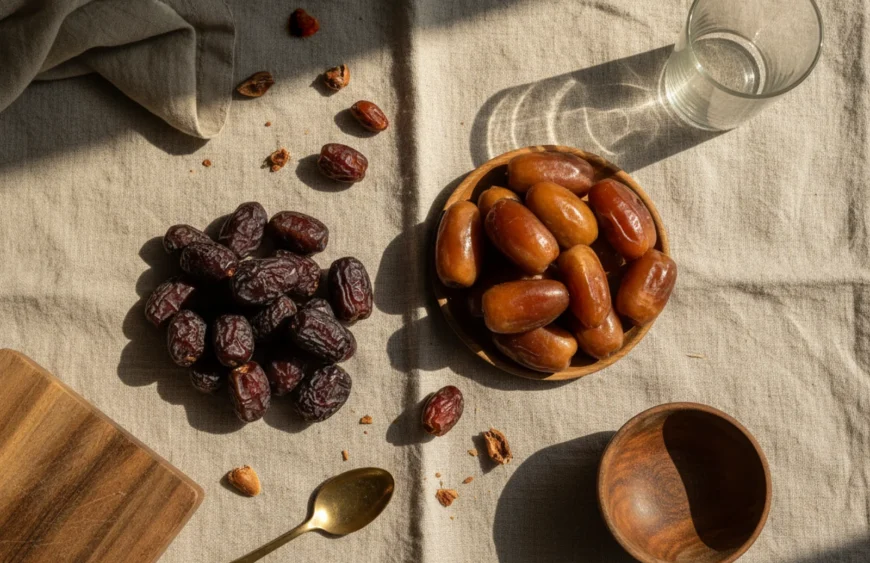
A useful Indian split sits inside this map. Kharek in Gujarati and kharak in Punjabi point to the dry-cured date (sun-dried for storage, harder bite). Khajoor points to the soft, fresh-stage date that most Indians eat in winter and Ramzan. The fruit is the same; the curing differs.
Quick reference: variety, origin, and what each name signals
| Indian shop name | English / variety | Typical origin | Texture |
|---|---|---|---|
| Medjool khajoor | Medjool | Jordan Valley, Jordan and Israel | Soft, large, caramel finish |
| Ajwa khajoor | Ajwa | Madinah, Saudi Arabia | Soft, small, raisin-like |
| Mazafati / Kimia khajoor | Mazafati (Kimia) | Bam, Iran | Wet, dark, fresh-stage |
| Safawi khajoor | Safawi | Madinah, Saudi Arabia | Semi-dry, mild sweetness |
| Kharek / kharak | Dried date (variety mixed) | Iran, Pakistan, India | Hard, sun-dried, long shelf life |
Variety changes moisture, sugar profile, and price. For a deeper look at the two most-asked varieties, see Medjool vs Ajwa dates.
Does the name change the nutrition?
No. Per 100 g of Medjool dates, USDA FoodData Central lists about 277 kcal, 75 g carbohydrates (66 g sugars), 7 g fibre, 1.8 g protein, 656 mg potassium, and 0.9 mg iron. These values describe khajoor sold under the same variety; a packet labelled in Hindi or English will not move the numbers.
The differences between varieties are real but modest. Drier varieties (Safawi, Kimia) tend to read a touch lower in moisture and a touch higher in sugar per 100 g by weight. Smaller fruits (Ajwa) carry less calorie load per piece, useful for portion-controlled snacking. For practical portions, see how many dates per day. A small randomised trial published in the Journal of Obstetrics and Gynaecology found late-pregnancy date consumption was linked to shorter labour and less need for induction; the fruit in that study was the same Phoenix dactylifera, regardless of language.
When the word khajoor shifts meaning slightly
Two everyday cases worth knowing:
- Khajoor as the tree. In some Indian dialects, khajoor names not just the fruit but the date palm itself. Bengali khejur gachh is the tree; khejur is the fruit; khejur gur is the palm jaggery tapped from the trunk.
- Wild date palm. India grows Phoenix sylvestris, the silver date palm, across north-Indian plains. Its fruit is small and rarely eaten; the tree is mainly tapped for neera (toddy) and palm jaggery. Locals sometimes call this desi khajoor. The retail dates sold in any grocery are Phoenix dactylifera.
Sourcing transparency
- Ingredient: Dates
- Origin (Medjool): Jordan Valley, Jordan / Israel
- Origin (Ajwa): Madinah region, Saudi Arabia
- Origin (Mazafati): Bam, Iran
- Note: Religious significance, Ajwa traditional in Prophetic narrations
Ammari Foods ships Medjool dates from the Jordan Valley harvest and Ajwa dates sourced from Madinah suppliers. For variety-by-variety detail with prices, religious context, and use cases, see the premium dates buying guide India.
Frequently Asked Questions
Is khajoor the same as dates?
Yes. Khajoor is the Hindi-Urdu name and dates is the English name for the same fruit, Phoenix dactylifera. There is no nutritional or botanical difference. The split is linguistic. Variety differences (Medjool, Ajwa, Mazafati, Kimia, Safawi) sit under both names.
What is the difference between khajoor and kharek?
Both come from the date palm. Khajoor in everyday Indian usage points to the soft, fresh-stage date eaten as a winter snack or in Ramzan iftar. Kharek (Gujarati) or kharak (Punjabi) refers to the dried, sun-cured date, harder and longer-keeping, often used in puja and traditional sweets. Same species, different curing.
Which khajoor is best for daily eating?
For most Indian adults, 2 to 3 Medjool dates per day or 5 to 7 Ajwa dates per day is the practical range, depending on size. Medjool gives the richest caramel taste; Ajwa is smaller and sits inside Islamic dietary tradition. Mazafati and Kimia are wetter and best as a fresh-stage snack. See how many dates per day for detail by group.
Does khajoor mean date palm or date fruit?
In modern Indian usage, khajoor almost always means the fruit. In some regional dialects (notably Bengali khejur gachh) the same root is used for the tree. The palm itself is Phoenix dactylifera; the fruit is the dried or fresh drupe sold in any grocery.
Are Ajwa dates more sacred than Medjool?
Within Islamic tradition, Ajwa carries specific religious significance, with narrations attributed to the Prophet Muhammad mentioning the variety by name. Medjool does not carry that scriptural mention; it is prized for size, softness, and taste. Both are halal; the religious distinction is specific to Ajwa within Islamic context. For more, see Medjool vs Ajwa dates.
Can diabetics eat khajoor?
In moderation, yes. Dates have a glycaemic index in the 42 to 55 range, which is low to medium. The Diabetes Care and Education Specialists guidance is to count 2 small dates as one carbohydrate exchange (~15 g carbohydrate). Whole-fruit dates with their natural fibre cause a smaller blood-glucose rise than sugar-sweetened sweets at the same calorie load. People with diabetes should consult their clinician for a personalised limit.
Why is khajoor recommended in pregnancy and Ramzan?
In Islamic and South Asian tradition, dates are the recommended food for breaking fast at Ramzan iftar because the quick natural sugars restore energy after a long fast. In pregnancy, a Journal of Obstetrics and Gynaecology trial linked late-pregnancy date consumption to shorter labour times and lower induction rates[2]. The fruit’s iron and folate content also supports red-blood-cell formation in the third trimester.