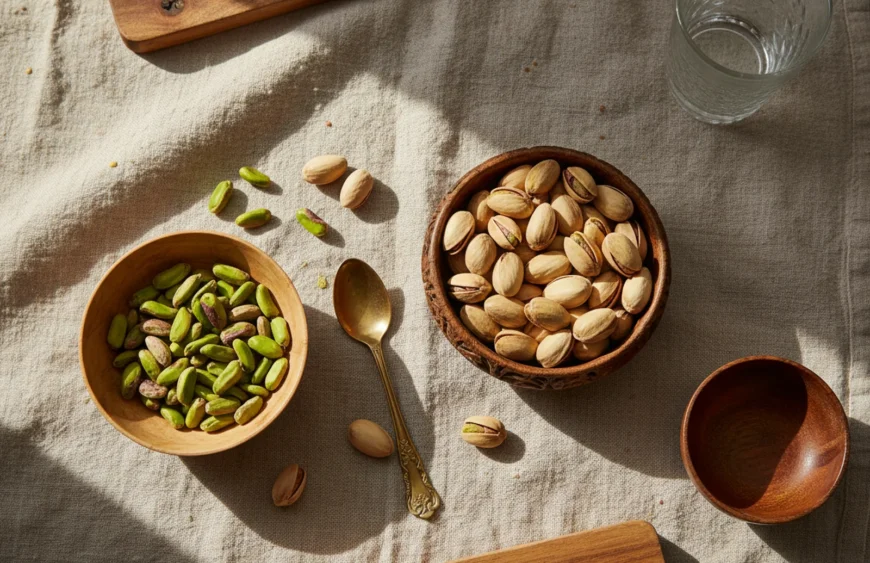
TL;DR
Pista vs pistachios is a translation, not a comparison. Both words name the seed of Pistacia vera, the pistachio tree native to the dry highlands of Iran and Central Asia. “Pista” enters Hindi-Urdu from Persian pista; “pistachio” enters English from Italian pistacchio, from Greek pistakion, ultimately from the same Persian root. Per USDA FoodData Central, a 100 g serving of raw pistachios supplies about 560 kcal, 20 g protein, 10 g fibre, and 1,025 mg potassium, values that apply to any pista regardless of label.
What changes between packets is the variety: Akbari (long, premium), Kerman (rounder, sweeter), Ahmad Aghaei (medium), and the Indian-grown Kashmiri pistachio. Ammari Foods ships Iranian pistachios from the Kerman belt, the variety most Indian households mean by asli pista. For variety-by-variety detail, see the Iranian pistachios buying guide India.
Are pista and pistachios the same thing?
Yes. They are the same kernel. The split is purely linguistic; the way kishmish and raisin describe one food.
The botanical name is Pistacia vera, a member of the cashew family. The tree is native to the dry, mountainous belt of Iran, Turkmenistan, and northern Afghanistan, and has been cultivated for at least 4,000 years. The edible part is the green seed inside a hard, partly opened shell. Commercial growers across Iran, the United States (California), Turkey, and Syria all grow the same species. There is no separate plant called pista; the word names the same fruit in Persian, Hindi, and Urdu.
A small note on usage: in Indian shops, pista often defaults to the unsalted, in-shell Iranian variety, while the larger, lighter American pistachios get an English label even on Hindi tags. This is shop convention, not a botanical split. For retail purposes, pista and pistachios are interchangeable.
Etymology and regional names across India
The word pista travelled into Indian languages from *Persian pista** (پسته), which itself comes from Middle Persian pistag. The Persian word may go back to an older Iranian root for the resin-bearing Pistacia* genus.
The English pistachio comes from Italian pistacchio, from Latin pistacium, from Greek pistakion, from the same Persian root. The chain runs Persian → Greek → Latin → Italian → English. Both pista and pistachio therefore trace to the same source word in old Iranian.
A short tour of the Indian map:
- Tamil: pistā paruppu (kernel)
- Telugu: pistā pappu
- Kannada: pistā beeja
- Malayalam: pistā
- Marathi / Gujarati / Punjabi: pista
- Bengali / Assamese: pesta or pista
In a Mumbai or Delhi shop, asking for pista gets you the in-shell Iranian Kerman variety by default. Asking for Akbari pista points to the longer, premium-priced variety; American pista points to the larger California Kerman variety.
Quick reference: variety, origin, and what each name signals
| Indian shop name | English / variety | Typical origin | Shape / size |
|---|---|---|---|
| Regular pista | Kerman | Kerman, Iran | Rounder, medium |
| Akbari pista / long pista | Akbari | Rafsanjan, Iran | Long, narrow, premium |
| Ahmad Aghaei pista | Ahmad Aghaei | Damghan, Iran | Pointed, medium |
| American pista | California Kerman | Central Valley, USA | Larger, lighter shell |
| Kashmiri pista | Kashmiri (small batch) | Kashmir valley | Small, deep-green kernel |
Variety changes shell-opening rate, kernel colour, and price. Akbari runs the highest price tier; California Kerman is the most volume-friendly. For a deeper variety walkthrough, see Akbari vs Kerman pistachios.
Does the name change the nutrition?
No. Per 100 g of raw pistachios, USDA FoodData Central lists about 560 kcal, 20 g protein, 45 g fat (24 g monounsaturated), 10 g fibre, 1,025 mg potassium, and 121 mg magnesium. A standard Indian portion is a mutthi of about 30 g, roughly 49 in-shell kernels.
The differences between varieties sit at the cosmetic level: Akbari has a deeper-green kernel and a longer shell, Kerman has a rounder kernel, and California pistachios open a touch more reliably on the tree. None of this changes the calorie or protein profile in a way that matters at typical portions. A randomised trial known as the pistachio principle study found that in-shell pistachios led to about 41 percent lower calorie intake versus shelled pistachios in the same snacking session, simply because the act of cracking slows eating. The fruit is the same; the format does the work. For portion guidance, see how many pistachios per day.
When the word pista shifts meaning slightly
Two everyday cases:
- Pista colour. In Indian fashion and paint shops, pista green names the soft yellow-green shade of the kernel itself. The word describes the colour, not the food.
- Pista flavour in mithai and ice cream. Pista kulfi, pista barfi, and pista cake use ground pistachio kernel, sometimes blended with cardamom and saffron. The flavour is from real Pistacia vera. In some lower-priced kulfis, the green tint is from food colour, not from the nut. Check the label.
In any grocery, packaged, or D2C setting, pista on the bag means Pistacia vera. The cases above are spoken or colour usage, not retail.
Sourcing transparency
- Ingredient: Pistachios
- Origin (Iranian): Kerman Province, Iran
- Harvest: Sep–Oct
- Varieties: Akbari, Kerman, Ahmad Aghaei
Ammari Foods ships Iranian pistachios from the Kerman belt, the variety most Indian households mean by asli pista. For variety-by-variety detail with prices and use cases, see the Iranian pistachios buying guide India and the Akbari vs Kerman pistachios explainer.
Frequently Asked Questions
Is pista the same as pistachio?
Yes. Pista is the Hindi-Urdu word and pistachio is the English word for the same kernel, Pistacia vera. There is no nutritional or botanical difference. The split is purely linguistic, the same way jeera and cumin describe one spice. Variety differences (Akbari, Kerman, Ahmad Aghaei) sit under both names.
Why is Iranian pista priced higher than American pista?
Iranian pistachios from Kerman and Rafsanjan carry a deeper-green kernel and a thinner, more open shell than American varieties. Akbari, the long Iranian variety, sits at the top tier. Sanctions, smaller harvest volume, and the traditional hand-grading process all push the price above American pistachios, which run on industrial scale in California.
Which pista is best for daily eating?
For most Indian adults, about 30 g of pistachios per day (roughly 49 in-shell kernels) is the practical range. Regular Iranian Kerman or American pistachios cover daily snacking at sensible cost. Akbari is best kept for gifting and festive use. In-shell formats slow eating and reduce calorie intake. See how many pistachios per day.
Does pista mean pistachio or pistachio kernel?
In modern Indian usage, pista names both the in-shell nut and the kernel. When a Hindi recipe calls for pista, it almost always means the shelled kernel ready to chop or grind. The word does not split between shell and kernel the way English sometimes does with pistachio vs pistachio meat.
Is Kashmiri pista the same as Iranian pista?
Both belong to Pistacia vera. Kashmiri pista is a small-batch Indian-grown variety, with a smaller kernel and a deeper-green colour, harvested in limited quantity. Iranian pista runs at much larger volume and sits at three or four mainstream varieties. Genuine Kashmiri pista is rare; most retail pista in India is Iranian or American.
Are salted and unsalted pista the same nut?
Yes. Same Pistacia vera, different post-harvest treatment. Salted pistachios are roasted with brine, often topped with extra salt; a 30 g portion of salted pistachios can carry 300 to 400 mg of sodium. Unsalted pistachios are roasted plain or sold raw. For daily snacking, unsalted is preferable, especially for anyone managing blood pressure.
Why is pista green inside?
The green colour comes from chlorophyll in the kernel, which the tree builds during ripening. Akbari and Iranian varieties hold a deeper green because they ripen on dry, high-altitude trees with slower chlorophyll loss. California pistachios tend toward a paler green or yellow-green for the same reason: faster ripening on irrigated land.