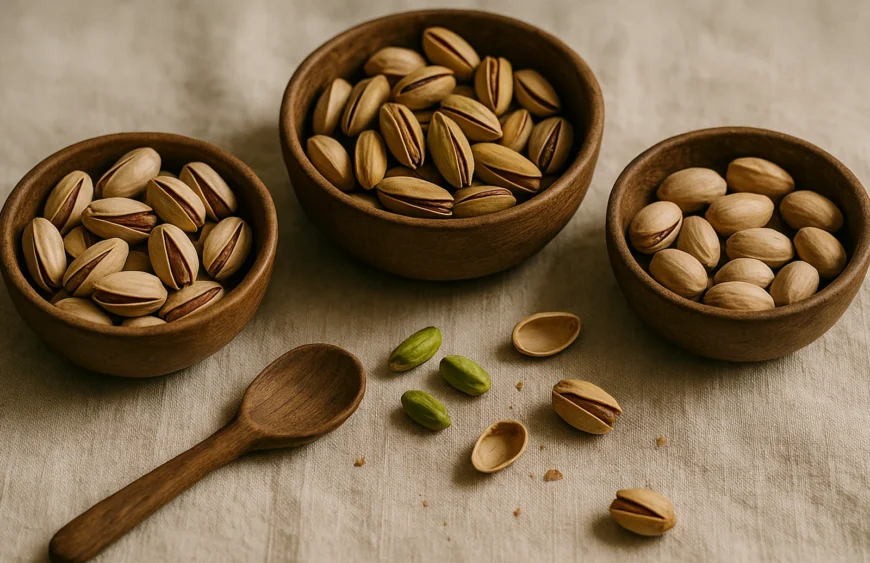
Iranian Pistachios India: Iranian Pistachios Buying Guide India: The Short Answer
Last updated: 19 May 2026
Iranian pistachios beat everything else for kernel size, colour, and flavour. Akbari is the gold standard.
- Akbari (₹2,800–4,200/kg) – long, pointed, deep-green kernel; premium gifting + festival variety.
- Ahmad Aghaei (₹2,400–3,500/kg) – slightly smaller than Akbari, similar flavour, broad appeal.
- Kerman (₹1,800–2,800/kg) – round-to-oval, everyday cooking and snacking.
- Fandoghi / Round (₹1,500–2,400/kg) – small round kernel, most affordable Iranian variety.
- Look for: naturally open shells (not mechanically split), green-tinted kernel, no white film, no rancid smell.
- Avoid: bleached pale shells, “pistachio mix” without origin, cheap “pista” that’s actually US (Kerman cultivar) at Iranian prices.
- Daily intake: 30 g (~49 kernels) is a reasonable daily handful – high in lutein, eye-healthy fats, and 6 g protein.
Pistachios (Pista) are the seeds of Pistacia vera, a small Mediterranean tree native to Western Asia, with Iran’s Kerman and Rafsanjan provinces producing the world’s most prized varieties. The pistachio is technically a drupe whose stony shell splits open naturally on the tree as the kernel ripens – a feature Iranian growers call the “smiling pistachio”. For Indian buyers, four Iranian cultivars dominate the premium market: Akbari, Ahmad Aghaei, Kerman and Fandoghi. This guide explains how those varieties differ, how to identify genuine Iranian pista, how much to eat, and how to use them across festival cooking, Ayurvedic snacking and Diwali gifting.
Pistachio varieties – Akbari, Kerman, Ahmad Aghaei, Round
Iranian pistachios buying guide india – here is what actually matters when you choose. Iran cultivates more than thirty registered pistachio varieties, but four travel far enough to reach Indian shelves. Each has a distinct shape, a distinct shell-split rate and a distinct price band, which is why understanding the cultivar matters before you buy.
Akbari is the long, almond-shaped pistachio considered the top of the Iranian pyramid. The kernels are visibly elongated, deep green at the heart with a violet edge, and the shells split cleanly with a pronounced smile. Akbari commands the highest price per kilo and is what most Indian connoisseurs mean when they say “premium Iranian pista”.
Ahmad Aghaei is even longer than Akbari but slimmer and a touch lighter in shell colour. Growers describe it as the second-tier premium variety; flavour is mild, kernel colour is bright green, and it is often selected for high-end gift packs because it photographs beautifully.
Kerman, despite its name appearing on California labels, originated as an Iranian round-shaped cultivar. The kernels are smaller and more spherical, the shell split is less aggressive, and the price sits in the middle of the range – an excellent everyday pista.
Fandoghi (also spelled Fandoughi) is the round, smaller, value-tier pistachio that supplies most Iranian export volume. It is a workhorse rather than a showpiece – perfect for kheer garnish, ice cream and baking, where shape matters less than freshness.
| Variety | Shape | Length | Tier | Best uses |
|---|---|---|---|---|
| Akbari | Long, pointed, almond-like | Largest | Premium | Gifting, snacking, hero garnish |
| Ahmad Aghaei | Very long, slim | Long | Premium (second-tier) | Gift packs, baklava, mithai |
| Kerman | Oval, slightly round | Medium | Mid-tier | Daily snacking, biryani garnish |
| Fandoghi | Round, smaller | Smallest | Value | Kheer, kulfi, baking, paste |
Iran’s pistachio empire – Kerman & Rafsanjan
Iran has been the heart of the pistachio world for more than three thousand years. The wild ancestor of Pistacia vera grows across the dry highlands of Khorasan and into the Kerman plateau, and the city of Rafsanjan in Kerman province is still informally called the pistachio capital of the world. Hot summers, cold winters, alkaline soil and the deep groundwater that feeds traditional qanat channels give Iranian pistachios their deep-green kernel and concentrated flavour.
Iranian growers still rely on flood irrigation and open-air sun-drying – slower than the mechanised pipelines of California, but kinder to the kernel. Trees grow in low, gnarled rows for miles across Kerman; many orchards are family-owned and have been worked by the same households for generations.
Between 2018 and 2024, California became neck-and-neck with Iran in tonnage, helped by drought-tolerant rootstocks and aggressive replanting. Volume parity, however, has not translated into flavour parity in Indian premium retail. Buyers in Mumbai, Delhi, Jaipur and Hyderabad continue to pay a clear premium for Iranian-origin pista because the green kernel reads better in mithai and baklava, and because Iranian Akbari has no Californian equivalent in shape or size.
How to spot real Iranian pistachios
Five visual checks separate authentic Iranian pista from re-packed or adulterated product, and you can do all of them at home before you cook.
Natural smile. Genuine Iranian pistachios split on the tree, so the open mouth is irregular, slightly off-centre, and the shell edges are uneven. Mechanically split nuts show a perfectly straight crack and often a chip mark on one lip.
Shell colour. The shell should be cream to warm buff, sometimes with a faint pink blush at the seam. A uniformly chalk-white shell is a red flag – it usually means the lot has been bleached to mask age or surface mould.
Kernel colour. Crack one open. A fresh Iranian kernel is a deep, slightly waxy green from edge to centre – that green is chlorophyll and lutein, and it fades with age. Pale yellow-green kernels indicate an older crop.
No salt crystals on raw. Raw pistachios should look matte, not glittery. Visible white crystals on a “raw” label means the lot has been salted to extend shelf life and you are likely paying premium for stale stock.
Clean snap. A fresh shell snaps crisply between thumb and forefinger and the kernel slips out whole. Soft, leathery shells point to humidity damage in transit.
The three common scams in the Indian market are Chinese pistachios re-packed as Iranian (rounder, paler kernel), bleached old-crop sold as new arrival, and over-salted lots designed to mask staleness. Buy from sellers who name the variety and the crop year on the label.
Roasted-salted vs raw – when to choose what
The roast-versus-raw decision should follow the recipe, not the price. Raw cooking-grade kernels are non-negotiable for anything where pistachio is the hero ingredient: pista kheer, pista kulfi, baklava syrup-soaked layers, sheer khurma during Eid, and the bright-green dust scattered across a finished biryani. Salt and roasting both kill the delicate floral note and dull the kernel colour, which is exactly what you do not want when the dish depends on that emerald shimmer.
Roasted-salted pistachios belong on the snacking table, alongside drinks at a Diwali card party, in a trail mix, or crushed into a savoury crust for paneer and chicken. Choose lightly salted lots so the salt punctuates rather than drowns the nut.
For cooking, our Iranian pistachios are the everyday workhorse – long Akbari kernels, no salt, no oil, ready to be slivered, ground or scattered. For snacking and gifting, the roasted pistachios are dry-roasted and lightly salted to keep the kernel green rather than browning it. A good kitchen keeps both jars open at once: one for the cook, one for the table.
How to use pistachios – Indian recipes & gifting
Pistachios sit at the centre of Indian festive cooking, and a small handful of well-chosen recipes will carry you through most of the calendar.
Pista kheer. Reduce full-fat milk by a third, add soaked-and-peeled raw pistachios blended to a coarse paste, sweeten lightly, finish with cardamom and a slick of saffron-infused milk. The dish is built on kernel colour, so use young-crop Akbari or Ahmad Aghaei.
Pista kulfi. A no-cook version uses condensed milk, fresh cream, ground pistachios and a pinch of green cardamom; freeze in matka moulds. The texture depends on coarsely ground kernels rather than smooth paste.
Sheer khurma. The signature Eid breakfast – vermicelli, milk, dates, slivered pistachios and almonds – needs raw kernels, slivered at the last minute so they keep their snap and colour.
Biryani garnish. A Hyderabadi or Lucknowi dum biryani is finished with fried onions, mint and a scatter of slivered raw pistachios; the green note cuts the richness of the gosht.
Baklava. Turkish and Lebanese baklava in India almost always uses Iranian pistachios; the long Akbari kernel chops cleanly into the layered filling and holds its colour through the syrup.
Pistachio barfi. Khoya, sugar, cardamom and ground pistachio set into squares – a Diwali staple that travels well in corporate gift hampers.
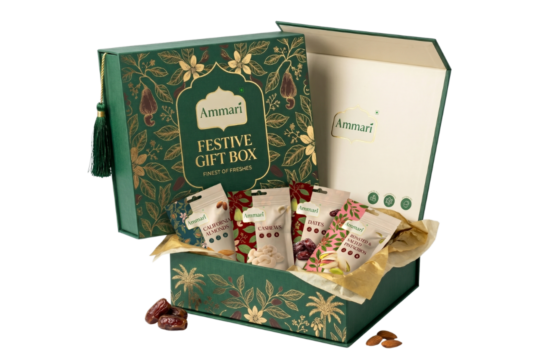
For Diwali corporate gifting, pistachios sit at the top of every premium hamper because the long Akbari shape photographs beautifully and stays fresh for the full festive window. Build a hamper around Iranian pistachios alongside California almonds and premium cashews for variety, colour and intent in a single open of the lid.
Pistachio nutrition
A 30g serving of pistachio kernels – roughly forty-nine nuts, the standard nutrition reference – delivers about 165 kcal, 6g of plant protein, 13g of mostly mono- and polyunsaturated fats, and 3g of fibre. Pistachios are unusually rich in vitamin B6 (important for protein metabolism), copper, manganese and potassium for a tree nut. They also carry meaningful levels of lutein and zeaxanthin – the same carotenoid antioxidants found in green leafy vegetables – which is why the kernel is green in the first place. Ayurveda places pistachio in the warming, vata-pacifying group, traditionally recommended in winter and in convalescence.
Common mistakes when buying pistachios
- Bleached-white shells. Cream and buff are the natural colours; chalk-white means the lot has been chemically bleached to mask age.
- Salt overload masking staleness. Heavy salt and oily film on roasted lots usually hide a kernel that is past its prime.
- No origin or variety on the label. A premium pistachio is sold by cultivar (Akbari, Ahmad Aghaei, Kerman, Fandoghi) and origin; a generic “imported pista” tag is a warning sign.
- “Indian pistachio” misnomer. India barely cultivates Pistacia vera at commercial scale; almost all pistachio sold in India is imported from Iran, the United States or Turkey.
- Buying out-of-season. Iranian harvest runs September to October; the freshest, greenest kernels reach Indian shelves between November and February.
References & further reading
For independent reference points, the USDA FoodData Central – nutrient database is the standardised dataset we cross-check composition against. Clinical work like the PubMed – pistachios and metabolic health helps separate marketing claims from evidence.
Frequently Asked Questions
What are the best pistachios in India?
The best pistachios available in India are Iranian Akbari and Ahmad Aghaei – long, pointed kernels with a deep green centre and a natural open-mouth split. Akbari sits at the top of the price ladder and is what most Indian buyers describe as “premium Iranian pista”. For everyday cooking and snacking, Iranian Kerman or Fandoghi varieties offer the same flavour profile in a smaller, rounder kernel at a more accessible price. Look for sellers who name both the cultivar and the crop year on the label.
Akbari vs Kerman – what’s the difference?
Akbari and Kerman are both Iranian, but they belong to different style families. Akbari is long, pointed and almond-shaped, with the largest kernel of the four major varieties; it is the gifting and hero-garnish pista. Kerman is rounder, smaller and slightly more uniform, originally bred in Iran’s Kerman province and later widely planted in California. Akbari delivers visual impact and commands a higher price; Kerman delivers consistency and value, which is why it dominates everyday snacking.
How can I tell if pistachios are fresh?
Fresh pistachios have a cream to buff shell, a natural irregular split, a deep green kernel, a brittle shell that snaps cleanly between thumb and forefinger, and a clean, slightly sweet aroma. Stale or old-crop pistachios show pale yellow-green kernels, leathery shells that bend instead of snapping, a flat or oily smell, and often a chemical-white shell from bleaching. If the kernel slips out whole and the inside is emerald rather than mustard, the lot is fresh.
How many pistachios should I eat per day?
A 30g serving – roughly forty-nine kernels, or a small adult fistful – is the widely cited daily reference for healthy adults. That delivers about 165 kcal, 6g of protein, 13g of mostly unsaturated fat and 3g of fibre, alongside meaningful vitamin B6, copper and lutein. Children, older adults and those managing sodium intake should choose raw or lightly salted lots. Ayurveda traditionally recommends pistachio in cooler months and during recovery, when the warming, vata-pacifying property is most useful.
Why are Iranian pistachios so expensive?
Iranian pistachios carry a premium because of cultivar, climate and process rather than marketing. Akbari and Ahmad Aghaei are slow-growing, large-kernel cultivars that yield less per tree than rounder varieties. Iranian orchards still rely on traditional flood irrigation and open-air sun-drying, which is gentler on the kernel but lower in volume than mechanised drying. Add export logistics, currency volatility and the fact that the deep-green Iranian kernel has no Californian equivalent in shape or colour, and the price gap follows.
Looking for more? premium dry fruit collection at Ammari Foods – almonds, pistachios, dates, walnuts and curated gift boxes.