Soaked Vs Raw Almonds: The Short Answer
Last updated: 20 May 2026
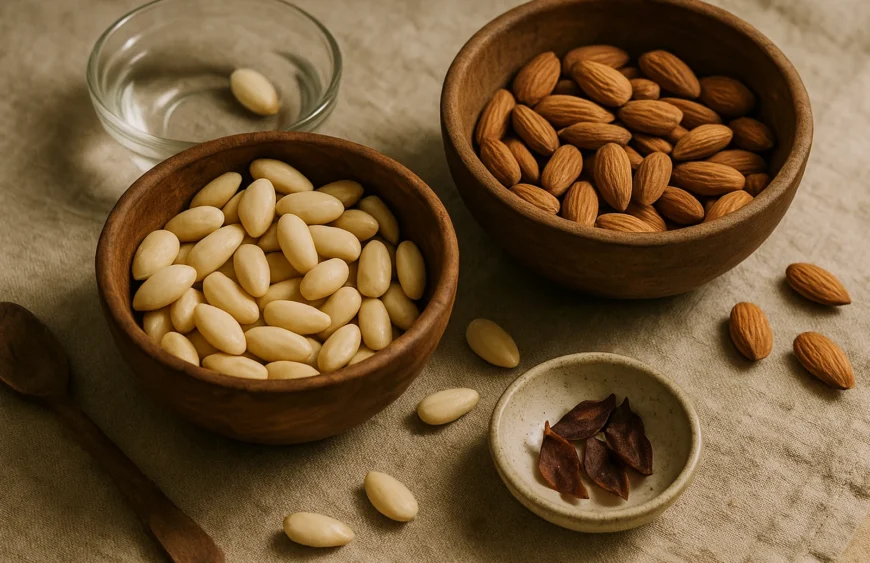
Soaked almonds are softer, easier to digest, and traditionally preferred in Indian households. Raw almonds retain marginally more vitamin E. Roasted lose a small amount through heat. Pick by who is eating them and what you cook with them.
- Soaked (8 hours overnight, peeled): softest, most digestible, 30% less phytic acid, traditional Ayurvedic standard. Best for children, elderly, sensitive digestion.
- Raw (whole, unpeeled): highest vitamin E retention, fully fibre intact, harder chew. Best for healthy adults, snacking, travel.
- Roasted (unsalted): mid-tier in nutrition (~10–15% vitamin E loss from heat), shelf-stable, easy to chew. Best for snacking and recipes that benefit from a toasted note.
- Salt-roasted: add ~250 mg sodium per 28 g – meaningful for blood-pressure management. Pick unsalted versions for daily consumption.
- Daily portion: 20–23 almonds at 28 g – see our how many almonds per day guide for age-specific portions.
For variety-specific notes (California vs Mamra vs Gurbandi soaking behaviour), see our complete almonds buying guide.
What soaking actually does to almonds
Soaked vs raw almonds – here is what actually matters when you choose. The Indian household practice of overnight-soaking almonds is grounded in three concrete chemical changes:
- Phytic acid drops by approximately 30 percent. Phytic acid binds zinc, iron, and calcium in the gut, reducing how much your body absorbs from the meal. After 8 hours in plain water, much of the phytic acid leaches out. The minerals from the almond and from foods you eat alongside (milk, paneer, spinach) are absorbed more cleanly.
- Tannins soften. The dark brown skin contains tannins that can be hard on sensitive digestion. After soaking, the peel slips off easily and the kernel is gentler on the gut. People with mild GI sensitivity, IBS, or who simply find raw almonds heavy notice the difference within days of switching.
- Texture and flavour change. Hydration makes the kernel creamier, softer, and slightly sweeter. The chew effort drops by roughly half, useful for children, elderly with dental concerns, and anyone with reflux issues.
The Ayurvedic standard adds one more step: peel the skins after soaking. This isn’t strictly necessary nutritionally, but it does eliminate the tannin layer entirely and makes the kernel even gentler.
Soaked vs raw vs roasted – head-to-head comparison
The three forms differ in five practical ways:
- Texture: Soaked is creamy/soft. Raw is firm/crunchy. Roasted is crisp/snappy. Roasted-and-salted is identical to roasted but with salt-induced surface dryness.
- Digestibility: Soaked > Roasted > Raw. Soaking is the easiest on sensitive digestion; raw requires the most chewing and digestive effort.
- Phytic acid load: Soaked has ~30% less than raw. Roasted reduces phytic acid only slightly (~5–10%) – heat alone doesn’t break it down efficiently.
- Vitamin E retention: Raw retains the most (~7.3 mg per 28 g). Soaking has minimal vitamin E impact (water doesn’t degrade fat-soluble vitamins much). Roasting strips 10–15% of vitamin E through heat exposure.
- Shelf life and convenience: Roasted lasts longest (4–6 months at room temperature). Raw is similar (3–5 months). Soaked-and-peeled almonds keep just 2 days in the fridge – you have to do them daily.
For most healthy Indian adults, soaked is the best daily-habit choice; roasted unsalted is the best travel/snack choice; raw is fine for any healthy adult who prefers the crunch.
Who should pick which
The right form depends on who is eating them:
- Children 3 to 12 – soaked, peeled. Always. Whole raw almonds are not recommended below age 3 (choking hazard). Even older children digest soaked-and-peeled more comfortably.
- Pregnant women – soaked, peeled. The reduced phytic acid means iron and zinc absorption from accompanying foods (dal, leafy greens) is better, which matters during pregnancy when iron stores deplete.
- Healthy adults under 60 – raw or roasted unsalted, daily preference. Either works. Many Indians keep both: 8–10 soaked in the morning, 12–15 raw or roasted as an afternoon snack.
- Adults 60+ – soaked, peeled. Chewing capacity decreases with age; almond meal stirred into porridge or daliya is a softer alternative.
- People with digestive sensitivity or IBS – soaked. The lower phytic acid + softer skin reduces bloating and gas in roughly two-thirds of sensitive individuals.
- People with kidney stones (oxalate-prone) – soaked, peeled, at reduced portion. Soaking doesn’t reduce oxalate content meaningfully. Cap intake at 5 almonds daily regardless of preparation.
- Athletes and active adults – any form. Roasted is convenient pre-workout; soaked is gentler post-workout for digestion.
How to soak almonds correctly
The standard Indian household method, as documented across regional cookbooks:
- Take 23 raw almonds (the daily serving). Pick whole, undamaged kernels – broken or shrivelled almonds will absorb water unevenly.
- Cover with plain water by 2 cm. Use clean, room-temperature water – not warm or hot, which cooks the surface.
- Cover the bowl with a saucer or muslin cloth. Leave at room temperature 8 hours minimum (overnight is the simplest pattern).
- Drain in the morning. The water turns slightly tan from the leached tannins – that’s normal. Discard it.
- Pinch each almond gently. The skin slips off cleanly under thumb pressure. The kernel will be lighter, plumper, and creamy white.
- Eat fresh or store the peeled kernels in a covered bowl with a little water in the fridge. They keep 2 days maximum before the texture starts to break down.
Some Indian households soak in lukewarm water (not hot) to speed up the skin slipping process – the difference is marginal but takes the soaking time down to 6 hours instead of 8.
What soaking does NOT change
A few claims commonly attached to soaked almonds that don’t hold up:
- Soaking does not increase vitamin content. Water doesn’t add nutrients. The total vitamin E, magnesium, and protein in a soaked almond is essentially identical to a raw one.
- Soaking does not reduce calories. A soaked almond contains the same ~7 calories as a raw one. The “lighter” feeling is from texture, not energy density.
- Soaking does not eliminate oxalates. People prone to kidney stones still need to limit intake; soaking changes phytic acid but not oxalate content.
- Soaking does not detoxify. The “removes toxins” framing in some marketing is overstated. Phytic acid isn’t a toxin – it’s just a nutrient-binding compound that can be useful or limiting depending on context.
The honest case for soaking: digestibility, mineral absorption, and texture. Those alone justify the practice.
Sourcing transparency
- Ingredient: Almonds
- Origin (California): Central Valley, USA
- Varieties best for soaking: California (peels easiest), Sonora
- Origin (Mamra): Aleppo Province, Iran and parts of eastern Afghanistan
- Mamra soaking: higher oil content means soaked Mamra retains more richness; popular for festival cooking
- Origin (Gurbandi): Indian Kashmir
- Gurbandi soaking: denser kernel takes 10 hours rather than 8; dark skin slips off cleanly
Related reading
References & further reading
For independent reference points, the USDA FoodData Central – nutrient database is the standardised dataset we cross-check composition against. Clinical work like the PubMed – almonds and cardiovascular risk review helps separate marketing claims from evidence.
Frequently Asked Questions
How long should I soak almonds?
Eight hours is the standard for Indian households – typically overnight. Six hours in lukewarm water also works. Beyond 12 hours the kernel can start to ferment slightly, especially in summer heat. If you forget overnight, a quick 4-hour soak still softens the skin enough to peel, just with marginally less phytic acid reduction.
Are soaked almonds better than raw?
For most Indian households, yes – easier on digestion, better mineral absorption, more pleasant texture for children and elderly. Raw almonds retain marginally more vitamin E and convenience (no prep), so for healthy adults who don’t have digestive sensitivity, raw is perfectly fine. Many people keep both forms for different times of day.
Should I peel soaked almonds?
The traditional Ayurvedic standard is yes – peel the skins after soaking. The peel contains tannins that can irritate sensitive digestion. For healthy adults without digestive issues, eating soaked almonds skin-on is fine and retains slightly more fibre. Children and elderly should always have skins removed.
Can I soak roasted almonds?
You can, but the result is texturally odd – roasted almonds soften unevenly and lose their characteristic crispness without gaining the creamy-soaked texture of raw soaked almonds. Soak raw almonds for the soaked-almond habit; eat roasted almonds dry. They serve different purposes.
Do soaked almonds have fewer calories?
No. The calorie content of an almond doesn’t change with soaking – it stays around 7 calories per kernel regardless of preparation. The “lighter” feeling some people describe is from texture and easier digestion, not lower energy density.
How long do soaked almonds last in the fridge?
Two days maximum, in a covered bowl with a little water. After that, the texture starts to break down and a slight fermentation flavour develops. The Ayurvedic recommendation is to soak each day’s portion fresh – 23 almonds at night, eaten in the morning.
Can diabetics eat soaked almonds?
Yes. Almonds – soaked or otherwise – have a low glycemic load and modestly improve post-meal blood sugar response. Soaked almonds are particularly easy on digestion for older diabetics. The standard 20–23 daily limit applies; pair with paneer, yogurt, or another protein source for steadiest glucose control.
Is it true that soaked almonds make hair shiny?
The mechanism is plausible – vitamin E and biotin support hair quality, and soaked almonds are slightly more bioavailable than raw. The effect is modest, however, and slow to appear. Daily almonds (any form) plus a balanced diet matters more than the specific preparation. Direct topical almond oil has a more visible immediate effect on hair than eating them.