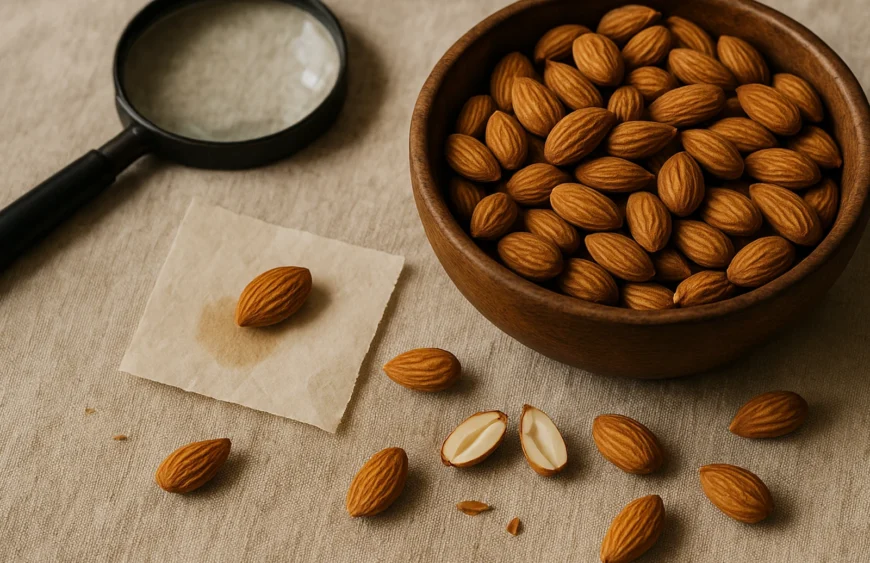
How To Identify Real Mamra Almonds: The Short Answer
Last updated: 20 May 2026
Real Mamra almonds come from Iran (Aleppo Province) and Afghanistan, retail at ₹2,500–4,500/kg, and pass seven physical tests that California cannot fake.
- Size & shape: small, plump, rounded – never long-and-flat like California
- Colour: deep amber-beige with natural tonal variation between kernels (not uniform pale)
- Oil bleed: crack a kernel – real Mamra leaves a faint oil mark on tissue; California stays mostly dry
- Husk attachment: real Mamra often has small skin fragments still clinging where it joined the shell
- Aroma test: distinct nutty perfume when freshly cracked; California is comparatively neutral
- Snap and chew: softer break with more give; California snaps cleaner
- Price honesty: real Mamra rarely retails below ₹2,500/kg from any honest seller
For variety-specific guidance and full pricing context, see our complete almonds buying guide and Mamra almonds benefits.
Why fake Mamra is everywhere in India
How to identify real mamra almonds – here is what actually matters when you choose. Mamra commands ₹2,800 to ₹4,500 per kilogram – three to four times the price of California at ₹800 to ₹1,100. That price gap creates massive incentive for sellers to relabel California (or the cheaper Sonora variety) as Mamra. The visual difference is real but subtle, so most untrained shoppers can’t tell them apart in a packed retail bin. The result: a large fraction of “Mamra” packs sold in Indian general stores, even at ₹1,500 to ₹2,000/kg, are actually mislabelled California .
Real Mamra is supply-constrained. Iranian and Afghan growers produce roughly half the per-hectare yield of California orchards, the harvest window is narrower, and sanctions plus transit logistics limit how much reaches India through formal channels. That scarcity is the basis for the price – and any “Mamra” pack that bypasses that scarcity by selling cheap is, by definition, not real Mamra.
The 7 tests, in order of reliability
Run these tests on any pack you’re considering. Real Mamra passes all seven; California masquerading as Mamra fails at least three.
Once you’ve verified authenticity, the next question is almond portion size – Mamra is denser in oil, so the same 20-23 daily count still applies, just chew slowly.
Test 1 – Size and shape (visual)
Pick up an almond and look at its silhouette:
- Real Mamra: small to medium length, plump, rounded shape – looks like a chubby teardrop or oval. Length typically 18 to 22 mm.
- California : long, flat, uniform – looks like a slender pointed teardrop. Length typically 22 to 28 mm.
If a “Mamra” pack contains long, flat almonds, it’s not Mamra. The shape difference is genetic and cannot be faked.
Test 2 – Colour variation (visual)
Lay 10 kernels on a white plate and look at colour distribution:
- Real Mamra: noticeable tonal variation between kernels – some lighter amber, some darker brown, some near-honey. The natural mineral-rich Iranian/Afghan soil produces this colour spread.
- California : uniformly pale beige across all kernels. Industrial irrigation and processing equalises colour.
Uniformly pale “Mamra” = not Mamra. Real Mamra has visible colour heterogeneity.
Test 3 – Oil bleed test (tactile)
Take a clean white tissue or paper. Crack a kernel in half between your thumbnails. Press the cracked surface against the tissue.
- Real Mamra: leaves a faint oil mark on the tissue within 30 seconds – the 55-60% oil content shows.
- California : tissue stays mostly dry; 49-52% oil content doesn’t bleed.
This is the single most reliable test if you have a tissue handy. Genuine Mamra cannot avoid the oil signature.
Test 4 – Husk attachment (tactile)
Examine the kernel where it would have attached to the shell during harvest:
- Real Mamra: small skin or husk fragments often still cling to the kernel – Iranian processing is gentler and less mechanised than California’s industrial dehulling.
- California : clean, smooth surface with no husk residue – heavy mechanical processing strips everything.
Excessive cleanliness on a “Mamra” kernel is suspicious. Some skin imperfection is a sign of authenticity.
Test 5 – Aroma (sensory)
Crack 3 to 4 kernels open and smell them immediately:
- Real Mamra: distinct nutty perfume with a faint woody-floral undertone – the high oil content carries the aromatic compounds prominently.
- California : mild and clean nutty smell – present but understated.
If the cracked kernels smell neutral, the pack is most likely California. Real Mamra has a perceptible aroma you can identify from arm’s length.
Test 6 – Snap and chew (tactile)
Bite into a kernel and pay attention to how it breaks:
- Real Mamra: softer break with slight give due to higher oil content; the chew is creamier and the aftertaste lingers buttery.
- California : crisp, clean snap; the chew is firmer and the flavour is short.
The chew test is more subjective than the others but matches the other six findings consistently.
Test 7 – Price honesty (the simplest filter)
Before any physical test, look at the per-kilogram price:
- Real Mamra (verified Iran/Afghanistan origin): ₹2,500 to ₹4,500 per kilogram, retail
- “Premium Mamra” pack at ₹1,500/kg: almost certainly California
- “Mamra” pack at ₹950/kg: definitely California or Sonora
Real Mamra cannot retail profitably below ₹2,500/kg given supply chain costs. Any seller offering it cheaper is either selling fake or selling old/rancid stock – both worth avoiding.
What to ask the seller
Beyond the seven tests, four direct questions separate honest Mamra suppliers from grey-market relabelers:
- “Where exactly does this Mamra come from?” – honest answer: Aleppo (Iran), Kunduz/Samangan/Baghlan (Afghanistan), or Khorasan (Iran). Vague answer like “imported” = not real Mamra.
- “What harvest year is this batch?” – Mamra harvest is September-October. The seller should know the year (2024, 2025, etc.). “We don’t track that” = stale stock.
- “Can I see a sample first?” – verified suppliers will let you taste 2-3 kernels before commitment. Sellers who refuse are hiding something.
- “What’s your return policy on freshness?” – premium suppliers stand behind quality. No-return policies are a warning.
Sourcing transparency
- Variety: Mamra (small-batch, hand-cracked tradition)
- Primary origin: Aleppo Province, Iran
- Secondary origin: Eastern Afghanistan (Kunduz, Samangan, Baghlan)
- Tertiary pocket: Khorasan, northeastern Iran
- Harvest: September through October
- Oil content: 55 to 60 percent (verified per batch)
- Verified retail price band: ₹2,500 to ₹4,500 per kilogram
References & further reading
For independent reference points, the USDA FoodData Central – nutrient database is the standardised dataset we cross-check composition against. Clinical work like the PubMed – almonds and cardiovascular risk review helps separate marketing claims from evidence.
Frequently Asked Questions
How can I tell real Mamra from fake almonds in a sealed pack?
Without breaking the seal, two tests work: visual inspection through any window (looking for shape and tonal variation) and price-per-kg honesty. If the pack costs less than ₹2,500/kg, it’s almost certainly not real Mamra regardless of label. After opening, run the seven tests in this guide – particularly the oil bleed and aroma tests, which are unfakeable.
Are all Iranian almonds Mamra?
No. Iran exports several almond cultivars including Mamra, Sangak, and Rabbi, at different price points. “Iranian almonds” without specifying Mamra usually means a mixed-origin midrange pack. True Mamra is one specific variety from Aleppo Province, with the small-rounded shape and high oil content described in this guide.
Why do real Mamra almonds cost so much more?
Three reasons: lower yield per hectare (Iranian/Afghan trees produce roughly half what California orchards do), narrower harvest window, and constrained supply chain from rural origin to India. The 3-4× premium over California is genuine and reflects production economics, not just brand positioning.
Can I trust a Mamra pack if it has FSSAI certification?
FSSAI certification confirms the pack is food-safe and accurately labelled at the packaging level – but doesn’t verify whether the contents are actually Mamra versus relabelled California. FSSAI is a baseline; you still need the seven physical tests to confirm variety. When evaluating how to identify real mamra almonds, the key is verification not branding.
Is there a chemical test for Mamra authenticity?
Not commonly available to consumers. Laboratory analysis can confirm oil percentage (Mamra > 55%, California < 52%) and run isotopic origin tracing, but these aren’t accessible at home. The seven physical tests in this guide are the practical alternatives.
Are Mamra almonds always organic?
Not by default. Mamra refers to the variety, not the cultivation method. Some Iranian Mamra is grown organically by tradition (small-batch, low chemical input) but it’s not certified organic unless explicitly labelled. If organic certification matters to you, look for a separate organic mark on the pack alongside the variety label.
What’s the difference between Mamra and Mamra Giri?
Mamra Giri is sometimes used as a marketing term for shelled Mamra kernels (Giri = kernel in Hindi/Urdu). They are the same variety. Some sellers use “Mamra Giri” specifically for the shelled-and-cleaned grade ready for direct eating; others use it generically alongside in-shell Mamra. Variety-wise, no difference.
Is “Iranian Mamra” different from “Afghan Mamra”?
Both are real Mamra variety, with subtle differences. Iranian Mamra (especially Aleppo Province) tends to have slightly higher oil content and a cleaner aromatic profile. Afghan Mamra (Kunduz, Samangan) has a slightly more rustic flavour with stone-fruit notes from the mineral-rich soil. Both pass all seven authenticity tests; the choice between them is preference, not authenticity.