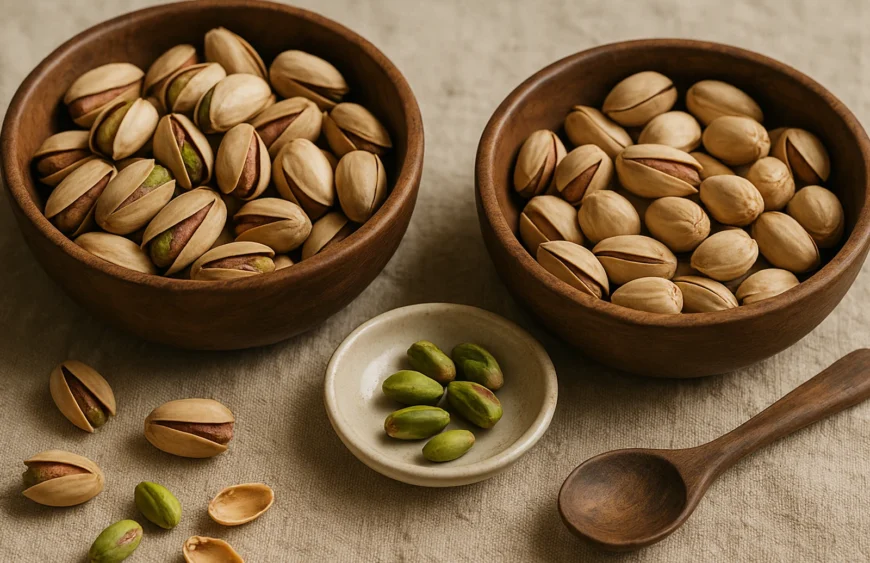
Akbari Vs Kerman Pistachios: The Short Answer
Last updated: 19 May 2026
Akbari and Kerman are the two most asked-about Iranian pistachio varieties in India – they are different in shape, flavour intensity, oil content, and price.
- Akbari (₹2,800–4,200/kg) – long, pointed, slim kernels with the deepest green colour and most aromatic flavour. The premium gifting and festival variety. ~30 to 35 kernels per 30 g.
- Kerman (₹1,800–2,800/kg) – round-to-oval, smaller, milder flavour, more uniform daily-use variety. ~45 to 49 kernels per 30 g.
- Common ground: both are from Iran (Kerman/Rafsanjan provinces), both have naturally-open shells, both are excellent in Indian cooking and for daily snacking.
- Pick Akbari if: you want maximum flavour, premium gifting, festival use, the deepest green colour, the longest visual impact.
- Pick Kerman if: you want everyday snacking value, larger quantity per rupee, milder flavour for cooking that should not dominate.
- Many households keep both – Akbari for gifting and ceremonial use, Kerman for daily eating.
For the full pistachio variety landscape, see our Iranian pistachios buying guide.
Origin and tradition – both come from Iran
Both Akbari and Kerman are grown in the same region: Iran’s Kerman province, particularly around the city of Rafsanjan, with smaller production in Khorasan. The two varieties have shared a single growing region for centuries. They are different cultivars (clonal varieties) of the same species, Pistacia vera, planted in the same orchards but distinguished by tree characteristics, kernel shape, and harvest timing.
Akbari is named after the kernel’s prized appearance – the longest and pointiest of the Iranian commercial varieties. Akbari trees yield less per hectare than other cultivars, and the harvest window is narrower (a 3–4 week peak in late September). The combination of constrained yield + premium quality drives the higher price.
Kerman (named after the province itself) is the most cultivated cultivar in Iran by total tonnage. It produces a more uniform, rounder kernel, with higher yield per tree and a longer harvest window (~6 weeks from late August through early October). The economics favour Kerman as the everyday Iranian pistachio.
Akbari vs kerman pistachios – here is what actually matters when you choose. Both varieties trace back to wild pistachio populations in Iran from at least 6,000 years ago – the species is one of the oldest cultivated nuts in human history.
Visual and sensory comparison
Set the two side by side and the differences are clear:
- Size: Akbari is significantly longer (about 22–25 mm per kernel) versus Kerman (about 16–18 mm). Akbari weighs ~0.95 g per kernel; Kerman ~0.65 g.
- Shape: Akbari is long, pointed, almond-shaped – the silhouette is distinctly elongated. Kerman is rounder, fatter, more oval.
- Shell colour: Both have natural open mouths from in-tree splitting, but Akbari shells tend to be slightly paler tan; Kerman shells are slightly darker.
- Kernel colour: Akbari has the deepest green inside – a rich emerald hue that’s the variety’s claim to premium status. Kerman is also green but slightly paler with a warmer yellow-green undertone.
- Aroma: Akbari carries a clear nutty perfume with floral notes when freshly cracked. Kerman is milder and more neutral.
- Texture: Akbari has a richer, oilier mouthfeel due to higher oil content (52–55% vs 45–48% for Kerman). The chew is creamier.
Flavour profile and use cases
The flavour difference drives most of the choice between the two:
- Akbari flavour is intensely nutty with a long aftertaste – buttery, slightly floral, with a clean green-pistachio note that dominates the palate. This makes Akbari exceptional for: festival kheer-khurma (where the pistachio should be tasted distinctly), Mughlai-style sweets, premium gifting boxes, and anywhere visual impact matters (the long green kernels stand out). Less ideal where you want subtle background pistachio character – Akbari can dominate.
- Kerman flavour is milder, cleaner, with a more standard pistachio sweetness. The shorter aftertaste makes Kerman versatile across recipes. This makes Kerman exceptional for: daily snacking (in shell or shelled), pistachio-flavoured ice cream and kulfi (where you want pistachio notes without overwhelming dairy), pulao garnish, baking, and large-volume use cases where Akbari pricing is impractical.
A practical Indian household pattern: keep a 250 g jar of Akbari for festival cooking and gifting boxes; keep a 200 g pack of Kerman for everyday snacking and cooking where the pistachio should support, not dominate.
Nutritional comparison per 100 g
The two varieties are similar at the macro level but differ slightly:
- Calories: Akbari ~570 kcal; Kerman ~560 kcal – comparable
- Protein: Akbari 21 g; Kerman 20 g – slight edge to Akbari
- Fat: Akbari 52–55%; Kerman 45–48% – Akbari notably oilier
- Fibre: both ~10 g per 100 g
- Vitamin E: ~2.5 mg per 100 g – both excellent sources
- Lutein + zeaxanthin: ~5 mg per 100 g – both lead among nuts for eye-health carotenoids
- Magnesium: ~110 mg per 100 g – comparable
- Potassium: ~950 mg per 100 g – comparable
The higher fat in Akbari means slightly more calories per kernel and a richer mouthfeel – relevant for daily-portion math (30 g of Akbari is fewer kernels than 30 g of Kerman, but at similar total nutrition).
Pricing and the supply equation
Akbari typically sells in India at ₹2,800 to ₹4,200 per kg; Kerman at ₹1,800 to ₹2,800 per kg. The 1.5–2× premium for Akbari is genuine and reflects:
- Lower yield per hectare – Akbari trees produce less by tonnage
- Narrower harvest window – limited timing pressure on supply
- Premium positioning – Akbari is specifically demanded as a gifting variety, which sustains its price
- Higher oil content = richer kernel = perceived quality premium
For the most cost-conscious daily snacking, Kerman delivers more pistachios per rupee. For ceremonial and gifting use where the kernel should impress visually and flavour-wise, Akbari justifies its price.
How to spot real Akbari and authentic Kerman
Both varieties get faked at lower price points. The tells differ:
Real Akbari checklist:
- Long, pointed, slim kernels (22–25 mm length is standard) – never round
- Deep green inner kernel colour, visibly more vivid than Kerman
- Strong nutty aroma when shells are cracked
- Pricing: ₹2,800 to ₹4,200 per kg for verified origin
- Origin label specifying Iran (Kerman/Rafsanjan/Khorasan)
Real Kerman checklist:
- Round-to-oval, shorter kernels (16–18 mm)
- Pale-to-medium green inner kernel
- Mild, clean pistachio aroma
- Pricing: ₹1,800 to ₹2,800 per kg for verified origin
- Origin label clearly stating Iran (or sometimes “Iranian Round”)
If a “Akbari” pack costs ₹1,400 per kg, it is not Akbari – almost certainly Kerman or a US-grown Kerman cultivar at a Akbari premium. If a “Kerman” pack costs ₹950 per kg, it is likely a US Kerman or a stale-batch Iranian. Always ask for harvest year and country of origin labelling.
Sourcing transparency
- Akbari origin: Iran (Kerman, Rafsanjan, Khorasan provinces)
- Akbari kernel size: 22–25 mm length (slim, pointed)
- Akbari oil content: 52–55%
- Kerman origin: Iran (Kerman, Rafsanjan provinces)
- Kerman kernel size: 16–18 mm length (round-oval)
- Kerman oil content: 45–48%
- Harvest: August–October (Kerman first, Akbari peak late September)
Related reading
References & further reading
For independent reference points, the USDA FoodData Central – nutrient database is the standardised dataset we cross-check composition against. Clinical work like the PubMed – pistachios and metabolic health helps separate marketing claims from evidence.
Frequently Asked Questions
Which is better – Akbari or Kerman pistachios?
Neither is universally better – they are different varieties for different uses. Akbari is the premium long-pointed kernel preferred for festival cooking and gifting (₹2,800–4,200/kg). Kerman is the round daily-use variety with milder flavour (₹1,800–2,800/kg). Many Indian households keep both: Akbari for occasions, Kerman for daily.
Why is Akbari more expensive than Kerman?
Three reasons: lower yield per hectare in Akbari trees, narrower harvest window, and significantly higher demand from premium-gifting markets. The kernel itself is also longer with more visible green colour – perceived quality premium that’s reflected in pricing. The 1.5–2× premium is genuine.
Are Akbari pistachios healthier than Kerman?
At the macro level (protein, fibre, magnesium, potassium, eye-health lutein), they are essentially equivalent. Akbari is slightly higher in fat and total calories per kernel (richer). For the same nutrition, Kerman gives you more kernels per rupee. For premium occasions where impact matters, Akbari delivers a denser flavour and visual experience.
Can I substitute Akbari for Kerman in recipes?
Yes for any recipe where pistachios should be tasted distinctly – kheer, halwa, cardamom-and-saffron sweets. Skip the substitution for delicate ice creams or kulfi where you want pistachio character without overwhelming dairy – Akbari can dominate. Many Indian sweet shops use Kerman in mass-produced sweets and reserve Akbari for premium tier.
How do I store Akbari and Kerman pistachios?
Both store best in airtight glass or food-grade steel jars, in cool, dry, dark cupboards. Pistachios in shell keep ~6 months at room temperature. Shelled green kernels go rancid faster – refrigerate after opening, especially during Indian summer. Vacuum-sealed packs hold quality up to 12 months.
Are Iranian pistachios always better than American?
Iranian pistachios – Akbari, Kerman, Ahmad Aghaei, Fandoghi – are generally considered superior in flavour and colour to US Kerman cultivar pistachios from California. The Iranian climate, soil, and traditional cultivation methods produce richer kernels. US pistachios are perfectly edible but milder. Most premium Indian buyers prefer Iranian for both varieties.
Is it true that pistachios help eye health?
Yes – pistachios have the highest lutein and zeaxanthin of any common nut. These carotenoids accumulate in the retina and act as natural blue-light filters. Both Akbari and Kerman are excellent sources (~5 mg lutein + zeaxanthin per 100 g). For daily eye-health support, 30 g of either variety is meaningful.
Which Iranian pistachio variety has the deepest green colour?
Akbari has the deepest green kernel – a rich emerald hue that distinguishes it visibly from other varieties. Kerman is paler. Ahmad Aghaei is between them. The deeper green comes partly from genetics and partly from harvesting at peak ripeness, which the slower-yielding Akbari trees allow.