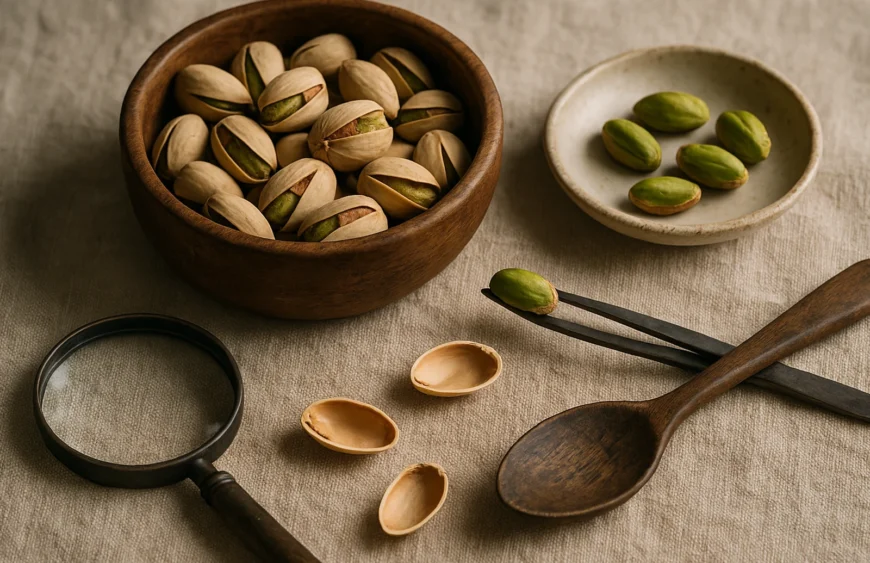
How To Identify Fresh Pistachios: The Short Answer
Last updated: 19 May 2026
Fresh Iranian pistachios pass seven physical tests. Stale or low-quality pistachios fail at least three.
- Open-shell ratio: at least 80% of premium Iranian pistachios should have naturally-open shells (split during in-tree ripening). Mostly closed-shell = mechanically split or low grade.
- Shell colour: pale tan/cream – not dusty grey, white-bleached, or dark spotted
- Kernel colour: vivid green for Akbari/Ahmad Aghaei, paler green for Kerman. Yellow or brown kernels = old or oxidised.
- Aroma: clean nutty perfume; no fishy, paint-like, or cardboard smells (those mean rancidity)
- Snap test: fresh pistachio shell snaps cleanly with audible crack; stale shell crumbles or bends
- No white film: white powdery film on shells = either bleach treatment or aflatoxin mould
- Price honesty: Iranian pistachios at ₹1,200/kg are almost certainly US Kerman cultivar at Iranian markup, or stale stock
For variety-specific guidance, see our Iranian pistachios buying guide and Akbari vs Kerman comparison.
Why pistachio freshness matters more than other nuts
Pistachios go rancid faster than almonds because of higher polyunsaturated fat content and greater shell-air exposure during storage. A pistachio that’s six months past its harvest tastes noticeably worse than a six-month-old almond. Worse: rancid pistachios can develop aflatoxin contamination from improper storage humidity – a serious food-safety concern.
The shells are also a diagnostic feature. Iranian premium varieties (Akbari, Ahmad Aghaei, Kerman) split open naturally on the tree when fully ripe, which is what gives them the characteristic “smile” appearance. US-grown Kerman cultivar pistachios are often mechanically split when they don’t open naturally, which is a quality-tell.
The 7 tests, in order of reliability
How to identify fresh pistachios – here is what actually matters when you choose. Run these tests on any pistachio pack before buying or before eating an opened batch.
Test 1 – Open-shell ratio (visual)
Pour a sample onto a plate and count open vs closed shells:
- Fresh premium Iranian pistachios: 80%+ shells open naturally, with the kernel visibly green inside through the split.
- Lower grade or US Kerman: 50-70% open; the rest mechanically split or cracked.
- Stale or fake pistachios: below 50% open, often with mechanical split marks (perfectly straight cuts rather than natural crack lines).
The open-shell ratio is set in the Iranian growing tradition – it’s a hallmark of premium origin and quality.
Test 2 – Shell colour (visual)
Look at the shell colour across the sample:
- Fresh: uniform pale tan to cream colour, slight natural variation, no spots.
- Bleached: uniformly bright white – chemical bleach is sometimes used to mask age. White film often visible.
- Old: dusty grey film, dark spots, or yellowed shells.
- Mouldy: visible black, green, or white mould patches on shells = discard immediately. Aflatoxin risk.
Test 3 – Kernel colour (visual)
Open a few pistachios and look at the kernel colour:
- Akbari, Ahmad Aghaei (premium Iranian): vivid emerald green, prized for its colour.
- Kerman (Iranian round variety): pale to medium green with warmer yellow undertone.
- US Kerman: pale green to yellow-green; subtly different from Iranian Kerman.
- Old or oxidised: yellow, brown, or grey kernels = rancid or near-rancid. Discard.
The deeper the green, the fresher (and likely more premium variety) the pistachio.
Test 4 – Aroma (sensory)
Crack 3-4 kernels and smell immediately:
- Fresh: clean nutty perfume with hints of grass, faint sweetness; pleasant.
- Stale: faint cardboard or musty smell; not yet rancid but on the way.
- Rancid: sharp paint-like, fishy, or cardboard smell – discard the entire batch. Even one rancid kernel can taint the rest.
The smell test is the single most reliable freshness indicator. If kernels smell off, throw them out regardless of how they look.
Test 5 – Snap test (tactile)
Hold a closed-shell pistachio between your thumb and forefinger; press to crack:
- Fresh: clean audible snap; shell breaks crisply with two halves staying intact in your fingers.
- Stale: shell crumbles or fragments; takes more pressure to break; shell pieces stick to the kernel awkwardly.
- Old & rancid: shell may bend slightly before breaking due to absorbed humidity; kernel inside is brown.
Test 6 – Salt and bleach indicators (visual)
Examine shells closely for white deposits:
- Salt residue (from roasted-salted): small white crystalline grains, typical and expected if the pack is salted.
- Bleach residue: uniform white powdery film across shells, almost dust-like – chemical bleach used to whiten shells. Avoid; this masks age and may carry residual chemicals.
- Aflatoxin mould: patchy, fuzzy white or grey patches on shells – discard immediately. Aflatoxin is carcinogenic and not destroyed by cooking.
Test 7 – Price honesty (the simplest filter)
Iranian pistachios have a real per-kg price floor:
- Akbari (premium Iranian): ₹2,800 to ₹4,200 per kg
- Ahmad Aghaei: ₹2,400 to ₹3,500 per kg
- Kerman / Round Iranian: ₹1,800 to ₹2,800 per kg
- Fandoghi: ₹1,500 to ₹2,400 per kg
- US Kerman cultivar: ₹1,200 to ₹1,800 per kg
A pack labelled “Iranian Akbari” at ₹1,400 per kg is mathematically impossible to be real Akbari. It’s either US Kerman, a different variety relabelled, or stale stock. Trust the price floor.
What to ask the seller
Four direct questions reveal the supply chain:
- “Where in Iran does this come from?” – honest answers: Kerman, Rafsanjan, Khorasan. “We don’t know” = avoid.
- “What harvest year?” – Iranian pistachio harvest is August-October. Seller should know.
- “Can I taste before buying?” – premium suppliers always allow sampling. Refusal is a warning.
- “Are these naturally split or mechanically?” – Iranian premium = naturally split. Mechanical split = lower grade.
Sourcing transparency
- Variety: Iranian pistachios (Akbari, Ahmad Aghaei, Kerman, Fandoghi)
- Primary origin: Iran (Kerman and Rafsanjan provinces, Khorasan)
- Harvest: August through October
- Open-shell ratio benchmark: 80%+ for premium grades
- Verified retail price band: ₹1,500 to ₹4,200 per kilogram (varies by variety)
Related reading
References & further reading
For independent reference points, the USDA FoodData Central – nutrient database is the standardised dataset we cross-check composition against. Clinical work like the PubMed – pistachios and metabolic health helps separate marketing claims from evidence.
Frequently Asked Questions
How can I tell if pistachios have gone rancid?
Smell first – fresh pistachios have a clean, faintly sweet nutty aroma. Rancid pistachios smell like paint, cardboard, or fish. Visually: yellow or brown kernels, dusty white shells. Taste: sharp, bitter, or off in any way. Discard the entire batch if any single kernel tastes rancid – the oxidation often spreads.
Why are some pistachio shells closed?
Mechanically split or harvested before fully ripening. Iranian premium varieties (Akbari, Ahmad Aghaei) naturally open on the tree when fully ripe – that’s the desired state. Closed shells in a “premium Iranian” pack indicate either lower grade, mechanically split, or US-grown cultivar relabelled as Iranian.
Are bleached pistachios safe to eat?
The bleaching process uses food-grade chemicals that are technically allowed but residue can remain. More importantly, bleached pistachios are typically older stock being cosmetically refreshed – the underlying freshness is the real concern, not the bleach itself. Avoid bleached packs as a quality signal.
What is the white film on pistachio shells?
Three possibilities, in order: salt (from salt-roasting – fine), bleach residue (chemical whitening to mask age – avoid), or aflatoxin mould (serious health risk – discard immediately). Salt is grainy and crystalline; bleach is powdery and uniform; mould is fuzzy and patchy. Distinguishing them visually takes practice.
How long do fresh pistachios stay fresh?
Six to nine months at room temperature in airtight storage; up to 12 months refrigerated; up to 18 months frozen. Vacuum-sealed origin-labelled packs hold longer. Once opened, refrigerate after the first month to slow rancidity. Iranian humidity in summer accelerates rancidity – refrigerate during May-September. When evaluating how to identify fresh pistachios, the key is verification not branding.
What’s the difference between Iranian and American pistachios?
Iranian pistachios – Akbari, Ahmad Aghaei, Kerman, Fandoghi – are generally considered superior in flavour and colour. The cultivation method, soil mineral profile, and traditional in-tree ripening produce richer kernels. American (mostly California Kerman cultivar) pistachios are perfectly edible but milder, paler, and often mechanically split.
Can rancid pistachios make me sick?
Rancid fats can cause digestive discomfort (nausea, indigestion) for some people. More seriously, improperly stored pistachios can develop aflatoxin contamination – a carcinogenic mould toxin that’s not destroyed by cooking. The combination of rancid smell + visible mould on shells is a clear discard signal. When in doubt, throw it out.
Why do my fresh pistachios sometimes have white powder?
If grainy and crystalline = salt from roasting (normal). If powdery and uniform = bleach residue (avoid future packs from this seller). If fuzzy or patchy with off-colours = mould (discard immediately). The first is harmless; the second is a quality concern; the third is a serious health risk.