Walnuts Vs Almonds Omega 3: Walnuts Vs Almonds Omega3: At a glance
Last updated: 19 May 2026
Walnuts and almonds are not competitors. They cover different nutritional gaps. Walnuts are the only common tree nut high in plant omega-3 (alpha-linolenic acid). Almonds are the densest vitamin-E source per 100 g among popular nuts.
- Omega-3 ALA per 100 g: walnuts ~9 g; almonds ~0.003 g. Walnuts deliver roughly 3,000 times more plant omega-3.
- Vitamin E per 100 g: almonds ~25.6 mg; walnuts ~0.7 mg. Almonds deliver about 36 times more.
- Protein per 100 g: almonds ~21 g; walnuts ~15 g. Almonds carry steadier protein.
- Calories per 100 g: walnuts ~654 kcal; almonds ~579 kcal. Walnuts are calorie-denser.
- Best pattern: 5 to 7 soaked almonds plus 2 to 4 walnut halves daily covers vitamin E, ALA, magnesium, and plant protein.
- Ammari stocks Kashmiri walnuts and California, Mamra, and Gurbandi almonds, packed to order in Jaipur.
For the wider almond landscape, see our complete almonds buying guide.
The two nuts cover different gaps
Walnuts vs almonds omega3 – here is what actually matters when you choose. The standard Indian question “walnuts or almonds, which is better” sets up a false choice. The honest answer is that they cover different gaps in a vegetarian diet.
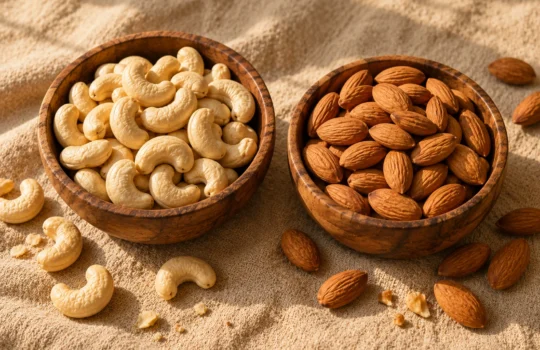
Almonds belong to the Prunus family (related to peaches and apricots). The kernel is dense, dry, and rich in monounsaturated fat. Per 100 g, almonds deliver roughly 21 g of protein, 25.6 mg of vitamin E, and 270 mg of magnesium. The vitamin-E density is the headline: one ounce (about 23 almonds) covers 50 percent of the daily reference value. No other commonly available nut comes close on this single nutrient.
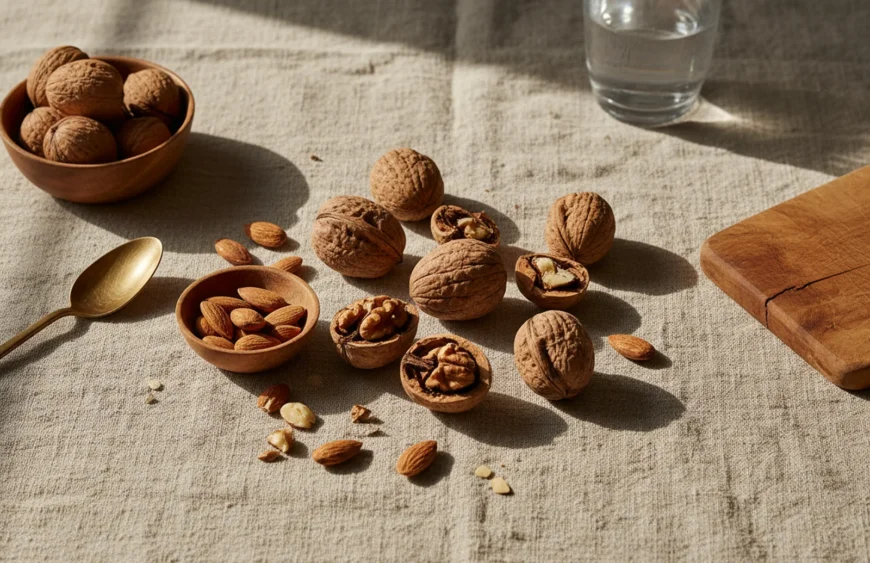
Walnuts belong to the Juglans family. The kernel is folded, lighter, and rich in polyunsaturated fat. Per 100 g, walnuts carry roughly 15 g of protein and a striking 9 g of alpha-linolenic acid (ALA), the plant precursor to omega-3 EPA and DHA. Among commonly eaten nuts in Indian households, walnuts are essentially the only meaningful source of plant omega-3 for vegetarians. The ALA in 5 to 7 walnut halves is comparable to what a single 100 g serving of salmon provides in EPA, though absorption efficiency is lower.
For vegetarian households, this matters. Omega-3 deficiency is common in Indian diets that exclude oily fish. A daily walnut habit closes the gap without supplements.
Nutrition per 100 g, side by side
| Nutrient | Walnuts | Almonds | Winner | |-|-|-|-| | Calories | 654 kcal | 579 kcal | almonds | | Protein | 15.2 g | 21.2 g | almonds | | Total fat | 65.2 g | 49.9 g | almonds | | Monounsaturated fat | 9.0 g | 31.6 g | almonds | | Polyunsaturated fat | 47.2 g | 12.3 g | walnuts | | Omega-3 ALA | 9.1 g | 0.003 g | walnuts | | Omega-6 linoleic acid | 38.1 g | 12.3 g | depends | | Carbohydrates | 13.7 g | 21.6 g | walnuts | | Fibre | 6.7 g | 12.5 g | almonds | | Vitamin E | 0.7 mg | 25.6 mg | almonds | | Magnesium | 158 mg | 270 mg | almonds | | Phosphorus | 346 mg | 481 mg | almonds | | Calcium | 98 mg | 269 mg | almonds | | Iron | 2.9 mg | 3.7 mg | almonds |
Read this table honestly. Almonds win on more line items, which is why “almonds are healthier” is a common claim. Walnuts win on the two specific categories that matter for vegetarian Indian diets: omega-3 ALA and polyunsaturated fat balance.
For Indian context: the average vegetarian diet is already high in omega-6 (from vegetable oils) and low in omega-3. Adding walnuts adjusts the ratio in the right direction; adding almonds does not move the needle on omega-3 at all.
Which one to eat when (and why both wins)
The walnut case: heart, brain, vegetarian omega-3.
- Heart health. Meta-analyses in JAMA Internal Medicine and American Journal of Clinical Nutrition link 28 to 56 g daily walnut intake with modest reductions in LDL cholesterol and triglycerides.
- Brain support. Walnuts contain ALA plus polyphenols studied for cognitive ageing in observational cohorts. The claim is not curative, but the signal is consistent.
- Vegetarian omega-3 only available source. Without walnuts, chia seeds, or flax, a vegetarian Indian diet covers zero plant omega-3. Walnuts are the most palatable of the three.
The almond case: vitamin E, daily protein, snacking volume.
- Vitamin E density. Almonds are the single best food source. Vitamin E protects cell membranes from oxidation and supports skin health.
- Protein for size. At 21 g protein per 100 g, almonds outperform walnuts (15 g), cashews (18 g), and most other nuts for plant-protein density.
- Daily-snack workhorse. Almonds tolerate higher daily intake (15 to 20 nuts per day) without the calorie spike that walnuts carry.
- Cooking versatility. Almond flour, slivered almonds, soaked-almond paste, badam halwa. The nut adapts to many forms.
The both-not-either pattern.
A daily intake of 5 to 7 soaked almonds plus 2 to 4 walnut halves covers vitamin E, ALA, magnesium, plant protein, fibre, and polyphenols together. Total calories: about 150 kcal. Total cost in 2026: roughly ₹15 to ₹25 per day depending on grade. This is the pattern most clinical dietitians recommend for Indian vegetarian adults.
For exact daily intake by age and goal, see how many almonds per day and how many walnuts per day.
Sensory and cooking differences
Visually and texturally the two could not be more different.
- Almonds: light brown skin, oval shape, dense crisp bite, mild sweet finish. Holds up to roasting, grinding, soaking, slivering, and frying. Almond paste is the base of badam halwa and several mithai. Soaked-and-peeled almonds carry a sweeter, slightly milky flavour.
- Walnuts: beige brain-shaped halves, brittle texture, bitter undertone from the tannin-rich skin. Best used whole or coarsely chopped. Soaking walnuts overnight in water and discarding the soak water reduces the bitter note significantly. Walnut paste is uncommon in Indian cooking but appears in baked goods and chocolate desserts.
In Indian sweets, almonds dominate (badam barfi, almond milk, kheer garnish, biryani topping). Walnuts appear in some Kashmiri preparations (walnut chutney, dum aloo), Christmas baking, and modern breakfast bowls. The two rarely substitute for each other in a recipe.
Price in India 2026
| Variety | Indicative price (₹/kg) | Best use | |-|-|-| | Kashmiri Wonth walnuts (premium) | 1,800 to 2,600 | Direct eating, gifting | | Kashmiri Burzul walnuts (standard) | 1,400 to 1,900 | Daily intake, cooking | | Chilean walnuts (imported) | 1,000 to 1,500 | Daily intake, baking | | Mamra almonds (premium) | 2,800 to 4,500 | Gifting, mithai | | California almonds | 700 to 1,200 | Daily snacking, baking | | Gurbandi (Kashmiri small) | 1,400 to 1,900 | Daily snacking |
A balanced daily-intake budget for the both-not-either pattern: 30 g of California almonds (~₹30) plus 15 g of Burzul walnuts (~₹25). Roughly ₹55 to ₹60 per day, ₹1,650 to ₹1,800 per month, for a couple eating this together. When evaluating walnuts vs almonds omega3, the key is verification not branding.
For more on walnut grades, see our Kashmiri vs Chilean walnuts buying guide.
Storage and freshness, where walnuts need more care
Walnuts go rancid faster than almonds. The high polyunsaturated fat content is what gives walnuts their omega-3 value, and what makes them oxidation-prone. Practical guidance: When evaluating walnuts vs almonds omega 3, verification beats branding.
- Walnuts: vacuum-packed in glass jars or steel containers, kept in a cool dark cabinet. Replace stock every 3 to 4 months. From April to September in Indian summer heat, refrigerate. Rancid walnuts taste sharply bitter and should be discarded; you cannot rescue them.
- Almonds: airtight jars at room temperature work fine for 6 to 8 months. Almonds carry mainly monounsaturated fat which oxidises slowly. Refrigeration is optional, not required.
A simple test for walnut freshness: open one, smell the kernel. Fresh walnuts smell faintly oily and sweet. Rancid walnuts smell sharp and almost paint-like.
Sourcing transparency
- Almonds: Mamra (Iran/Afghanistan origin), California (Central Valley, USA), Gurbandi (Indian Kashmir). All sourced through verified shippers.
- Almonds harvest: August through October. Stored vacuum-packed at our Jaipur facility.
- Walnuts: Kashmiri Wonth and Burzul grades from valley growers; Chilean stock from imported channels for daily-snack tier.
- Walnut harvest: September through October. Vacuum-packed and refrigerated on arrival.
- Where we ship from: Ammari Foods, Jaipur. Online-only D2C, all-India shipping.
- What we do not claim: that walnuts cure heart disease or that almonds improve skin. Both deliver real nutrients. Outcomes depend on total diet.
Both nuts are stocked alongside pistachios, dates, and cashews at Ammari Foods, packed to order.
References & further reading
For independent reference points, the USDA FoodData Central – nutrient database is the standardised dataset we cross-check composition against. Clinical work like the PubMed – almonds and cardiovascular risk review helps separate marketing claims from evidence.
Frequently Asked Questions
Which has more omega-3, walnuts or almonds?
Walnuts, by a wide margin. Per 100 g walnuts carry about 9.1 g of alpha-linolenic acid (ALA), the plant form of omega-3. Almonds carry virtually none (about 3 mg per 100 g). For vegetarian Indian diets, walnuts are essentially the only meaningful tree-nut source of omega-3. Five to seven walnut halves a day delivers roughly the ALA an adult needs to meet baseline targets.
Is it better to eat walnuts or almonds in the morning?
Both, ideally. The traditional Indian habit of soaked almonds in the morning works because soaked almonds digest gentler and the vitamin E and protein support steady energy. Adding 2 to 4 soaked walnut halves alongside covers the omega-3 gap. Soak both overnight, peel the almond skin if you prefer, eat first thing on an empty stomach.
Are walnuts better for the brain than almonds?
Walnuts have a slight edge for cognitive support because of the omega-3 (ALA) content. Observational studies in older adults link regular walnut intake with modest cognitive benefits. Almonds support brain health indirectly through vitamin E (an antioxidant) and steady blood sugar from the fibre content. The honest answer is that both contribute, walnuts through ALA, almonds through micronutrients.
Can I substitute almonds for walnuts in recipes?
For most Indian recipes, no. Walnuts have a bitter undertone and brittle texture that almonds do not match. For Kashmiri walnut chutney, walnut dum aloo, or walnut-based baking, the substitution changes the dish significantly. The reverse substitution also fails: walnuts in badam halwa would taste wrong. Use each nut for its intended dishes.
Which is healthier overall?
If you read 100 g side by side, almonds win more line items: higher protein, more fibre, more vitamin E, more calcium, more magnesium. Walnuts win on the one nutrient that matters most for vegetarian Indian diets: omega-3 ALA. The honest answer is to eat both daily rather than picking one. The both-not-either pattern is what dietitians actually recommend.
How many walnuts and almonds should I eat per day?
A common combined target: 5 to 7 soaked almonds plus 2 to 4 walnut halves (around 14 g almonds and 8 g walnuts). Total calories about 130 to 150 kcal. This covers vitamin E, ALA, magnesium, plant protein, and polyphenols together. Pregnant women, athletes, and growing children can scale up; people in weight-loss phases should stay closer to the lower end.
Are walnuts more fattening than almonds?
Walnuts are calorie-denser per 100 g (654 kcal versus 579 kcal for almonds). For a 28 g daily snack, walnuts give about 184 kcal versus almonds at 162 kcal. The 22-calorie gap is small. Total weight outcomes depend on total daily intake, not nut choice. Both fit weight-management plans at portioned intake.