Best Budget Dry Fruits India: At a glance
Last updated: 19 May 2026
Affordable dry fruits India typically means raisins, dates, peanuts, makhana, anjeer, cashews (mainstream grade), and California almonds priced under ₹1,000 per kilo. Indian dry fruit prices range across a 15x spread, from ₹250/kg raisins to ₹4,000/kg Mamra almonds, per APEDA market reports. The genuinely affordable tier sits between ₹250 and ₹900 per kilo and still covers most daily-nutrition needs (omega-3s, plant protein, iron, fibre).
A 100g daily mixed-nut habit at this tier costs roughly ₹50–80 per day per person, which puts annual dry fruit spend at ₹18,000–29,000 for a regular eater. The dry fruit category in India crossed ₹40,000 crore in retail sales in 2024.
Ammari Foods sources California almonds, Kashmiri walnuts, and Medjool dates direct from origin and packs at our Jaipur facility. For broader varietal context, see our notes on how many almonds per day.
What “affordable” means in dry fruits
Best budget dry fruits india – here is what actually matters when you choose. The dry fruit category in India runs across a price spread that few other food groups match. A kilo of raisins can cost ₹250 while a kilo of Mamra almonds runs ₹4,000. Both are dry fruits, both are nutritionally valuable, but they sit at completely different ends of the budget map.
The affordable tier, for this list, means anything reliably under ₹1,000 per kilo at standard urban retail. That threshold matters because it puts a 100g daily intake at under ₹100, which is the realistic ceiling for daily-habit dry fruit consumption in middle-income Indian households.
The honest framing: quality at this tier is real, but it isn’t premium. Mainstream-grade California almonds are nutritionally equivalent to Mamra almonds in protein and fibre, but lack the higher monounsaturated fat ratio and the distinctive texture. Regular cashews are 90% as good for daily snacking as W180-grade ones. Mainstream Medjool dates from Jordan Valley deliver the same fibre and natural sugar profile as Ajwa, just at a quarter of the price. When evaluating best budget dry fruits india, the key is verification not branding.
10 affordable dry fruits ranked by value-per-rupee
The ranking below weighs nutritional density, year-round availability, and per-kilo price across Indian urban retail markets in 2026.
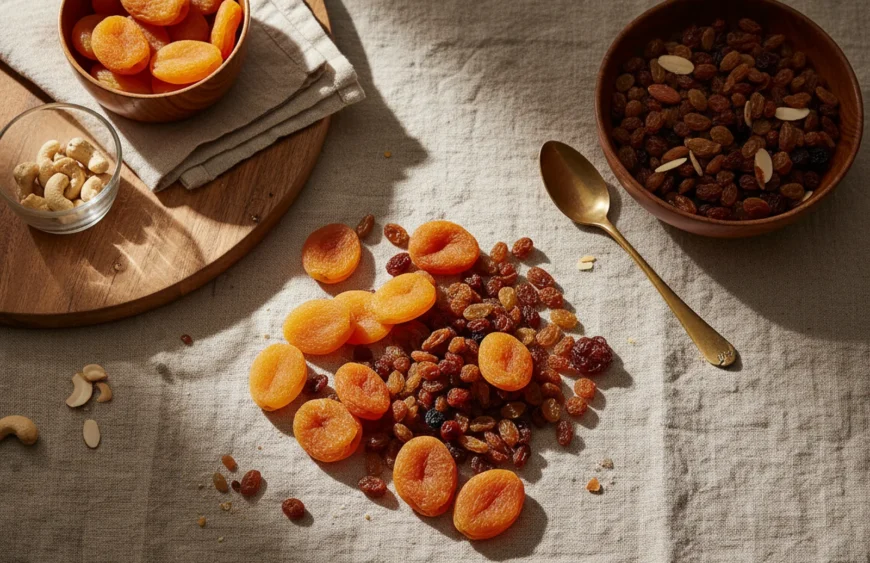
1. Raisins (kishmish), ₹250–450/kg
The cheapest mainstream dry fruit and arguably the best value per rupee. Black raisins (sun-dried) edge out yellow raisins on iron content. Excellent for daily snacking, kheer, oats, and as a natural sweetener in dishes. Around 300 kcal per 100g and high in natural sugars, so portion to roughly 20–30g per day for regular eaters.
2. Peanuts (mungphali), ₹120–200/kg
Technically a legume, classed culturally as a dry fruit in India. The most affordable protein-dense option at this tier, with 26g protein per 100g. Reliable as a daily snack, in chikki, sundal, or roasted with masala. Look for unblanched, single-origin Gujarat or Andhra Pradesh sources.
3. Makhana (fox nuts), ₹450–900/kg
Roasted makhana from Bihar is one of the best value dry-fruit-category snacks at this price. Low calorie (347 kcal/kg dry weight, but you eat far less), high satiety, and works as a savoury snack. Buy plain unroasted and toast at home for the best flavour-to-price ratio.
4. Anjeer (dried figs), ₹600–900/kg
Iranian and Turkish anjeer dominate at this price tier. Calcium, iron, fibre, and slow-release sugar make this one of the most nutritionally balanced dry fruits. Soak overnight for the best digestion. Two pieces per day covers a solid micronutrient base.
5. Cashews (W320 grade), ₹600–900/kg
Mainstream W320-grade cashews from Karnataka and Maharashtra. The W180-grade premium tier doubles the price without doubling the nutrition, making W320 the strong value pick. Around 553 kcal per 100g, so portion to 15–20g per day.
6. Dates (Tunisian Deglet Noor), ₹400–700/kg
The affordable date tier, replacing Medjool when budget matters. Deglet Noor from Tunisia is drier, smaller, and sweeter than Medjool but covers the same nutritional ground. Good for daily-snack jars and cooking. For premium occasions, switch to Medjool dates.
7. Walnuts (Kashmiri budded), ₹800–1,200/kg
Kashmiri walnut budded-pieces (chopped halves) sit just at the affordable threshold. Whole-shell Kashmiri walnuts cost double. The budded form retains all the omega-3 alpha-linolenic acid (around 9g per 100g) at far lower cost. Best for daily protein-and-omega habit. See walnuts brain health for the omega-3 case.
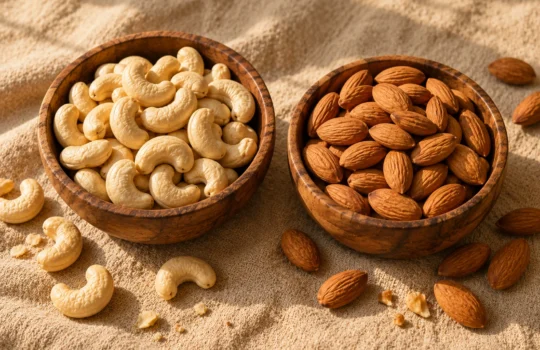
8. Almonds (California, standard grade), ₹700–900/kg
Mainstream California almonds, not Mamra. Nutritionally equivalent on protein (21g/100g) and fibre, slightly lower on monounsaturated fat density than Mamra. The strongest mainstream daily-almond choice, available year-round in 1kg packs.
9. Pistachios (Iranian Kerman, plain), ₹900–1,400/kg
Sits at the top of the affordable tier. Kerman variety is smaller than Akbari but identical in nutrition. Best for daily snacking when you want the protein-fat-fibre profile of pistachios without the gifting-grade price. Around 560 kcal per 100g.
10. Apricots (Hunza, dried), ₹700–1,000/kg
Hunza apricots from the Karakoram region. Beta-carotene, iron, potassium, and a chewy texture. Great for trekkers, runners, and breakfast oats. Best soaked overnight before eating.
Comparison: California almonds vs Mamra at the affordable tier
| Factor | California (mainstream) | Mamra (premium) | |-|-|-| | Price (₹/kg) | 700–900 | 3,000–4,500 | | Protein per 100g | 21 g | 21 g | | Fibre per 100g | 12.5 g | 12.5 g | | Mono-unsaturated fat ratio | Moderate | Higher | | Texture | Crunchy, uniform | Denser, smaller | | Daily-snacking suitability | Excellent | Excellent (but pricey) | | Best for | Daily habit, kids, kitchen use | Gifting, occasion, premium snacking |
For the daily intake answer, see our how many almonds per day breakdown.
What to avoid at the affordable tier
Three categories of “affordable” dry fruits often disappoint. Worth knowing before you buy.
Sugar-glazed cranberries and pineapple bits. Marketed as healthy, but the sugar load can hit 60–70g per 100g, more than most candy. Reads healthy, eats like dessert. Skip unless you specifically want a sweet treat.
Salted-roasted mixed-nut tins. The salt content (1.5–3g sodium per 100g) outpaces what nutritionists recommend for daily intake. Buy plain raw or roasted-unsalted and add seasoning at home.
Open-bin loose dry fruits from non-cold-chain shops. Walnuts and almonds turn rancid within 3 to 6 months in monsoon humidity. Open-bin retail rarely maintains turnover or sealed storage. Buy vacuum-sealed or air-tight-tin packaging only, even at the affordable tier.
How affordable dry fruits compare across nutrition needs
The right pick depends on what you’re optimising for:
- Maximum protein per rupee: Peanuts, then cashews W320, then almonds (California).
- Maximum omega-3 per rupee: Kashmiri walnut budded pieces. No real competitor at this tier.
- Maximum fibre per rupee: Anjeer, then raisins, then dates Deglet Noor.
- Maximum iron per rupee: Black raisins, anjeer, dried Hunza apricots.
- Best low-calorie snack: Makhana, far ahead of all alternatives.
- Best natural sweetener: Deglet Noor dates, then raisins.
Sourcing transparency
- Almonds (California): Central Valley, USA; Aug to Oct harvest.
- Dates (Medjool): Jordan Valley.
- Walnuts: Sopore belt, Kashmir; paper-shell Akhrot.
- Raisins: Sangli and Vijayapura belts, Maharashtra/Karnataka.
- Anjeer: Turkey and Iran, primary import origins for the Indian market.
Ammari Foods focuses on the premium end of the dry fruit category, but our sourcing notes for daily-grade varieties draw from APEDA and FSSAI market data.
References & further reading
For independent reference points, the USDA FoodData Central – nutrient database is the standardised dataset we cross-check composition against. Clinical work like the NIN-Hyderabad Dietary Guidelines for Indians helps separate marketing claims from evidence.
Frequently Asked Questions
Which is the most affordable dry fruit in India that’s still nutritionally worth eating?
The single most affordable nutritionally-dense option is black raisins (kishmish) at ₹250–450 per kilo. They deliver iron, antioxidants, and natural sugars in a stable, year-round supply. Peanuts are even cheaper (₹120–200/kg) and carry the strongest protein density at this tier, though they’re technically a legume. For a balanced daily mix on a tight budget, combine 20g raisins + 30g peanuts + 10g cashews; that hits roughly ₹15–20 per day.
Are affordable California almonds nutritionally the same as premium Mamra almonds?
Largely yes, with one nuance. California and Mamra are nutritionally close on protein (21g/100g), fibre (12.5g), and overall calorie density. Mamra has a slightly higher monounsaturated fat ratio and a denser, smaller texture some prefer. For daily-snacking, California almonds (₹700–900/kg) deliver 90%+ of the nutrition at a quarter of the cost. Save Mamra (₹3,000+/kg) for gifting and special-occasion eating.
What dry fruits should I avoid at the budget tier?
Avoid three categories: sugar-glazed cranberries and pineapple (60–70% sugar by weight, marketed as healthy but eats like candy), salted-roasted mixed-nut tins (sodium loads can exceed daily-intake recommendations), and open-bin loose dry fruits from non-cold-chain shops, especially in monsoon (walnuts and almonds turn rancid within months). Stick to vacuum-sealed or air-tight-tin packaging from brands with origin transparency, even at the affordable tier.
How much should I budget for daily affordable dry fruit consumption?
For a balanced 80–100g daily mix at the affordable tier (raisins, peanuts, cashews W320, California almonds, Kashmiri walnut budded, dates Deglet Noor), expect ₹50 to 80 per person per day. Scaled annually, that’s ₹18,000 to 29,000 per regular eater. Two-person households can buy 1kg combo packs at ₹600–900 each, lasting roughly 10–15 days, which holds total spend in the budget range.