Corporate Dry Fruit Gifts: Corporate Dry Fruit Gifting India: At a glance
Last updated: 19 May 2026
Corporate dry fruit gift hampers are India’s most-ordered B2B gifting category, accounting for an estimated 35–40% of the ₹30,000 crore organised corporate gifting market (IBEF, 2024). Procurement runs in three waves: Diwali (October), year-end (December), and annual appreciation (March–April).
Bulk orders of 50 to 500 hampers typically unlock 15–25% discounts off retail, with clean B2B invoicing and 14-to-21-day lead times for branded personalisation. Six standard tiers serve every relationship, from a ₹500 employee token to a ₹15,000+ boardroom crate for investors and founders.
Ammari Foods packs corporate orders at our Jaipur facility using California and Mamra almonds, Iranian pistachios, Medjool dates, and Kashmiri walnuts. For the broader framework on selecting premium gifting brands, see our complete dry fruit gifting guide.
Why corporates choose dry fruits over chocolate or wine
Corporate dry fruit gifting india – here is what actually matters when you choose. Indian corporate gifting has shifted decisively toward dry fruits over the last decade, and the reasons are structural rather than seasonal.
Dietary universality. A hamper of badam, pista, and khajoor lands well across every Indian dietary tradition: Hindu, Jain, Sikh, Muslim, vegetarian, vegan. Chocolate carries milk solids that complicate Jain or strict-vegetarian recipients. Wine excludes Muslim, Jain, and many Hindu clients outright. Dry fruits remove the guessing game from a 200-name client list.
Shelf life and logistics. Mithai needs three-day delivery and refrigeration in transit. Chocolate softens in October Delhi heat and August Mumbai humidity. Vacuum-sealed dry fruits stay fresh for 6 to 9 months at room temperature, which means a procurement team can stage orders three weeks in advance without quality loss.
Per-unit value perception. A 200 g premium dry fruit hamper retails at ₹2,000 to ₹3,000. The same spend on branded chocolate covers roughly 300 g, and on wine, a mid-tier single bottle. The price-per-gram signal of premium nuts visibly communicates the gift’s worth without crossing into ostentation, which matters for client gifts under your company’s modesty norms.
Reconciliation simplicity. Dry fruit hampers integrate cleanly with corporate expense workflows. Invoices are straightforward, packaging variants stay within a predictable price band, and there are no state-by-state regulatory hurdles or reputational considerations of the kind alcohol gifting carries. Compliance teams routinely sign off without follow-up.
Six hamper tiers for corporate gifting
The Indian corporate gifting market is unusually tier-conscious. Match the hamper to the relationship, not the budget ceiling, because over-gifting reads as awkwardly as under-gifting.
Tier 1. Employee appreciation (₹500–800 per unit)
For all-hands Diwali, joining gifts, and year-end appreciation across 100+ employees. A 250 g pack of mixed almonds and pistachios in a sturdy metal tin, branded with the company logo on a slip-card. This tier requires the tightest per-unit cost discipline, since the same hamper goes to every employee from intern to senior manager. Order volumes here typically run 200 to 2,000 units.
Tier 2. Mid-management and team leads (₹1,500–3,000)
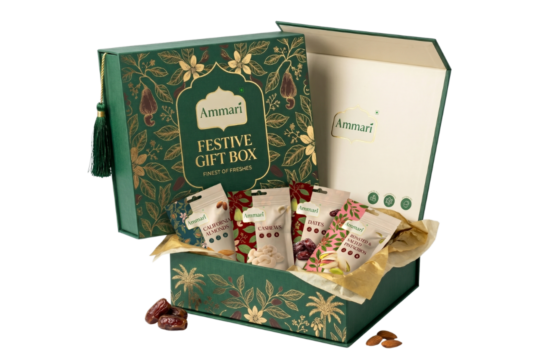
A 200 g four-variety hamper in a wood-veneer box: California almonds, Iranian pistachios, Kashmiri walnuts, and Medjool dates in equal portions. Suitable for managers, senior associates, vendors, and external consultants in routine engagement. Volumes typically run 50 to 200 units per Diwali cycle. The closest ready-built equivalent is the Ammari Festive Gift Box, which can be re-skinned for corporate branding on volumes of 50+.
Tier 3. Senior leadership and key vendors (₹4,000–6,000)
A 1 kg six-variety brass-finish hamper: mixed almonds, pistachios, walnuts, dates, anjeer, and raisins. The brass canister itself becomes a desk object after the contents are consumed, extending the gift’s brand-visibility window by months. Volumes typically run 20 to 80 units.
Tier 4. VIP clients and major partners (₹7,000–10,000)
A 1.5 kg premium assortment in a fabric-lined wooden crate: Mamra almonds, Akbari pistachios, Medjool dates or Ajwa dates, Kashmiri walnut halves, with two heritage Indian additions like gond and makhana. Brand presentation here moves from logo-stamped to embossed or laser-etched. Volumes typically run 10 to 50 units.
Tier 5. Boardroom, investors, and founder-level (₹15,000+)
A 2 kg+ trousseau crate with engraved brass canisters, recipient name laser-etched, and personalised note from the CEO or founding partner. This tier is used for investor relations, M&A; counterparties, regulator-facing relationships, and family-office introductions. Volumes are small (5 to 25 units) but per-unit complexity is high.
Tier 6. Annual subscription model (₹6,000–24,000 per recipient per year)
Quarterly hamper deliveries timed to Diwali, year-end, Holi, and Raksha Bandhan windows. This format replaces the once-a-year Diwali transaction with four touchpoints, deepening the relationship over the fiscal year. Increasingly common among Indian family offices, private banking teams, and B2B SaaS firms managing 50 to 200 strategic accounts. For the seasonal Diwali variant, see our Diwali dry fruit gift ideas for 2026.
Branding and personalisation options
Corporate dry fruit hampers earn their B2B premium through presentation, not just contents. Five personalisation layers, ranked by signal strength:
- Slip card with logo printing. Entry-level. ₹15 to ₹40 per unit. Lead time 5 to 7 days. Suitable for Tier 1 and 2 hampers at 100+ unit volumes.
- Ribbon colour matching to brand palette. Free or low-cost. Pairs satin ribbon to your company’s primary brand colour. Surprisingly high perceived effort for the cost.
- Embossed or foil-stamped wooden lids. Mid-tier. ₹150 to ₹400 per unit, 10 to 14 day lead time. Used for Tier 3 hampers where the wooden container itself becomes a brand surface.
- Laser-etched brass canisters with recipient name. Premium. ₹600 to ₹1,200 per unit, 14 to 21 day lead time. Used for Tier 4 and 5 hampers where each unit is individually personalised. The brass canister carries the recipient’s name and the company’s logo for years.
- Branded card with CEO signature or handwritten note. Negligible material cost; high signal weight. Particularly powerful when the note references something specific about the recipient relationship. Avoid generic “Happy Diwali” cards on Tier 4+ gifts; they cheapen the rest of the presentation.
A practical rule for Indian corporate gifting: spend roughly 10 to 15% of the hamper budget on personalisation. Below 10%, the package reads generic; above 15%, the contents start to feel like an afterthought to the wrapping. When evaluating corporate dry fruit gifting india, the key is verification not branding.
Procurement and finance considerations
Corporate gifting orders go through procurement, not marketing, which means the supplier must speak procurement’s language fluently.
Single consolidated invoice. All hamper orders should ship with a single consolidated invoice carrying the buyer’s billing details. Ask the supplier upfront whether they can issue line-item clarity on contents, packaging, and personalisation, since this affects audit trail and downstream reconciliation.
Per-unit cost consistency. The hamper’s per-unit cost must hold steady across the order. Variation by even ₹50 per hamper creates reconciliation headaches when one finance team is matching 300 line items to a purchase order. Suppliers who quote a single rate-card price for the full bulk run save procurement hours of back-and-forth.
Payment terms. Standard corporate gifting payment terms in India run 30 to 50% advance, balance net-30 on delivery. Larger orders may negotiate 100% credit terms on delivery against a confirmed PO. Confirm whether the supplier accepts bank-transfer payments against a proper invoice rather than just consumer-facing payment gateways.
Minimum order quantities. Most premium suppliers set MoQs between 25 and 50 units for branded personalisation. Below 25 units, custom printing is uneconomical for both sides; above 500 units, suppliers may offer further tiered discounts. Bulk orders of 100+ hampers typically unlock 15 to 25% off equivalent retail, before personalisation costs.
Cancellation and replacement policy. Confirm in writing what happens if 5% of the hamper list is wrong (employee left, address changed, recipient is on leave). A supplier who silently absorbs small list-error rates saves hours of HR coordination.
Lead times and bulk delivery logistics
Indian corporate gifting calendars are unforgiving. The Diwali window from late September to early November sees roughly 4x the order volume of any other month, and every supplier’s capacity tightens accordingly.
- Mid-August. Initial discussions with suppliers for Diwali. Lock hamper selection by tier. Premium varieties like Mamra almonds and Akbari pistachios are committed at supplier level by early October.
- Early September. Confirm employee and client lists. For orders over 200 units with personalisation, this is the latest comfortable confirmation window.
- Late September. Final PO issued. Branded printing, laser etching, and personalisation begin. 14 to 21 days needed for orders above 100 units.
- Mid-October. Hampers ship from supplier facility. For pan-India distribution, allow 3 to 7 days of courier transit, with longer windows for tier-3 cities and the North-East.
- One week before Diwali. Last delivery confirmation. Inter-state courier networks saturate within 72 hours of Dhanteras, and same-city delivery is the only reliable channel.
For year-end and March-April appreciation cycles, lead-time pressure is lower, but a 14-day minimum is still the safest planning window for personalisation. The single most common corporate gifting failure is committing to a hamper count three weeks before Diwali without confirming supplier capacity, then absorbing per-unit cost increases of 30 to 40% on a rush replacement.
Sourcing transparency
Ammari Foods sources California almonds from the Central Valley harvest each Aug–Oct, Mamra almonds from Aleppo Province (Iran) and parts of eastern Afghanistan with the September–October crop, Iranian pistachios from Kerman Province (varieties: Akbari, Kerman, Ahmad Aghaei), Medjool dates from the Jordan Valley, and Kashmiri walnuts from the Sopore belt. Corporate hampers are assembled, branded, and vacuum-sealed at our Jaipur facility within 48 hours of dispatch. For Diwali corporate orders specifically, see our Diwali hamper guide, and for the underlying sourcing framework, our dry fruit gifting guide for India outlines what to confirm with any premium gifting supplier.
References & further reading
For independent reference points, the FSSAI Food Safety & Standards Authority of India is the standardised dataset we cross-check composition against. Clinical work like the NIN-Hyderabad Dietary Guidelines for Indians helps separate marketing claims from evidence.
Frequently Asked Questions
What is the typical bulk discount on corporate dry fruit hampers?
Bulk orders of 50 to 500 hampers typically unlock 15 to 25% off equivalent retail pricing before personalisation costs. The discount tier usually steps at 25, 100, and 500 units. Orders above 500 hampers may negotiate further on payment terms or freight rather than additional headline discount. Personalisation adds 5 to 15% back to the per-unit cost depending on the tier: slip cards at the low end, laser-etched brass canisters at the high end. Confirm the discount is calculated before any applicable taxes, not after.
How early should we order corporate Diwali hampers?
For Diwali orders with branded personalisation, finalise quantities and recipient lists by early September, with the purchase order issued by late September. This gives 14 to 21 days for branded printing and personalisation, plus 3 to 7 days for pan-India courier transit. Orders above 200 units with personalisation booked after the first week of October face per-unit cost increases of 30 to 40% and limited variety availability. For year-end gifting in December and March-April appreciation cycles, a 14-day lead time is generally sufficient.
Can corporate hampers be shipped to multiple addresses?
Yes. Most premium suppliers handle multi-address dispatch from a single PO, with the buyer providing a spreadsheet of recipient names, addresses, and personalisation details. Per-shipment courier charges apply for direct-to-recipient delivery, typically ₹80 to ₹250 per address depending on pin-code zone. For orders going to 50+ separate addresses, consolidated dispatch to corporate HR for in-office handover is often more economical than individual courier, particularly for Tier 1 employee hampers within metro offices.