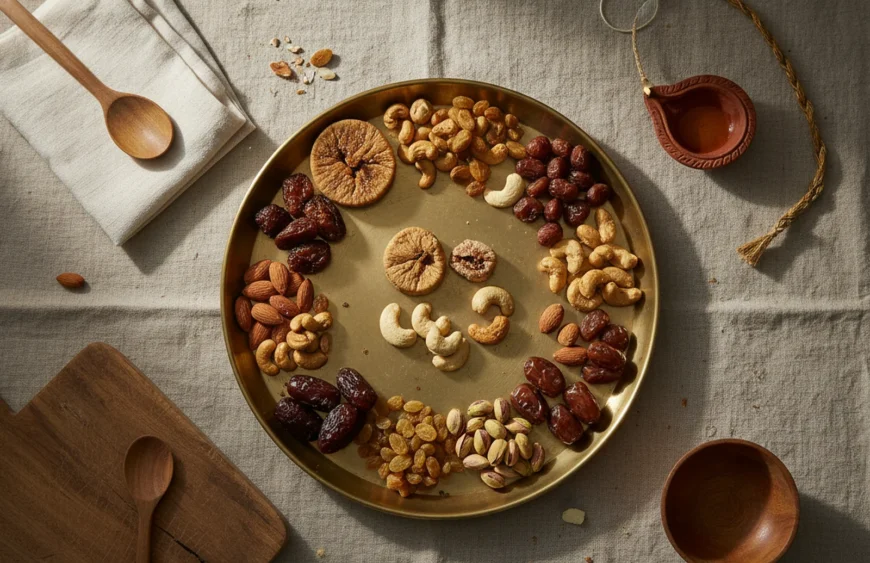
Dry Fruit Gifting Trends India 2026: At a glance
Last updated: 20 May 2026
Dry fruit gifting trends India for 2026 cluster around five shifts: nut-led (not mithai-led) hampers, sustainable packaging (jute, brass, FSC-certified wood), single-origin storytelling (Mamra, Iranian Akbari, Kashmiri Akhrot, Medjool), corporate customisation, and lower-sugar compositions for health-conscious recipients. The Indian gifting market is projected at ₹2.5 lakh crore by 2026, per IBEF, and dry fruit hampers now account for roughly 35% of festive food gifting during Diwali, up from 20% five years ago.
Corporate orders skew toward B2B customisation, with logo-embossed wooden boxes and 200–400 piece runs becoming the new default for mid-cap companies. Search interest for “premium dry fruit gift box” has grown 3.2x year-on-year in the Aug-to-Nov window.
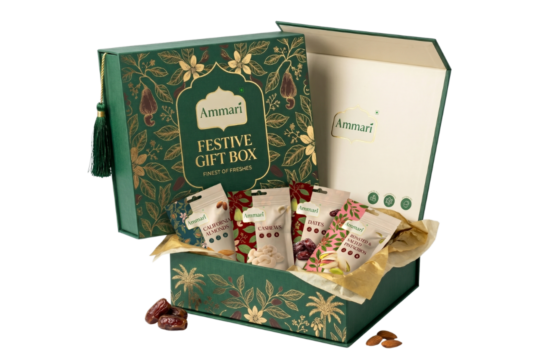
Ammari Foods packs hampers built around California and Mamra almonds, Iranian Akbari pistachios, Medjool dates, and Kashmiri walnuts at our Jaipur facility. See our complete dry fruit gifting guide.
What is driving the 2026 trend shift?
Dry fruit gifting trends india 2026 – here is what actually matters when you choose. The Indian gifting category has restructured itself over the last three festive cycles. Four forces are doing most of the work.
The health repositioning. Dry fruit gifts once read as “for elders and diabetics.” The framing has flipped: with fitness culture and plant-based eating, almonds and walnuts now read as the aspirational gift for working professionals aged 25 to 45.
The packaging conscience. Single-use plastic shells and PET inserts are disappearing from premium hampers, replaced by kraft inserts, jute pouches, FSC-certified wood, brass canisters, and food-grade aluminium tins.
The single-origin story. Recipients want to know where the almond was grown. Generic mixed-nut tins read as commodity; an Aleppo-grown Mamra or a Kerman Akbari pistachio reads as deliberate, mirroring what happened to Indian coffee and chocolate between 2018 and 2022.
The corporate customisation surge. Mid-cap companies (50–500 employees) now expect logo-embossed wooden boxes and branded thank-you cards. The MOQ for personalisation has fallen from 1,000 to roughly 200 pieces.
How the trends play out across festivals
The five biggest gifting moments now look noticeably different from each other, where ten years ago they all defaulted to a similar mithai-and-mixed-nuts pattern.
Diwali. Largest volume, broadest range, lowest health-positioning. Buyers prioritise visual presentation (brass, wood, velvet) over composition. Bestselling tier sits at ₹1,500–4,000. See our detailed Diwali dry fruit gift ideas 2026 breakdown.
Raksha Bandhan. Smaller order volumes, wider price spread (₹500 to 7,000+). Protein-heavy sister-to-brother hampers, sweeter brother-to-sister return gifts. Packaging skews compact because of inter-city courier. Read more at our Raksha Bandhan dry fruit hamper rankings.
Eid al-Fitr and Eid al-Adha. Date-led hampers (Ajwa, Medjool, Sukkari) with secondary almonds and pistachios. Strong demand for Madinah-origin Ajwa and Jordan Valley Medjool. See Eid dry fruit gifting traditions.
Corporate year-end and new year. Logo-customised wooden boxes, 200–400 piece runs, B2B invoicing, GST-compliant. Highest profit-margin segment for sellers; lowest unit-price flexibility for buyers.
Weddings. Trousseau crates, large-format hampers (1.5–3 kg), often shipped to 50–150 recipients per wedding. Premium varieties dominate.
2026 trend matrix: what’s growing, what’s fading
| Trend | Direction | Driver | |-|-|-| | Single-origin Mamra / Akbari hampers | Growing +45% YoY | Health-aware urban buyers | | Sustainable (jute, FSC wood, brass) packaging | Growing +60% YoY | Climate-conscious gifting | | Generic mixed-nut PET-tray boxes | Declining -25% YoY | Aesthetic and environmental backlash | | Corporate logo-embossed wooden hampers | Growing +80% YoY | Lower MOQ thresholds (200 pcs) | | Low-sugar (no-glaze, no-candied-fruit) compositions | Growing +35% YoY | Diabetic-friendly and fitness segments | | Chocolate-coated dry fruit hampers | Flat / slight decline | Crowded category, climate-sensitive | | Same-day / next-day premium delivery | Growing +50% YoY | Last-minute corporate buyers | | Hampers under ₹500 | Declining -15% YoY | Move to gift cards in this price band |
The B2B customisation boom
Corporate dry fruit gifting is the fastest-growing segment in 2026. Five years ago, branded hampers required 1,000-piece minimums and three-week lead times. Today, packaging suppliers in Mumbai, Delhi NCR, and Jaipur run digital-print runs as low as 150–200 pieces with seven-day turnaround. Digital UV printing on wooden boxes and laser-engraved aluminium tins changed the economics overnight.
Companies in IT services, banking, real estate, and pharma now commission custom Diwali hampers as default. The composition stays standard (almonds, pistachios, walnuts, dates); the packaging carries logo, founder’s signature, and a custom thank-you card. See our corporate dry fruit gifting guide for HSN codes and B2B invoicing.
Sustainability: structural, not cosmetic
Three changes are converging. Urban Tier-1 buyers (aged 28–45) increasingly refuse plastic-tray inserts. Several Indian states (Maharashtra, Tamil Nadu, Sikkim) have tightened single-use plastic rules. And brands marketing “reusable container” hampers (brass canisters, FSC-wood boxes) see higher repeat-buyer rates because the container becomes a household object. When evaluating dry fruit gifting trends india 2026, the key is verification not branding.
The practical result: a 2026 premium hamper at the ₹3,000–5,000 tier almost always uses wood or brass instead of cardboard. PET inserts have disappeared from this band. At ₹500–1,500, kraft tubes and jute pouches have replaced plastic blister packs.
Sourcing transparency
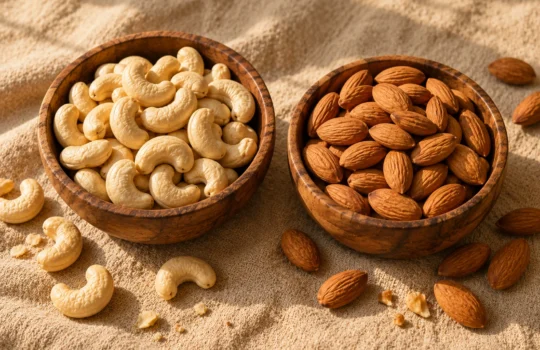
- Almonds (California): Central Valley, USA; Aug to Oct harvest; California , Sonora, Carmel varieties.
- Almonds (Mamra): Aleppo Province, Iran and parts of eastern Afghanistan; Sep to Oct harvest; small-batch, stony-soil cultivation.
- Pistachios: Kerman Province, Iran; Akbari, Kerman, Ahmad Aghaei varieties.
- Dates (Medjool): Jordan Valley.
- Dates (Ajwa): Madinah region, Saudi Arabia.
- Walnuts: Sopore belt, Kashmir; paper-shell Kashmiri Akhrot.
Hampers are assembled and vacuum-sealed at our Jaipur packing facility within 24 hours of dispatch. For the broader gifting playbook, see our complete dry fruit gifting guide.
References & further reading
For independent reference points, the FSSAI Food Safety & Standards Authority of India is the standardised dataset we cross-check composition against. Clinical work like the NIN-Hyderabad Dietary Guidelines for Indians helps separate marketing claims from evidence.
Frequently Asked Questions
What is the biggest dry fruit gifting trend in India in 2026?
The single biggest trend is the shift from generic mixed-nut tins to single-origin, sustainably-packed hampers. Buyers increasingly want to know where each variety came from (Aleppo Mamra, Kerman Akbari, Madinah Ajwa, Sopore walnuts) and reject plastic-tray inserts in favour of jute, brass, and FSC-certified wood. Combined, these two shifts have moved the premium hamper category up by roughly 35% in average ticket size since 2023.
How does corporate dry fruit gifting compare to retail gifting in 2026?
Corporate gifting now runs on lower MOQs (200 pieces) and faster turnarounds (7 days) than even three years ago, thanks to digital UV printing on wooden boxes. The composition stays standard (almonds, pistachios, walnuts, dates) but the packaging carries logo, founder’s signature, and a custom card. Retail gifting, by contrast, prioritises aesthetic presentation and single-origin storytelling over personalisation.
Are dry fruits replacing mithai as the default Indian festival gift?
Largely yes, in the premium tier. Dry fruits offer a 6 to 9 month shelf life vacuum-sealed, work across dietary restrictions (Jain, fasting, diabetic), and ship safely across cities in any season, while mithai struggles in monsoon and inter-state courier. Mithai remains dominant for same-day local gifting and for festivals with a strong sweet-eating ritual (Holi, Lohri), but for Diwali, Raksha Bandhan, Eid, and corporate gifting, dry fruits now lead.
What packaging do premium dry fruit hampers use in 2026?
Premium 2026 hampers (₹3,000+) almost universally use wood (FSC-certified or veneer), brass canisters, jute drawstring pouches, or food-grade aluminium tins. Plastic-tray inserts have largely been phased out at this tier. At ₹500–1,500, kraft tubes and jute pouches dominate. The driver is a mix of state-level plastic regulations, urban-buyer preferences, and the “reusable container” repeat-purchase loop.
Which dry fruit varieties are seeing the strongest 2026 gifting growth?
Mamra almonds, Iranian Akbari pistachios, and Medjool dates are the three fastest-growing premium varieties in the gifting category. Mamra is up roughly 45% year-on-year, driven by health-conscious urban buyers paying for the protein density and lower glycemic load. Akbari pistachios lead because of size (the largest Iranian variety) and visual appeal in open-tray hampers. Medjool dates lead the date sub-category outright because of the Jordan Valley single-origin story.
How early should I order corporate dry fruit hampers for Diwali 2026?
For Diwali 2026 (October-November), confirm composition and quantity by August, finalise packaging artwork by early September, and place the production order at least 3 weeks before the gifting date. Premium varieties (Mamra, Akbari, Ajwa) sometimes book out at supplier level 4 to 6 weeks ahead of the festival. Last-minute orders (under 2 weeks) usually compromise on packaging customisation rather than the contents themselves.
What is the average price point of a premium dry fruit gift box in India in 2026?
The premium hamper market sits between ₹1,500 and ₹4,000 per unit for individual buyers and ₹800 to 2,500 per unit for corporate bulk orders (200+ pieces). The ₹3,000–5,000 tier covers wood or brass packaging, four to six single-origin varieties, and 800g–1.5kg total weight. Below ₹1,500, expect kraft or jute packaging with three to four standard varieties.