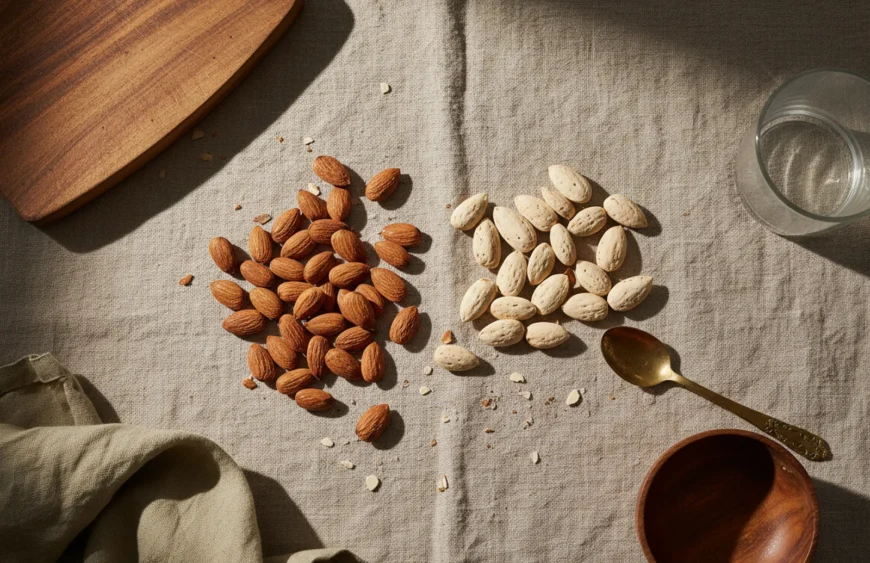
Badam Vs Almonds Difference: At a glance
Last updated: 20 May 2026
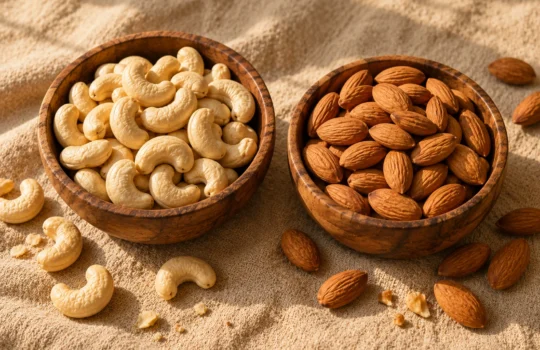
Badam vs almonds is not a comparison; it is a translation. Both words name the seed of Prunus dulcis, the sweet-almond tree. “Badam” enters Hindi and Urdu from Persian bādām; “almond” enters English from Old French alemande, itself from Greek amygdale. They are the same food at every level: USDA FoodData Central lists about 579 kcal, 21 g protein, 12.5 g fibre, and 25.6 mg vitamin E per 100 g for raw almonds, values that apply equally to badam sold in any Indian grocery.
What does change is the variety: California (, Carmel), Mamra (Iran or eastern Afghanistan), and Gurbandi (Kashmir) all sit under the same Hindi label. Ammari Foods ships small-batch Mamra almonds from the Aleppo belt of Iran, the variety most often meant when Indian households say “asli badam”. For variety-by-variety detail, see the complete almonds buying guide India.
Are badam and almonds the same thing?
Yes. They are the same kernel. The split is purely linguistic, the way aaloo and potato are the same tuber.
The botanical name is Prunus dulcis, a stone fruit in the rose family, native to a belt running from the Iranian plateau through Anatolia to the eastern Mediterranean. The edible part is the seed inside the hull; commercial growers across California, Iran, Spain, and Australia all grow the same species. There is no genus called “badam” and no separate cultivar group. When Indian grocers say “regular badam” they almost always mean California-origin almonds, simply because California supplies roughly 80 percent of the world’s almond trade by volume.
A related point of confusion: the Hindi word badam is sometimes used loosely for other nuts in regional cooking, especially *Indian almond (Terminalia catappa)*, the tree planted along south-Indian coasts. That is a different species and not what any grocer sells as edible badam. For the kitchen, badam and almonds are interchangeable.
Etymology and regional names across India
The word badam comes from *Persian bādām**, which travelled east with traders and Sufi scholars through the medieval Indo-Persian world. From Persian it entered Hindi, Urdu, Bengali (badam), Marathi (badam), Gujarati (badam), and Punjabi (badam). The same Persian root sits behind the Turkish badem and Azeri badam*.
The English almond comes from Old French alemande, which descends from Late Latin amandula, a softened form of Latin amygdala, which itself goes back to Greek amygdale. The Greek term is the source of the modern English word amygdala for the almond-shaped brain region.
Badam vs almonds difference – here is what actually matters when you choose. A short tour of the Indian map:
- Tamil: vadumai or badham
- Telugu: badamu or badam pappu (kernel)
- Kannada: badami
- Malayalam: bādām
- Bengali / Assamese: badam (in Bengal, the word also covers groundnut, so context matters)
- Marathi / Gujarati / Punjabi: badam
In a Mumbai or Delhi shop, asking for kaagzi badam gets you paper-shell California almonds; asking for asli badam or Iranian badam usually points to Mamra; choti giri or gurbandi points to the small Kashmiri variety.
Quick reference: variety, origin, and what each name signals
| Indian shop name | English / variety | Typical origin | Average kernel size |
|---|---|---|---|
| Regular badam / kaagzi badam | California , Carmel | Central Valley, USA | 1.2–1.4 g |
| Mamra badam / asli badam | Mamra almonds | Aleppo, Iran; eastern Afghanistan | 0.9–1.1 g |
| Gurbandi / choti giri | Gurbandi almonds | Kashmir valley | 0.7–0.9 g |
| Sonora badam | Sonora variety | California | 1.0–1.2 g |
Variety changes oil content, flavour, and price. A Mamra kernel runs roughly 3 to 4 times the price of California almonds for genuine origin lots. For a deeper variety walkthrough, see the complete almonds buying guide India.
Does the name change the nutrition?
No. Per 100 g of raw kernels, badam and almonds give the same USDA-anchored profile: about 579 kcal, 21 g protein, 49 g fat (31 g monounsaturated), 12.5 g fibre, 269 mg magnesium, and 25.6 mg vitamin E. A standard Indian portion is a mutthi of 8 to 10 kernels, roughly 12 to 15 g.
The very small differences between varieties are about oil content (Mamra tends to run a touch higher in monounsaturated fat) and trace minerals (Gurbandi tends to carry slightly more iron, per agricultural-board data). These differences are not big enough to change clinical advice. For portion guidance by age and condition, see how many almonds per day. For soaking practice, see soaked vs raw almonds.
When the word badam does not mean almond
Two everyday cases:
- *Indian almond (Terminalia catappa). A tropical tree planted across coastal India and the islands. Locals sometimes call its seed desi badam or natuvadam*. The kernel is edible but small, oily, and not commercially sold as almond.
- Pili nut, paradise nut, or chironji. In some regional kitchens, chironji (also charoli) is loosely called badam in mithai context, mainly because it replaces almond in classic sweets like thandai and phirni. Chironji is the seed of Buchanania lanzan and is a different food entirely.
In any grocery, packaged, or D2C setting, badam on the label means Prunus dulcis. The cases above are spoken usage, not retail.
Sourcing transparency
- Ingredient: Almonds
- Origin (California): Central Valley, USA
- Harvest: Aug–Oct
- Varieties: California , Sonora, Carmel
- Origin (Mamra): Aleppo Province, Iran (and parts of eastern Afghanistan)
- Harvest: Sep–Oct
- Varieties: Mamra (small-batch)
- Note: Stony-soil cultivation, hand-cracked tradition
- Origin (Gurbandi): Indian Kashmir
- Varieties: Gurbandi (Choti Giri)
Ammari Foods ships Mamra almonds sourced from the Aleppo belt of Iran, the variety most Indian households mean when they say asli badam. For everyday baking and snacking, our California almonds come from the Central Valley harvest. For variety-by-variety detail with prices and use cases, see the complete almonds buying guide India.
References & further reading
For independent reference points, the USDA FoodData Central – nutrient database is the standardised dataset we cross-check composition against. Clinical work like the PubMed – almonds and cardiovascular risk review helps separate marketing claims from evidence.
Frequently Asked Questions
Is badam the same as almond?
Yes. Badam is the Hindi-Urdu word and almond is the English word for the same seed, Prunus dulcis. There is no nutritional or botanical difference. The split is purely linguistic, like aaloo and potato. Variety differences (California, Mamra, Gurbandi) sit under both names.
Why is Mamra badam priced higher than regular badam?
Mamra almonds come from rain-fed, stony soils in Iran and eastern Afghanistan, with low per-tree yield, hand cracking, and limited supply. Genuine Mamra runs roughly 3 to 4 times the price of California almonds. California almonds dominate global trade at scale, which keeps their price lower.
Which badam is best for daily eating?
For most Indian adults, California almonds at 8 to 10 kernels per day cover protein, fibre, magnesium, and vitamin E at sensible cost. Mamra and Gurbandi are smaller, oilier, and traditionally given to children, recovering patients, and elders in Ayurvedic practice. See how many almonds per day for portion detail by group.
Does badam mean almond in every Indian language?
In nearly every Indian language with a Persian or Sanskrit lineage (Hindi, Urdu, Bengali, Marathi, Gujarati, Punjabi, Tamil, Telugu, Kannada, Malayalam), badam with minor spelling variation names the almond kernel. In Bengal, the same word can mean groundnut in casual speech, so context matters at the grocer.
Is Indian almond (Terminalia catappa) the same as badam?
No. Indian almond is a tropical tree planted along coastal India. Its seed is sometimes called desi badam in spoken usage, but it is a different species from Prunus dulcis and is not what any grocer sells as edible badam. For cooking, baking, or daily snacking, badam means sweet almond.
Should I soak badam before eating?
Soaking is optional and tradition-led, not nutrition-led. Soaking softens the brown skin and reduces the tannin bite for sensitive stomachs. Most published trials show no large change in absorbed nutrients for healthy adults. For the full evidence trade-off, see soaked vs raw almonds.
What does kaagzi badam mean?
Kaagzi literally means paper in Hindi-Urdu, and kaagzi badam refers to paper-shell almonds, varieties with a soft, thin shell that cracks under hand pressure. In Indian shops today, kaagzi badam almost always points to California , which has a thin shell and a clean, sweet kernel.