Pistachios Shelf Life: Pistachios Storage Shelf Life: The Short Answer
Last updated: 19 May 2026
Pistachios oxidise faster than almonds. Storage choice and humidity control matter more.
- In-shell pistachios: 6 to 9 months at room temperature (below 25°C); up to 12 months refrigerated
- Shelled pistachio kernels: 3 to 5 months pantry; 6 to 9 months refrigerated; up to 12 months frozen
- Roasted-salted pistachios: add 2-3 months over raw – salt slightly inhibits oxidation
- Indian summer (April–September): always refrigerate – both rancidity and aflatoxin risk rise sharply above 30°C and 70% humidity
- Spoilage signs: paint-like or fishy smell, white powdery film, mould patches, yellowed kernels – discard
- Aflatoxin warning: improperly stored pistachios can develop carcinogenic mould toxins. Visible mould = discard immediately
For variety-specific guidance, see our Iranian pistachios buying guide and how many pistachios per day.
Why pistachios need extra-careful storage
Pistachio kernels are about 45 to 55 percent fat by weight, with a higher proportion of polyunsaturated fats than almonds. Polyunsaturated fats are chemically more reactive and oxidise faster. A pistachio batch that’s been open for 6 months tastes noticeably worse than a 6-month-old almond batch.
Pistachios storage shelf life – here is what actually matters when you choose. Two additional risks unique to pistachios:
- Aflatoxin contamination – Aspergillus mould species produce aflatoxins (carcinogenic) on improperly stored pistachios, especially in humid conditions above 70% RH and 25°C. The mould prefers in-shell pistachios with minor shell cracks. Aflatoxin is not destroyed by cooking – visible mould means discard the whole batch.
- Shell humidity exposure – naturally-open Iranian pistachio shells have wider mouths than mechanically-split US pistachios, exposing more kernel to ambient air. This is good for fresh pistachios (which are naturally open) but means storage humidity matters more than for almonds.
Storage methods ranked by shelf life
- Freezer (long-term) – up to 12 months with quality intact. Use freezer-safe glass jars or vacuum-sealed bags. Best for buying premium Iranian varieties (Akbari, Ahmad Aghaei) in 500g+ quantities.
- Refrigerator (default for summer) – 9 to 12 months in-shell, 6 to 9 months shelled. Cold air slows both oxidation and mould growth. Bring to room temperature 30 minutes before eating.
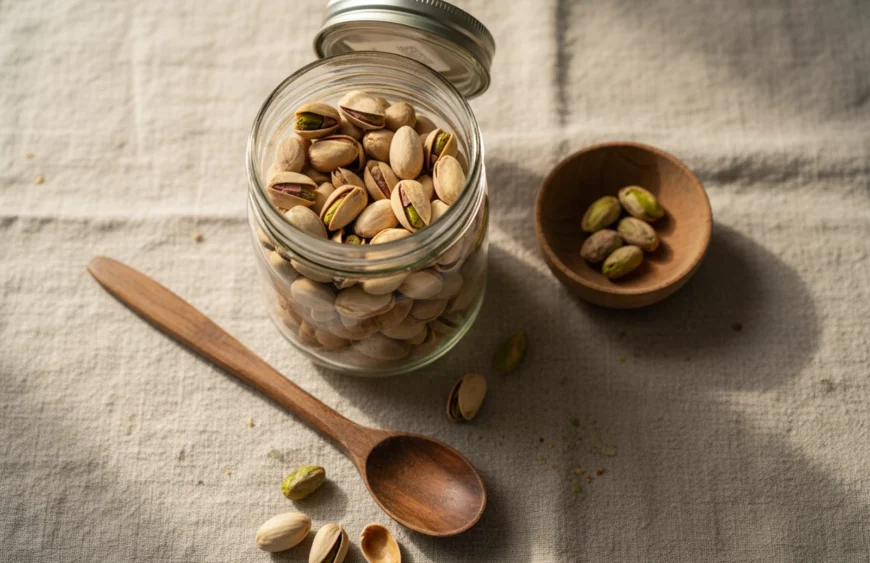
- Pantry, airtight (cooler months only) – 6 to 9 months in-shell at 20-25°C; 3 to 5 months for shelled kernels. Use glass or food-grade steel; pistachios absorb plastic oils over months.
- Pantry, opened original pack – 2 to 3 months max. Pistachio packaging is rarely fully airtight after first open.
In-shell vs shelled – a meaningful storage difference
Iranian pistachios are predominantly sold in-shell with naturally-open mouths. Shells provide partial protection:
- In-shell pistachios – the shell acts as a moisture and oxygen barrier; kernel air-exposure is reduced. Shelf life roughly 30-40% longer than shelled kernels.
- Shelled pistachios (loose green kernels) – full air exposure; oxidation accelerates. Best stored frozen if not consumed within 3 months.
For premium Iranian varieties, buy in-shell and shell at point of consumption. The shell-cracking habit slows eating naturally and the kernels stay fresher longer.
What accelerates pistachio rancidity
Five factors that shorten pistachio shelf life:
- Humidity above 70% – particularly during Indian monsoon. Encourages aflatoxin mould.
- Temperature above 25°C – kitchen above-stove storage halves shelf life.
- Light exposure – clear glass jars on windowsills accelerate oxidation.
- Each container opening – oxygen ingress. Smaller frequent-use containers are better than one large infrequent one.
- Storage with strong-smelling foods – pistachios absorb odors more readily than almonds due to the wider shell openings.
Signs pistachios have gone bad
Test before eating any batch older than 4 months:
- Smell – rancid pistachios smell like paint, cardboard, or fish. Fresh pistachios have a clean, sweet, faintly grassy aroma.
- Visual: shell – white powdery film on shells (could be sugar bloom, bleach residue, or aflatoxin mould). Distinguish: salt is grainy/crystalline (fine); bleach is uniform powdery (avoid future packs); mould is fuzzy/patchy (discard).
- Visual: kernel – vivid green is fresh. Yellow or brown kernels = oxidised; discard.
- Taste – bitter or sharp aftertaste. Even one rancid kernel taints the batch – discard whole.
Practical storage routine for Indian households
- Buy in-shell rather than shelled where possible – better natural protection
- Decant into a glass jar when you open the pack
- Store in cool dark cupboard October-March (below 25°C)
- Move to refrigerator April-September (Indian summer)
- For premium Akbari – fridge default year-round given the price premium
- Pre-shelled kernels – freeze if not consumed within 3 months
For sourcing context and variety-specific notes, see our Akbari vs Kerman comparison and pistachios health benefits.
Sourcing transparency
- Ingredient: Pistachios (Iranian varieties – Akbari, Ahmad Aghaei, Kerman, Fandoghi)
- Pack format: 250 g vacuum-sealed for freshness rotation
- Recommended storage: in-shell preferred; airtight container; refrigerate during Indian summer
- Shelf-life benchmarks (in-shell): pantry 6-9 months · fridge 9-12 months · freezer 12+ months
- Spoilage indicator: rancid paint-like smell or visible mould on shells
References & further reading
For independent reference points, the USDA FoodData Central – nutrient database is the standardised dataset we cross-check composition against. Clinical work like the PubMed – pistachios and metabolic health helps separate marketing claims from evidence.
Frequently Asked Questions
How long do pistachios last in storage?
In-shell premium pistachios last 6 to 9 months at room temperature (below 25°C), 9 to 12 months refrigerated, and up to 12 months frozen. Shelled kernels have shorter windows: 3-5 months pantry, 6-9 months fridge. Indian summer cuts these by roughly 30% – refrigeration becomes mandatory.
Can pistachios go bad?
Yes. The high polyunsaturated fat content makes them go rancid faster than almonds. Worse, improperly stored pistachios can develop aflatoxin (a carcinogenic mould toxin). Always smell-test pistachios before eating any batch older than 4 months. Visible mould = discard immediately.
Should I refrigerate pistachios in India?
Yes during summer (April-September). Indian temperatures regularly exceed 30°C in summer, and humidity above 70% during monsoon both accelerate rancidity and increase aflatoxin risk. For premium Iranian varieties, refrigeration year-round is the safer default.
Are roasted-salted pistachios shelf-stable longer?
Slightly. Salt has mild antimicrobial properties and dehydrates the kernel surface, both of which slow rancidity. Expect roughly 2-3 months longer shelf life than unsalted raw. The downside: salted pistachios add ~250 mg sodium per 30 g serving, which matters for daily consumption.
What’s the white powder on my pistachio shells?
Three possibilities. Salt = grainy, crystalline (normal if salted). Bleach residue = uniform powdery (chemical whitening, avoid future packs). Aflatoxin mould = fuzzy patchy off-colour (discard immediately, don’t taste). Distinguishing them takes practice; when in doubt, discard.
Can I freeze pistachios?
Yes – freezer is the longest-shelf-life option (up to 12 months). Use freezer-safe glass jars or vacuum-sealed bags. Both in-shell and shelled pistachios freeze well. Bring to room temperature 30 minutes before eating; cold pistachios taste flat. No quality loss after thawing. When evaluating pistachios storage shelf life, the key is verification not branding.
Do shelled pistachios store as well as in-shell?
No. Shelled green pistachio kernels have full air exposure and oxidise faster – expect 3-5 months pantry vs 6-9 in-shell. For shelled kernels you’ll use slowly, freeze in 100g portions and pull out as needed. For everyday snacking, in-shell is the better storage default.
How do I know if my pistachios have aflatoxin?
Visible mould on the shells (green, black, or fuzzy white patches) is the clearest sign – discard immediately. Subtle aflatoxin without visible mould is harder to detect; rely on origin reputation (vacuum-sealed Iranian premium packs from verified suppliers have low aflatoxin risk) and never eat pistachios with off-smells. When in doubt, throw it out.