Dates For Pregnancy: At a glance
Last updated: 19 May 2026
Most healthy pregnant women benefit from 2 to 6 dates per day, scaled by trimester and always discussed with your obstetrician first. The well-cited Mansoura University trial (Al-Kuran et al., 2011) tested 6 dates daily in the last 4 weeks of pregnancy. The date group had shorter active labour and a higher rate of spontaneous onset than non-consumers. Across pregnancy, dates supply natural sugars, fibre, potassium, magnesium and trace iron. By weight, 6 medium dates equal roughly 60 to 90 grams and 160 to 280 calories, depending on variety. Soft, premium Medjool dates from the Jordan Valley are gentlest on first-trimester nausea and easiest to chew; smaller Ajwa is the traditional Ramadan choice. Women with gestational diabetes should monitor post-meal glucose and stay at the lower end. For variety details, see our premium dates buying guide.
Why dates work in pregnancy
Dates for pregnancy – here is what actually matters when you choose. Dates during pregnancy fit Indian dietary patterns because they pack iron, folate, magnesium and natural sugars into a small, calorie-dense fruit. Per 100 g, dates supply roughly 1.0 to 1.5 mg iron, around 15 micrograms folate, and 50 to 60 mg magnesium. Potassium ranges from 270 to 700 mg depending on variety. None of these alone meet daily targets, but stacked on top of a balanced Indian plate they close common gaps that pregnant women in India frequently fall short on.
The labour-ease evidence is the most-cited reason expecting mothers ask about dates. The original Mansoura University trial in Jordan (Al-Kuran et al., 2011) followed 69 women in the final 4 weeks before delivery. The date-consuming group had a higher rate of spontaneous labour and a shorter active phase. Replication studies in Iran (Kordi et al., 2014) and a more recent Iranian randomised trial (Razali et al., 2017) reported similar directional findings: shorter labour, fewer interventions, no adverse effects. The proposed mechanism centres on tannins and saturated fatty acids influencing cervical ripening and uterine receptivity, though the trials are small and obstetric practice varies.
ICMR-NIN dietary guidelines for India recommend daily fruit intake of roughly 100 g. Dates are a useful fraction of that, particularly when summer-heavy nausea or food aversions narrow the menu. Two dates with milk in the morning is a traditional Ayurvedic preparation for expecting mothers, considered warming and grounding.
Trimester-by-trimester portion guide
Portions should shift across pregnancy. The progression below is the consensus pattern across Indian obstetricians and modern dietary guidance, and aligns with our how many dates per day guide.
- First trimester (weeks 1 to 13): 2 to 3 dates per day. Smaller portions are gentler on first-trimester nausea, and the folate content supports neural-tube development. Pair with milk or a glass of warm water in the morning. If aversions are sharp, even 1 date with a few almonds is meaningful.
- Second trimester (weeks 14 to 27): 3 to 4 dates per day. Iron demand rises sharply as blood volume expands, and dates pair well with vitamin-C foods (citrus, amla) to improve iron absorption. This is also the comfortable phase to add dates to laddoo, smoothies and bedtime milk.
- Third trimester, early weeks (28 to 35): 4 to 5 dates per day. Magnesium and potassium support muscle function as the uterus expands. Continue pairing with protein (paneer, yoghurt, almonds) to slow sugar absorption.
- Third trimester, last 4 weeks (36 to 40): 6 dates per day, per the Mansoura trial protocol. Most Indian obstetricians are comfortable with this dosage in low-risk pregnancies. Confirm with your doctor first, particularly if you have gestational diabetes, suspected macrosomia, or are taking insulin.
- Postpartum and lactation (first 12 weeks): 2 to 4 dates per day. Traditional Indian recovery diets include dates in panjeeri, gond ke laddoo and bedtime milk for steady energy during night feeds.
Best varieties for pregnancy
Variety matters more during pregnancy than at other life stages, because texture, sugar concentration and ease of chewing all shape compliance. The pregnant body tolerates softer, less concentrated dates better, particularly during nausea-prone weeks.
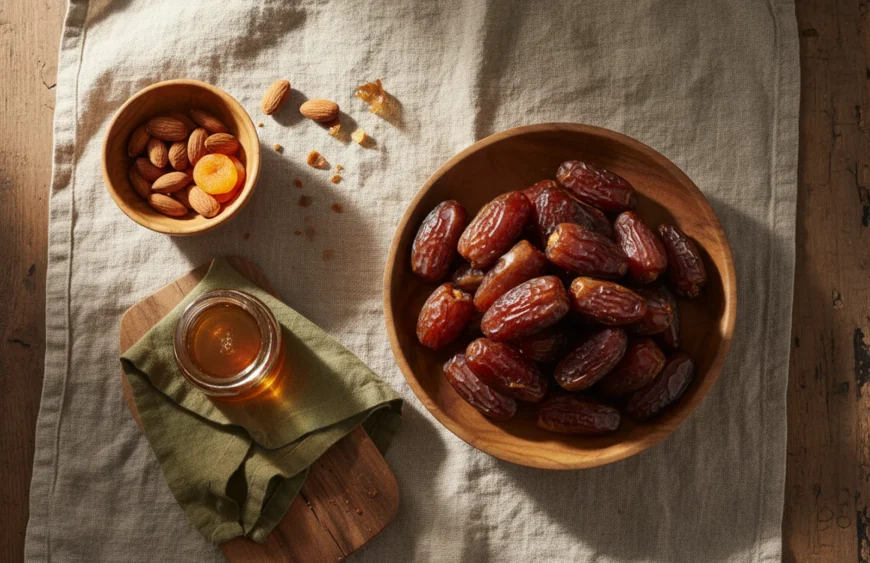
- Medjool is the softest premium date and the gentlest choice in the first trimester. The plump, semi-soft flesh chews easily, swallows without effort, and pairs naturally with milk or stuffed with almonds. The premium Medjool dates from the Jordan Valley are the standard we stock at Ammari Foods. For a full head-to-head, see Medjool vs Ajwa dates.
- Ajwa carries deep religious significance for Muslim mothers, mentioned in hadith as a daily protective food. The firmer, slightly drier texture means most pregnant women prefer Ajwa dates soaked in milk overnight rather than eaten dry. Iron content is marginally higher than Medjool (1.5 mg vs 0.9 mg per 100 g).
- Sukkari is a Saudi-origin golden date with a melt-in-mouth softness similar to Medjool, at a friendlier price point. A good everyday choice for the middle trimesters.
- Avoid very dry, hard dates like older-stock Khalas or unrefrigerated commercial packs. They strain digestion, increase the choking risk, and the sticky residue is harder on tooth enamel already stressed by pregnancy hormones.
Whichever variety you pick, soaking the day’s portion overnight in plain water or milk softens the flesh and reduces digestive load.
Safety considerations and when to scale back
Dates are food, not medication, and a few situations call for caution. Discuss daily portions with your obstetrician before scaling up, particularly in the third trimester.
- Gestational diabetes (GDM): dates have a moderate glycemic index of 42 to 55, lower than white bread or most Indian sweets, but they are concentrated sugar. Women with GDM should pair dates with protein (almonds, paneer, yoghurt). Monitor blood glucose 30 to 60 minutes after the meal. Stay at 2 to 3 dates daily under medical guidance rather than scaling to 6.
- First-trimester nausea: large portions on an empty stomach can worsen reflux. Split the portion across two intakes and pair with a bland carbohydrate (toast, plain roti) if mornings are rough.
- Date pit hazard: always check for and remove pits before eating, particularly when feeding stuffed dates or dates blended into laddoo. Pits can break teeth.
- Storage and contamination: pregnancy heightens sensitivity to foodborne pathogens. Pick vacuum-sealed, origin-labelled packs, store in airtight glass or food-grade steel containers, and refrigerate from April through September across most of India.
- Sulphite-treated imports: some bulk commercial dates use sulphur dioxide as a preservative. Pregnant women with asthma or sulphite sensitivity should pick sulphite-free, origin-labelled packs.
How to prepare and pair
The traditional Indian preparations for dates during pregnancy are simple and lean on staple ingredients already in most kitchens. Each pattern below pairs natural sugars with slower-absorbing fat, protein or fibre to flatten the glucose curve. When evaluating dates for pregnancy, the key is verification not branding.
- Soaked overnight in milk: 4 dates softened in warm milk before bedtime supports steady night-time energy and is the most-recommended Ayurvedic preparation for the second and third trimesters.
- With almonds at breakfast: 2 dates plus 5 soaked, peeled almonds delivers iron, folate, magnesium and protein in a single hand-portion. A clean morning pattern across all trimesters.
- In smoothies: blend 3 dates with banana, milk and a spoon of peanut butter for a quick second-trimester breakfast. The fat slows sugar absorption meaningfully.
- Date and almond laddoo: homemade laddoo using pitted Medjool, California almonds, Kashmiri walnuts and a pinch of cardamom replaces refined-sugar mithai with steadier-release calories. A small piece daily is a traditional postpartum recovery food.
- Gond ke laddoo: the classical North Indian postpartum sweet made with dates, almonds, edible gum, ghee and whole wheat flour. Consumed in small daily portions through the first 40 days after delivery.
Sourcing transparency
- Ingredient: Dates (across multiple varieties)
- Origin (Medjool): Jordan Valley
- Origin (Ajwa): Madinah region, Saudi Arabia (verified)
- Note (Ajwa): Religious significance, al-Ajwa traditional
- Packed at: Jaipur facility, Rajasthan
- Storage: airtight container in cool dry place; refrigerate during Indian summer
References & further reading
For independent reference points, the NIN-Hyderabad Dietary Guidelines for Indians is the standardised dataset we cross-check composition against. Clinical work like the PubMed – folate intake in pregnancy helps separate marketing claims from evidence.
Frequently Asked Questions
How many dates during pregnancy are safe per day?
For most healthy pregnant women, 2 to 6 dates per day is the consensus range, scaled by trimester. First trimester: 2 to 3 daily for folate and gentle nausea support. Second trimester: 3 to 4 for iron and steady energy. Last 4 weeks of pregnancy: 6 daily, per the Mansoura trial protocol, in low-risk pregnancies under medical guidance. Women with gestational diabetes should stay at 2 to 3 daily paired with protein.
Do dates really shorten labour?
The original Mansoura University trial (Al-Kuran et al., 2011) tested 6 dates daily in the final 4 weeks. The date group had a shorter active labour phase and higher rate of spontaneous onset than non-consumers. Iranian and Jordanian replication studies reported similar directional findings. Trials are small, mechanisms are proposed rather than proven, and individual outcomes vary. Treat dates as a supportive food choice, not a replacement for obstetric care.
Are Medjool or Ajwa dates better during pregnancy?
Medjool dates are softer, sweeter and easier to chew, which makes them gentlest during first-trimester nausea. Ajwa is firmer and slightly higher in iron (1.5 mg vs 0.9 mg per 100 g), and carries religious significance for Muslim mothers. Most Indian households keep both: Medjool for daily eating and dessert pairings, Ajwa for traditional and Ramadan use. Soaking Ajwa overnight in milk softens it considerably for pregnant women.
Can women with gestational diabetes eat dates?
Yes, in smaller portions, paired with protein, and only under medical supervision. Dates have a moderate glycemic index of 42 to 55, lower than white bread, but they are concentrated sugar. Most obstetricians comfortable allowing 2 to 3 dates daily for GDM patients ask for blood-glucose monitoring 30 to 60 minutes after the meal. Pair with paneer, almonds or yoghurt, and confirm exact daily limits with your treating doctor.