Walnut Grades India: At a glance
Last updated: 19 May 2026
Walnut grades in India follow three overlapping systems: kernel form, kernel colour, and origin standard.
- Kernel form (size grades): 4-Piece halves are the premium tier (whole halves, 8 to 12 mm thick, ₹1,400 to ₹2,200 per kg). 2-Piece is roughly 60 to 75% whole. Quarters and Pieces drop progressively in price (₹650 to ₹1,100 per kg).
- Colour grade: Extra Light is the palest, sweetest kernel, prized for eating and gifting. Light and Amber Light are mid-tier. Amber is the darkest, used for cooking and baking where colour does not show.
- Origin grade: Kashmiri paper-shell (Sopore belt) holds a price premium for thin shell and higher oil percentage. Chilean walnuts trade at commodity rates with consistent supply. Californian halves dominate the export-grade USDA tier.
For variety-level differences, see our Kashmiri vs Chilean walnuts buying guide.
Indian walnut grading by kernel form
The first axis any Khari Baoli or Crawford Market dealer asks about is piece size. Indian wholesalers use a five-step descending scale:
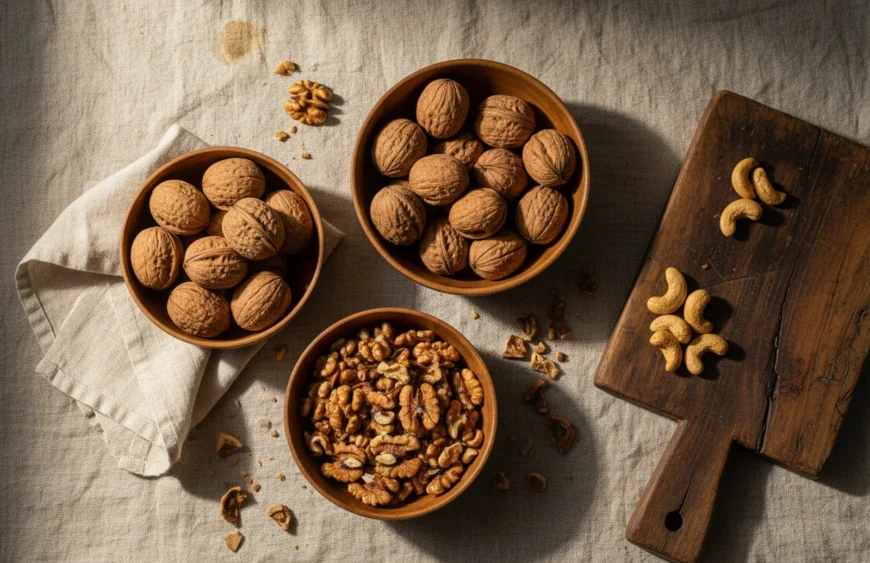
- 4-Piece (Halves Premium): intact kernel halves, 8 to 12 mm thick, roughly 95% whole pieces. For table eating, gifting boxes, decorative garnish. ₹1,400 to ₹2,200 per kg.
- 2-Piece (Halves Standard): about 60 to 75% whole halves, 25 to 40% quarters and fragments. The everyday cooking grade for rogan josh garnish, halwa, kheer. ₹1,100 to ₹1,700 per kg.
- Halves (Mixed): roughly half whole halves, half quarters. A working kitchen grade for daily use, paratha stuffings, chyawanprash-style mixes. ₹950 to ₹1,400 per kg.
- Quarters: broken into four-piece sections, less than 25% halves. Right for chopped use in laddoos, granola, brownies. ₹800 to ₹1,200 per kg.
- Pieces (Bits): small fragments, 4 to 8 mm. For cold-pressed walnut oil, commercial baking, walnut paste. ₹650 to ₹1,100 per kg.
Walnut grades india – here is what actually matters when you choose. The price gap between 4-Piece and Pieces runs 2 to 3 times, almost entirely about kernel integrity, not nutrition.
Colour grading and what causes the variation
The second axis is kernel colour, set when the kernel is harvested and dried. The Indian trade follows the USDA-AMS four-step scale, which APEDA references in its walnut export guidance:
- Extra Light: palest cream-to-pale-amber kernel, no dark spots. Sweetest, lowest tannin. Premium for raw eating, gifting, white desserts. Roughly 5 to 10% of harvest.
- Light: pale amber with minor flecking, slightly stronger flavour. The standard premium tier for retail packs and table use. Roughly 30 to 40% of harvest.
- Light Amber (Amber Light): medium amber, mild tannin notes. The mid-tier for baking, cooking, value retail. Roughly 30 to 40% of harvest.
- Amber: darkest commercial grade, strong tannin, slight bitter edge. For processed baking, oil pressing, bulk industrial. Roughly 15 to 20% of harvest.
Colour is set by three things: time on tree before harvest, exposure to direct sun after husking, and storage temperature in the first month. FSSAI’s nuts and oilseeds standard treats all four colour grades as fit for human consumption. Colour gradation is mandatory on dealer invoices for export-grade lots.
Origin grading: Kashmir, Chilean, Californian
The third axis is origin standard, where conventions actually diverge:
- Kashmiri walnuts (paper-shell or kaghazi): grown in the Sopore, Shopian, and Kupwara belts of the Kashmir Valley. Thin paper-like shell, 65 to 70% oil content (highest of the three origins), pale-to-amber kernel. APEDA classifies these under the geographical-indication-eligible category. Most premium domestic sales in Delhi and Mumbai are Kashmiri 4-Piece.
- Chilean walnuts: commercial high-yield orchards in central Chile, harvested April through May. The Southern Hemisphere off-season supports Indian supply continuity. Thicker shell, 60 to 65% oil content, uniform kernel size, lighter colour. Grading maps cleanly onto USDA tiers.
- Californian walnuts: Central Valley orchards, harvested September through October. USDA-AMS certification is standard: US No. 1 (95% halves, Extra Light/Light), US Commercial (mixed), US No. 2 (broken pieces). Californian halves set the reference for premium import pricing in India.
In practice, an Indian wholesaler quotes three labels at once: “Chilean 2-Piece Light Amber, ₹1,150 per kg” or “Kashmiri 4-Piece Extra Light, ₹2,100 per kg.” All three axes matter.
How to choose by use case
Matching grade to purpose saves money and avoids waste:
- Eating whole (snacking, gifting, soaked walnuts): Kashmiri or Californian 4-Piece, Extra Light or Light. The premium is justified by visual impact and sweeter flavour. See our guide on how many walnuts per day.
- Chopping for halwa, kheer, ladoo, paratha stuffing: 2-Piece or Halves Mixed, any colour. The kernel gets chopped, so size integrity is wasted spend.
- Baking (brownies, walnut bread, banana cake): Quarters or Pieces, Light Amber or Amber. Colour vanishes into the bake.
- Garnishing (kulfi top, salad sprinkle, decorated mithai): 4-Piece, Extra Light. Visual is the whole point.
- Walnut oil or paste at home: Pieces, Amber. The cheapest grade is the right grade.
If you cannot read the kernel form on inspection, our guide on how to identify real Kashmiri walnuts walks the visual tells in detail.
Reading wholesale invoices and avoiding common cons
Three patterns to watch for at the dealer level:
- Mixed-grade pass-off: “4-Piece” packs containing only 50 to 60% whole halves, padded with quarters underneath. Always inspect the bottom third of any 5 kg or 10 kg bag, not just the top.
- Broken-percentage misrepresentation: 2-Piece invoices that should run 60 to 75% halves but contain less than 50%. Ask for a kernel-integrity guarantee in writing on bulk orders above 25 kg.
- Colour-grade upselling: Light Amber sold as Light, or Amber sold as Light Amber. The price gap between consecutive colour grades is 8 to 15%, a quiet but real margin grab. Compare kernels against a USDA colour card if you order regularly.
For comparison context across origins, see our Kashmiri vs Chilean walnuts buying guide, and the Kashmiri walnuts benefits post on why the Sopore-belt kernel commands its premium.
Sourcing transparency
- Kashmiri walnuts: Sopore belt, Kashmir; variety Kashmiri Akhrot (paper-shell)
- Chilean walnuts: Chile, higher-yield commodity grade
- Oil content: 60 to 70% by kernel weight (Kashmiri highest)
- Harvest: September through October (Kashmir and California); April through May (Chile)
- Storage: 6 to 9 months airtight at cool room temperature; up to 12 months refrigerated
References & further reading
For independent reference points, the USDA FoodData Central – nutrient database is the standardised dataset we cross-check composition against. Clinical work like the PubMed – walnuts and cognitive function helps separate marketing claims from evidence.
Frequently Asked Questions
What are walnut grades in India and how are they classified?
Walnut grades in India are classified on three axes: kernel form (4-Piece, 2-Piece, Halves, Quarters, Pieces), kernel colour (Extra Light, Light, Light Amber, Amber), and origin standard (Kashmiri paper-shell, Chilean, Californian USDA-AMS). The three labels appear together on any wholesale invoice. Price varies 2 to 3 times across the size scale and 8 to 15% between colour tiers.
Which walnut grade is best for daily eating?
For daily eating, raw or soaked, 4-Piece or 2-Piece kernels in Extra Light or Light colour are best. These deliver whole or near-whole halves with the sweetest flavour and lowest tannin. Kashmiri paper-shell 2-Piece Light at roughly ₹1,400 to ₹1,700 per kg is the practical mid-premium choice. Save 4-Piece Extra Light for gifting and table presentation.
Are Kashmiri walnuts always graded higher than Chilean or Californian?
Not in grade name, but typically in price. Kashmiri walnuts use the same 4-Piece to Pieces size scale, but the thinner shell, higher oil content (65 to 70%), and limited supply push prices 30 to 50% above Chilean and Californian equivalents at the same grade. Chilean and Californian dominate the standardised USDA-AMS export tier with consistent year-round availability.
What is the price difference between walnut grades in India?
Across the size scale, the gap between top-tier 4-Piece (₹1,400 to ₹2,200 per kg) and bottom-tier Pieces (₹650 to ₹1,100 per kg) runs 2 to 3 times. Colour grades carry an 8 to 15% gap between consecutive tiers. Origin adds another 30 to 50% premium for Kashmiri paper-shell over Chilean commodity grade at matched size and colour.
What does “4-Piece” actually mean on a walnut pack?
A 4-Piece pack means the kernel halves are largely intact, broken only along the natural seam into two clean halves per kernel. The lot should contain approximately 95% whole halves, with 8 to 12 mm thickness, and minimal quarters or fragments. It is the premium piece-size tier in Indian wholesale, used for table eating and gifting where visual integrity matters.
Does FSSAI regulate walnut colour grades in India?
FSSAI’s nuts and oilseeds standard treats all four USDA colour grades (Extra Light, Light, Light Amber, Amber) as fit for human consumption and sets limits on aflatoxin, moisture, and broken-piece percentage. Colour-grade labelling itself is mandatory on dealer invoices for export-grade lots but is not separately regulated on retail packs. APEDA references the USDA-AMS colour scale for export documentation.