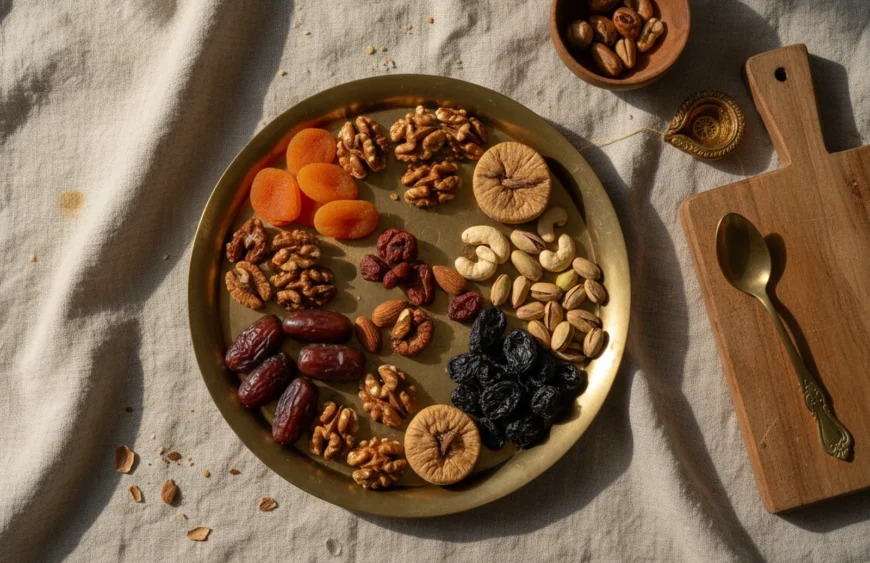
Eid Dry Fruit Gifts: Eid Dry Fruit Gifting: At a glance
Last updated: 19 May 2026
Eid dry fruit gifts are curated hampers built around dates (especially Ajwa and Medjool) and premium nuts, exchanged during Ramadan and on both Eid al-Fitr and Eid al-Adha. The format reflects the Sunnah of breaking iftar with dates and the seven-dates tradition that shapes Ramadan eating across observant households.
Most Indian families spend ₹1,000 to 4,000 per Eid hamper, with corporate and HNI orders reaching ₹8,000+. Dates carry roughly 75 to 85% sugar by dry weight per USDA FoodData Central, which is why a small portion at iftar restores blood glucose quickly after a 13-to-15 hour fast.
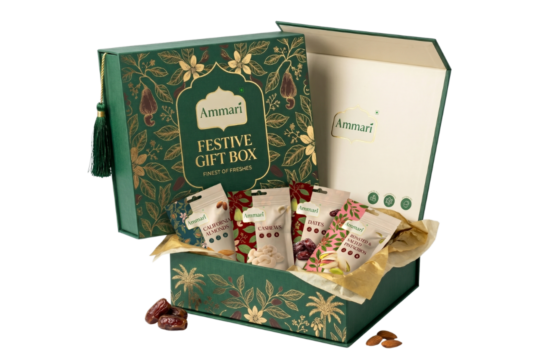
Ammari Foods ships Eid hampers built around Ajwa and Medjool dates, Mamra almonds, and Iranian pistachios, packed at our Jaipur facility. For the broader framework see our dry fruit gifting guide for India.
Why dates and dry fruits anchor Eid gifting
Eid dry fruit gifting – here is what actually matters when you choose. Eid sits at the end of Ramadan, the month in which observant Muslims fast from pre-dawn to sunset. Two practices shape the gifting category more than any festive tradition in India.
First, the iftar-with-dates Sunnah. The Prophet ﷺ is reported to have broken his fast with fresh dates, dry dates, or water in that order of preference. Most households follow this respectfully each evening of Ramadan. A gift of premium dates is, therefore, not a generic festive present; it is a practical, daily-use item during the month leading into Eid.
Second, the seven-dates tradition. A widely cited hadith mentions the protective benefit of eating seven Ajwa dates in the morning. Many families honour this through Ramadan with Ajwa specifically. The result: Ajwa dates from Madinah carry a spiritual and cultural weight in Eid gifting that no other variety matches.
These traditions explain why dates are not just one item in an Eid hamper, they are the centrepiece. Almonds, pistachios, and walnuts surround the date selection rather than competing with it.
A note on framing. The Sunnah is a spiritual practice with its own value, independent of modern nutrition research. That said, the practical fit is real: a 30 g serving of dates (roughly 3 to 4 Medjool) restores around 22 g of natural sugars and a small dose of potassium and magnesium per USDA data – the same nutrients depleted during a long fast. Tradition and physiology happen to align.
8 Eid hamper ideas across budget tiers (₹500 to 8,000+)
The Eid gifting market spans courtesy hampers exchanged between neighbours during Ramadan to flagship hampers given on Eid day itself. Match the hamper to the relationship and the moment in the calendar.
Tier 1. Ramadan-month courtesy and neighbour gifts (₹500 to 1,200)
- 250 g Medjool dates in a small fabric pouch. The simplest, most respectful Ramadan hand-out for neighbours, colleagues, and friends. Reads as a sincere gesture without overcommitting. Many households keep a small stack of these to send out as iftar invitations are exchanged.
- 200 g Medjool dates with a 100 g pack of California almonds. Pairs the iftar-opener with a small protein companion. Strong for sending across to non-Muslim neighbours during Ramadan as a “share our practice” gesture.
Tier 2. Eid day, close friends and second-tier family (₹1,500 to 3,500)
- 200 g Ajwa-and-Medjool dates assortment. 250 g each in a wood-veneer box. The respectful, on-tradition Eid day gift. Ajwa carries the spiritual weight; Medjool carries the eating-pleasure load. This pairing is the single most-given Eid hamper format in urban India.
- 200 g four-variety hamper. Ajwa dates, Medjool dates, Iranian pistachios, and Mamra almonds in equal portions, packed in a wood-veneer box. The standard primary-relative Eid hamper.
- Iftar-pairing combo. 250 g Ajwa dates, 150 g Mamra almonds, 150 g pistachios, plus a small jar of saffron-infused honey for the post-iftar dessert moment. The honey lifts the hamper above standard dry-fruit assortments and signals thought.
Tier 3. Eid day, primary family, elders, and important relationships (₹4,000 to 8,000+)
- Premium dates trousseau, 750 g. 250 g each of Ajwa, Medjool, and Sukkari in a velvet-lined wooden box. Particularly strong for older recipients and for the gift a son or daughter sends to parents on Eid morning. Restraint reads as luxury at this tier; do not over-fill.
- 6-variety brass-finish hamper. Ajwa and Medjool dates, Mamra and California almonds, Akbari pistachios, Kashmiri walnuts, in a reusable brass canister set. The brass container itself becomes a household object after Eid, doubling as memory.
- Eid-and-Ramadan subscription. A small weekly hamper through Ramadan plus a flagship hamper on Eid day. Increasingly common among family heads gifting to siblings across cities. Replaces the one-off gift with a relationship gesture across the month.
For B2B and client gifting during Ramadan and Eid (a growing segment in Indian metros), see our notes on corporate dry fruit gifting in India.
Ajwa vs Medjool: how to choose for an Eid hamper
The two dates do different jobs in an Eid hamper, and most first-time buyers do not realise this.
Ajwa dates from Madinah are smaller, drier, less sweet, and carry the strongest spiritual weight in Islamic tradition. They are the variety associated with the seven-dates hadith and with the Prophet’s ﷺ household. In a hamper, they signal respect, intention, and an understanding of the recipient’s practice. Texture is firmer; flavour is more raisin-like than caramel-like. Older recipients and observant households appreciate Ajwa over Medjool.
Medjool dates from the Jordan Valley are larger, softer, sweeter, and read as a luxury eating date. They are not a Sunnah-tradition variety, but they are the variety most people enjoy popping straight from the box. Children, younger relatives, and households new to dates lean Medjool.
The strongest Eid hamper carries both. Ajwa for the tradition signal, Medjool for the eating pleasure. Avoid hampers that pad the box with low-grade Kimia or Safawi as filler; the date selection is what the recipient evaluates first.
For a deeper comparison see our standalone explainer on Medjool vs Ajwa dates.
Pairing the hamper with iftar and Eid moments
Eid hampers serve three distinct moments. The format shifts slightly for each.
Iftar invitations during Ramadan. Hampers exchanged when one household hosts another for iftar. Keep these compact (200 to 250 g), date-heavy, and ready-to-eat the same evening. A pouch of dates plus a small pack of almonds is enough; the host has cooked a full meal already.
Sehri-week gifts to elders. A few families send a small hamper of dates and nuts to grandparents or elderly relatives during the last week of Ramadan, before the Eid day rush. Smaller portion, premium quality. Ajwa dates and Mamra almonds work especially well here for the recommended daily intake of dates most older recipients already follow.
Eid day flagship gift. The main hamper exchanged on Eid al-Fitr or Eid al-Adha morning, often accompanying a cash eidi envelope for younger relatives. This is where the wood box, brass canister, or velvet-lined trousseau lives. Larger format (200 g to 1 kg), six varieties, and presentation that reads beyond the food itself.
Skipping this segmentation is the most common Eid gifting failure: people send a single mid-tier hamper for all three moments and either over-deliver at iftar or under-deliver on Eid day.
Packaging and presentation notes
Eid packaging reads differently from Diwali or Raksha Bandhan. The cultural cues are restrained: deep greens, gold accents, geometric Islamic motifs, calligraphy. Avoid bright orange, marigold themes, and diya iconography that read as Hindu festival. When evaluating eid dry fruit gifting, the key is verification not branding.
Container hierarchy, low to high signal:
- Fabric pouch with a single ribbon → Ramadan courtesy gift
- Wood-veneer box with green-and-gold ribbon → Eid day mid-tier
- Velvet-lined wooden trousseau → Eid day primary family
- Brass canister set, optionally calligraphy-etched → VIP and elders
Halal context. Pure dry fruits and unflavoured nuts are inherently halal. If a hamper includes added items (chocolate-coated dates, honey, flavoured nuts), verify the included ingredient is halal-certified or alcohol-free, particularly when gifting outside immediate family or for corporate use. Most premium Indian dry fruit gifting brands now mark hampers as halal-friendly by default; ask if it is not stated.
Lead-time advice: when to order
The Eid window is calendar-locked but moves each year because Ramadan follows the lunar calendar. Plan from the relationship to the moon-sighting, not a fixed date.
- Two weeks before Ramadan begins. Confirm your hamper shortlist and the recipient list. Ajwa dates often book up at the supplier level a month before Ramadan; Medjool stays available longer.
- First week of Ramadan. Send out the Ramadan-month courtesy hampers and any iftar-invitation gifts. Early in the month builds goodwill and avoids the last-week rush.
- One week before expected Eid day. Order all Eid-day flagship hampers. Inter-city courier networks tighten in the final 48 hours.
- 48 hours before Eid. Only same-city express delivery is reliable. Inter-state shipping risks arriving the day after Eid, which collapses the gesture.
The single most common Eid gifting failure is treating the moon-sighting as the order trigger. The moon settles the date by a day or two; the hamper logistics need a full week of slack.
Sourcing transparency
- Ajwa dates: Madinah region, Saudi Arabia.
- Medjool dates: Jordan Valley.
- Almonds (Mamra): Aleppo Province, Iran and parts of eastern Afghanistan; Sep to Oct harvest.
- Almonds (California): Central Valley, USA; Aug to Oct harvest.
- Pistachios: Kerman Province, Iran; Akbari, Kerman, Ahmad Aghaei varieties.
- Walnuts: Sopore belt, Kashmir; paper-shell Kashmiri Akhrot.
Ammari Foods is a Jaipur-based online-only D2C brand. Hampers are assembled and vacuum-sealed at our Jaipur facility within 24 hours of dispatch, with halal-friendly handling and no cross-contact with non-halal ingredients. For the full sourcing framework and the questions to ask any Eid hamper brand before ordering, see our dry fruit gifting guide for India.
References & further reading
For independent reference points, the FSSAI Food Safety & Standards Authority of India is the standardised dataset we cross-check composition against. Clinical work like the NIN-Hyderabad Dietary Guidelines for Indians helps separate marketing claims from evidence.
Frequently Asked Questions
What is the best Eid dry fruit gift under ₹2,000?
The strongest sub-₹2,000 Eid hamper is a 200 g Ajwa-and-Medjool dates assortment with 250 g of each variety in a wood-veneer box. The Ajwa carries the Sunnah-tradition weight that observant recipients recognise immediately; the Medjool covers eating pleasure for younger family members and children. Add a 100 g pack of Mamra almonds if budget allows. The combination reads as considered and respectful, not as a generic festive hamper, and ships safely cross-city. Avoid hampers padded with lower-grade Kimia or Safawi at this tier.
Why are dates the centrepiece of Eid hampers?
Dates anchor Eid hampers because of the Sunnah of breaking iftar with dates and water, a practice followed by most observant households each evening of Ramadan. The seven-dates tradition (associated with Ajwa specifically) reinforces the role through the month. Nutritionally, dates restore the natural sugars and small amounts of potassium and magnesium depleted during a 13-to-15 hour fast, per USDA FoodData Central composition data. Tradition and physiology align: a small portion of premium dates at iftar is both spiritually grounded and practically restorative.
When should I order Eid dry fruit gifts?
Order Eid-day flagship hampers at least one week before the expected Eid date, working from the moon-sighting calendar each year. Ajwa dates often book up at the supplier level a month before Ramadan, so confirm your shortlist by two weeks before Ramadan begins. Ramadan-month courtesy hampers can ship through the first week of the month. Inter-state courier networks tighten 48 hours before Eid; last-minute orders only succeed for same-city express delivery. Build in a week of slack so the gesture lands on Eid morning, not the day after.
Are Ajwa or Medjool dates better for an Eid hamper?
Both, in roughly equal portions. Ajwa dates from Madinah carry the strongest spiritual weight in Islamic tradition and are the variety associated with the Sunnah of seven dates; observant and older recipients value them most. Medjool dates from the Jordan Valley are larger, softer, and sweeter, reading as a luxury eating date for children and younger relatives. A 250 g + 250 g split in a single hamper covers both audiences and signals you understand the difference. Pure-Medjool hampers feel modern but lose the tradition signal; pure-Ajwa hampers can feel austere for mixed-age households.