Pistachios Vs Cashews Nutrition: At a glance
Last updated: 19 May 2026
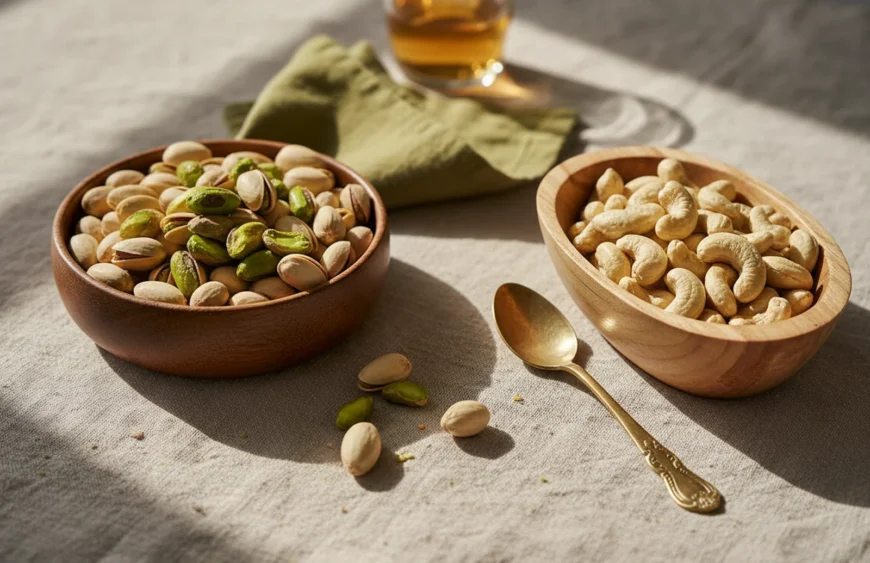
Pistachios and cashews look similar on a snack plate but split sharply on nutrition. Pistachios carry more protein, more fibre, and more antioxidants. Cashews carry more carbohydrate, slightly more zinc, and a creamier texture for cooking.
- Protein per 100 g: pistachios ~20 g; cashews ~18 g (USDA FoodData Central).
- Fibre per 100 g: pistachios ~10 g; cashews ~3.3 g. Pistachios deliver roughly 3x the fibre.
- Calories per 100 g: pistachios ~560 kcal; cashews ~553 kcal. Functionally identical for portion planning.
- Antioxidants: pistachios deliver lutein and zeaxanthin (eye-health carotenoids); cashews carry none of these in meaningful amounts.
- Glycemic index: pistachios about 15; cashews about 25. Both low, pistachios slightly better for blood-sugar steadiness.
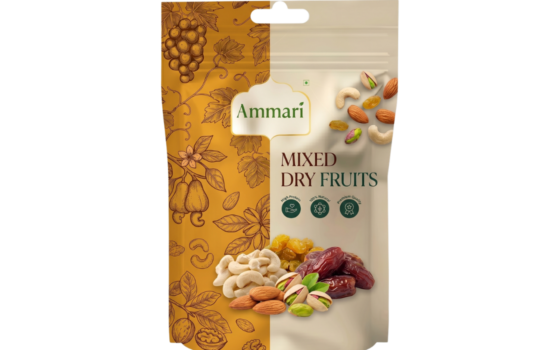
- Ammari stocks Iranian-origin Akbari pistachios and W-320 cashews, packed to order in Jaipur.
For Indian buyers, our Iranian pistachios buying guide covers grades, origin, and pricing.
Origin and basic identity
Pistachios are the seeds of Pistacia vera, a tree native to Central and West Asia. The major commercial origins today are Iran (Akbari, Kerman, Ahmad Aghaei varieties) and the USA (California). India imports nearly all of its premium pistachios from Iran, with smaller volumes from California. The shell splits naturally when the kernel ripens, which is why pistachios are sold in-shell more often than other nuts.
Cashews are the seeds of Anacardium occidentale, native to north-eastern Brazil but now grown extensively across Vietnam, India, Ivory Coast, and Tanzania. India is both the largest producer and the largest processor in the world. The kernel comes from inside a kidney-shaped shell that contains caustic oil; this is why cashews are never sold in-shell and are always processed before reaching the consumer.
Pistachios vs cashews nutrition – here is what actually matters when you choose. The processing difference matters for price. Pistachios reach the buyer with minimal processing once cracked open. Cashews go through steam, drying, shelling, peeling, and grading before they hit the pack. That labour cost is one reason cashews carry higher per-kilo prices than the protein and fibre numbers alone might suggest.
Nutrition per 100 g, head to head
| Nutrient | Pistachios | Cashews | Winner | |-|-|-|-| | Calories | 560 kcal | 553 kcal | tie | | Protein | 20.6 g | 18.2 g | pistachios | | Fat (total) | 45.3 g | 43.8 g | tie | | Saturated fat | 5.9 g | 7.8 g | pistachios | | Carbohydrates | 27.5 g | 30.2 g | pistachios | | Sugars | 7.7 g | 5.9 g | cashews | | Fibre | 10.3 g | 3.3 g | pistachios | | Potassium | 1025 mg | 660 mg | pistachios | | Magnesium | 121 mg | 292 mg | cashews | | Iron | 3.9 mg | 6.7 mg | cashews | | Zinc | 2.2 mg | 5.8 mg | cashews | | Vitamin B6 | 1.7 mg | 0.4 mg | pistachios | | Lutein + zeaxanthin | 1405 mcg | 22 mcg | pistachios |
The headline gap is fibre. Pistachios carry roughly three times the dietary fibre of cashews per 100 g. That gap shows up in satiety: a 30 g pistachio snack typically holds appetite longer than the same weight of cashews, especially when eaten in-shell where the act of cracking each kernel slows down the eating pace.
The second headline is minerals. Cashews are notably richer in iron, zinc, and magnesium. For vegetarian Indian diets concerned about zinc and iron, cashews carry a real advantage. Pistachios win back ground on potassium and B6.
The third headline is antioxidants. Pistachios carry roughly 1,400 micrograms of lutein and zeaxanthin per 100 g, which is one of the highest levels in any tree nut. These carotenoids accumulate in the retina and support long-term eye health. Cashews contain almost none of these compounds.
Satiety, glycemic load, and weight management
For weight management, pistachios have the edge on three counts.
- Higher fibre means longer satiety. A controlled feeding study published in Nutrition (2014) compared 56 g pistachio and 56 g pretzel snacks in adults; the pistachio group reported lower hunger scores at the next meal.
- Lower glycemic index. Pistachios sit around GI 15; cashews around GI 25. Both are low, but pistachios produce slightly less of a post-snack blood-sugar bump.
- The shell effect. In-shell pistachios slow the eating pace by 40 to 50 percent because each kernel requires cracking. Visual evidence of empty shells also signals fullness. Cashews have no equivalent friction; a 100 g cashew snack disappears quickly.
For diabetics, pistachios at 30 g per day are typically the first nut clinical dietitians recommend after almonds and walnuts. Cashews are not excluded but carry slightly higher carbohydrates per 100 g, so portion control matters more.
For our take on portion sizing across nuts, see how many pistachios per day.
Cooking and culinary use
The two nuts behave differently in the kitchen.
- Pistachios are typically used in two states: lightly roasted and salted for snacking, or coarsely chopped as a garnish for kheer, kulfi, badam halwa, and biryani. The green colour adds visual contrast that cashews cannot match. Pistachio paste is a premium ingredient in some south-Indian sweets and in modern Indian fine dining. The flavour is grassy and slightly resinous.
- Cashews dominate Indian cooking. Cashew paste is the base of Mughlai gravies, korma, paneer makhani, and shahi paneer. Whole cashews fry quickly to a golden tone in ghee for biryani garnish. The flavour is gentle, buttery, and disappears into a sauce without competing for attention. Cashew milk has emerged as a creamy dairy-free alternative in coffee and smoothies.
For an Indian household keeping one of each, the typical pattern is: pistachios for direct snacking and visual garnish, cashews for cooking heavier dishes and ground-paste use. Substituting cashews for pistachios in a kheer changes the colour and flavour profile significantly.
Price in India 2026
| Variety | Indicative price (₹/kg) | Best use | |-|-|-| | Iranian Akbari pistachios (large) | 2,400 to 3,600 | Premium gifting, direct snacking | | Iranian Kerman pistachios (medium) | 1,800 to 2,800 | Daily snacking, mithai garnish | | California pistachios | 1,400 to 2,200 | Daily snacking, baking | | W-180 cashews (jumbo) | 1,400 to 1,900 | Gifting, premium garnish | | W-240 cashews (large) | 1,000 to 1,500 | Cooking, daily snacking | | W-320 cashews (medium) | 800 to 1,200 | Cooking paste, ground use |
Premium grades of either nut land in similar price brackets in 2026. The shell on pistachios accounts for about 45 percent of the weight, which is why kernel-only pricing for pistachios is roughly double the in-shell figure.
For the pistachio grade landscape, our Akbari vs Kerman comparison covers size, flavour, and price in more detail.
Allergies and digestion notes
Both pistachios and cashews are tree nuts and share cross-reactivity in some people with mango allergy (cashews are botanically related to mangoes). Tree-nut allergy is the second most common nut allergy after peanuts in India. If you have a confirmed tree-nut allergy, both should be avoided. When evaluating pistachios vs cashews nutrition, the key is verification not branding.
For digestion, pistachios are slightly heating in Ayurvedic terms and best soaked overnight in summer. Cashews are considered neutral and tolerate well year-round. Both should be stored airtight; pistachios go rancid faster than cashews because of the higher unsaturated fat content.
Sourcing transparency
- Pistachios: Iranian Akbari and Kerman grades sourced through verified shippers from Rafsanjan and Kerman provinces.
- Pistachio harvest: September. Air-dried at origin, vacuum-packed for shipping.
- Cashews: W-180 and W-320 grades from Indian processors in Kerala and Karnataka.
- Cashew harvest: February through May (Indian harvest cycle).
- Storage on arrival: vacuum-packed pouches at our Jaipur facility, humidity-controlled.
- Where we ship from: Ammari Foods, Jaipur. Online-only D2C, all-India shipping.
Both grades are stocked at Ammari Foods, packed to order in small batches.
References & further reading
For independent reference points, the USDA FoodData Central – nutrient database is the standardised dataset we cross-check composition against. Clinical work like the PubMed – pistachios and metabolic health helps separate marketing claims from evidence.
Frequently Asked Questions
Which has more protein, pistachios or cashews?
Pistachios carry about 20.6 g of protein per 100 g compared with 18.2 g for cashews. That is a meaningful gap for snack-portion-based vegetarian diets. A 30 g pistachio snack gives roughly 6 g protein; the same weight of cashews gives roughly 5.5 g. For overall plant-protein density, pistachios edge ahead, though almonds at 21 g per 100 g still lead the tree-nut category narrowly.
Are cashews higher in fat than pistachios?
Total fat is essentially the same: pistachios about 45 g per 100 g, cashews about 44 g. The split differs slightly. Cashews carry more saturated fat (7.8 g versus 5.9 g) and pistachios carry more monounsaturated fat. Both are heart-friendly in moderate portions; neither is a low-fat food.
Which is better for diabetics?
Pistachios are typically the first choice. The lower glycemic index (about 15 versus 25 for cashews), higher fibre (10.3 g versus 3.3 g per 100 g), and slower eating pace when consumed in-shell all favour blood-sugar steadiness. Cashews are not excluded but should be portioned at 20 to 25 g rather than 30 g per snack. Pair either with protein and fibre for slower absorption.
Are cashews fattening?
No more than any other tree nut. At about 553 kcal per 100 g, cashews sit in the same calorie band as pistachios, almonds, and walnuts. Weight outcomes depend on total daily intake, not nut-versus-nut choice. A 25 to 30 g portion per day fits most weight-management plans.
Why are Iranian pistachios more expensive than California pistachios?
Iranian Akbari and Kerman varieties are larger, longer, and more flavour-dense than California pistachios. The flavour profile is more pronounced and the colour is darker. Indian buyers traditionally prefer the Iranian grades for gifting and mithai garnish. Price reflects size and demand, not nutrition; California pistachios deliver near-identical macros and micros at a lower price point.
Can I substitute cashews for pistachios in kheer?
Yes for flavour, no for colour. Cashew kheer has a creamier, more buttery profile and a lighter colour. Pistachio kheer has a grassier flavour and a green tint that signals premium presentation. For traditional dishes where the pistachio green is part of the look (badam halwa, kulfi topping, biryani garnish), keep pistachios. For cashew-paste-based sauces, do not substitute pistachios; the resinous flavour competes with the dish.
Which has more iron?
Cashews. Per 100 g, cashews carry about 6.7 mg of iron compared with 3.9 mg for pistachios. For vegetarian Indian diets where plant iron sources matter, cashews are useful. Combine either nut with vitamin-C-rich foods (lemon, amla) to improve iron absorption.
How many of each can I eat per day?
For pistachios: 30 g in-shell, which is about 20 to 25 kernels, is the standard daily portion (~165 kcal). For cashews: 25 to 30 g, which is about 18 to 22 whole cashews, is the standard daily portion (~140 to 170 kcal). Both fit easily into a balanced diet at these amounts.