The Complete Dry Fruit Gifting Guide India: Diwali, Eid, Wedding & Corporate Hampers (2026)
Dry Fruit Gift Box: Dry Fruit Gifting Guide India: The Short Answer
Last updated: 19 May 2026
Premium dry fruits remain the most thoughtful Indian gift – survives all dietary restrictions, ages well, scales from ₹500 to ₹15,000+.
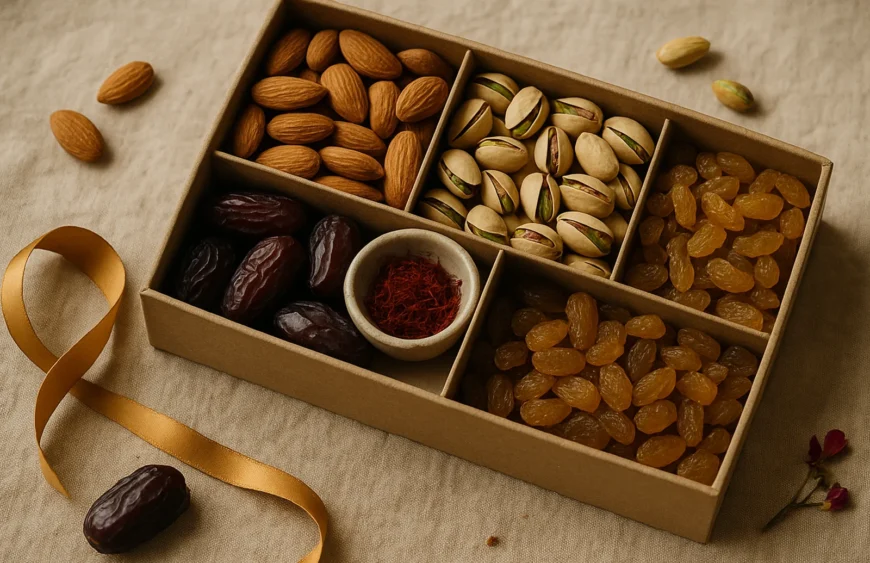
- Diwali (largest season): ₹1,500–2,500 mid-tier hamper covers 80% of needs – almonds, cashews, pistachios, dates, raisins in archival kraft box.
- Eid & Ramadan: dates first, then mewa – Ajwa or Medjool plus a mix of nuts; modest premium presentation.
- Wedding: ribbon-matched custom hampers, monogrammed cards, ₹2,000–8,000 per recipient depending on tier.
- Corporate: ₹500–1,000 entry, ₹1,500–2,500 mid, ₹3,000–4,000 managers, ₹5,000+ leadership; stay under ₹5,000 perquisite threshold.
- Five-component framework: base nut + accent nut + dates + raisins/figs + premium accent (saffron, raw honey, dry fruit jam).
- Avoid: plastic-heavy presentation, generic chocolate add-ons, undated stock, “premium” labels without origin.
A dry fruit gift hamper (mewa tohfa) is a curated assortment of premium nuts and dried fruits, traditionally exchanged in India during Diwali, Eid, Raksha Bandhan, and weddings, and increasingly used for corporate appreciation gifts. The composition – typically almonds, cashews, pistachios, raisins, and dates – is shaped by long-standing associations with prosperity and wellness, and the hamper itself has become a flexible vehicle that suits everything from a small ₹999 office gift to a ₹8,000+ luxury wedding shagun. This guide covers when, why, and how to gift dry fruits well across India in 2026.
Why dry fruits became the gold standard for Indian gifting
Dry fruit gifting guide india – here is what actually matters when you choose. Mewa has been the auspicious tohfa of choice in wealthy Indian households for centuries. Mughal court records mention almonds and pistachios as standard imperial gifts, and Ayurvedic and Unani texts long associated dry fruits with prosperity, vitality, and considered hospitality. That cultural memory is still doing quiet work every time a hamper changes hands.
Three practical reasons explain why the shift from sweets (mithai) to dry fruits (mewa) accelerated over the last fifteen years. First, universal acceptability – dry fruits are vegetarian by default, contain no eggs, no alcohol, no animal-derived gelatin, and sit comfortably with Jain, Muslim, and Hindu households alike. A box of mithai often carries dietary caveats; a box of mewa rarely does. Second, shelf life – a sealed hamper keeps for six to nine months, which means recipients can save it, share it across visiting relatives, or open it slowly through the festive season rather than racing the clock on a perishable mithai box. Third, perceived taste – a thoughtfully curated hamper signals considered taste and a higher price point per gram than a generic chocolate or sweet box, which matters when the gift is doing reputation work for the giver.
The pandemic accelerated the trend further. Hygiene concerns made packaged, sealed gifting feel safer than open mithai trays, and corporate India quietly standardised on dry fruit hampers as the default Diwali gift. By 2026, mewa is no longer the upmarket alternative to mithai – for many givers it is simply the default.
Diwali gifting – the biggest season of the Indian gifting calendar
Diwali is the single largest gifting event in India, accounting for the majority of annual hamper volume across the industry. Roughly two weeks before the festival, corporate procurement teams, family households, and small business owners all begin placing the same order: a clean, sealed dry fruit hamper that will travel by car, courier, or driver across cities and offices.
The classic Indian Diwali box used to be a four-component tray: California almonds, whole cashews, golden raisins, and dates, often in equal weight compartments. Over the last five years, two upgrades have entered the mix at the mid and premium tiers – Medjool dates from Saudi Arabia and Jordan have largely displaced ordinary chuara, and Iranian pistachios have become the standard “premium accent” alongside or instead of cashews. A Diwali hamper without at least one of these is starting to feel a little dated.
Pricing tiers for Diwali 2026 run as follows. Entry tier (₹500-1,000) covers small family gifts and lower-band employee hampers – typically 250-400g across three or four components. Mid tier (₹1,500-2,500) is the corporate workhorse, with five components and around 600-900g of product. Premium tier (₹3,000-6,000) adds Medjool dates, Iranian pistachios, and often a small jar of saffron or honey. Luxury tier (₹8,000+) involves Mamra almonds, Kashmiri walnuts, A-grade Iranian saffron, and lacquered presentation boxes for senior leadership and key clients.
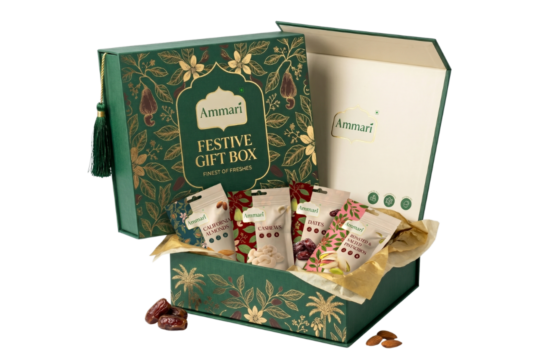
Bulk corporate orders are best placed three to four weeks before Diwali – see our festive gift box for the standard mid-tier composition, or contact us directly for fully customised volume orders.
Eid & Ramadan gifting – dates first, then mewa
The Eid gifting cycle has its own distinct shape. Through Ramadan, dates take centre stage – the Sunnah practice of breaking the fast (iftar) with dates means a small box or pouch of premium dates is the most-given gift across the month, often arriving before any larger hamper. Ajwa dates from Madinah carry particular religious significance and are commonly gifted by friends and family returning from Hajj or Umrah; their dense, almost prune-like sweetness and traditional associations make them a considered Ramadan tohfa rather than a generic snack.
Larger Eid-ul-Fitr and Eid-ul-Adha hampers usually arrive in the days before Eid itself or are exchanged after the morning prayer. Composition leans toward dates (Ajwa for religious significance, Medjool for energy and wider appeal), almonds, pistachios, and cashews, with vermicelli and cardamom often added when the recipient is expected to make sheer khurma – the traditional Eid morning dessert. A “sheer khurma kit” – fine vermicelli, premium dates, slivered pistachios, blanched almonds, and a small pouch of green cardamom – has become a popular gifting concept in 2026, especially among younger urban Muslim households.
For families with members returning from Hajj or Umrah, the gift flow runs in the other direction too: Madinah dates, Zamzam-themed pouches, and small mewa boxes are distributed to friends, neighbours, and colleagues as part of the welcome-home tradition.
Wedding & festive gifting – across every ceremony
Indian weddings move through a long cascade of ceremonies, and dry fruit hampers appear at almost every one. Roka and Sagai (engagement) often begin with mid-tier mewa boxes exchanged between the two families. Sangeet and Mehendi tend to bring smaller, decorative trays for close family. The wedding ceremony itself frequently involves a larger ritual gifting moment – badhai mewa boxes from the bride’s family side, shagun hampers from the groom’s family side, and individual boxes distributed to extended family, drivers, and household staff. Post-wedding, the same hampers travel back to in-laws’ homes, neighbours, and visiting guests for weeks afterward.
Quantity guidance for a mid-size Indian wedding (200-400 guests) typically runs 50-200 hampers across the full ceremony arc, depending on whether boxes are per-family or per-guest. A larger destination wedding can easily push that to 300-600 boxes. Customisation is where weddings differ most sharply from corporate gifting: ribbon colour matched to the wedding palette, a printed monogram or couple-initial sticker on the box, a printed message card with the family name and date, and occasionally fully bespoke compartments to suit the family’s preferred dry fruit mix.
Premium-tier wedding hampers (₹3,000-6,000 each) usually carry six to seven components, with at least one luxury accent – A-grade saffron, Iranian pistachios, Medjool dates, or Kashmiri walnuts. Everyday corporate hampers can lean toward volume; wedding hampers lean toward presentation, because every box is photographed, posted, and remembered. Lead time on a fully customised wedding order is typically two to three weeks, longer if printing and embossing are involved. The full gift box collection covers most wedding needs out of the catalogue, and bespoke orders are quoted directly.
Corporate gifting – what HR and procurement teams should know
Corporate dry fruit gifting in India is now a structured procurement category, and most mid-to-large companies run it through a defined band system. Entry-band employees typically receive ₹500-1,000 hampers; mid-band ₹1,500-2,500; manager-band ₹3,000-4,000; and leadership and key client gifts at ₹5,000+. Vendor and channel-partner gifting often sits at ₹2,000-3,500 per recipient, with a smaller premium tier for top-ten relationships.
Tax positioning matters in 2026. Gifts under ₹50,000 in aggregate per recipient per financial year to non-employees (clients, vendors, partners) generally remain tax-friendly under the current Income Tax Act framework, and dry fruit hampers sit comfortably within that band for almost every corporate gifting use case. Employee gifting is treated separately as a perquisite above ₹5,000 – most corporate hampers are deliberately priced just under that threshold for that reason. (Consult your finance team for specifics; tax rules shift.)
Why dry fruits beat corporate-logo merch is straightforward: a printed water bottle or notebook ends up in a drawer; a sealed dry fruit hamper goes home, gets shared with the family, and is remembered through the festive week. The brand association lives longer when the gift gets eaten and discussed across a household. Bulk volume pricing typically opens at 25-50 unit brackets, with meaningful per-unit reductions at 100, 250, and 500 units. Lead time considerations matter: 10-15 days is the typical floor for fully customised hampers in festive season – earlier orders get better customisation slots and avoid the late-October courier crunch.
Curating your hamper – the five-component framework
The difference between a generic mewa box and a thoughtful tohfa is usually structural. Most strong hampers – across price points – follow a simple five-component framework that balances familiarity, premium-ness, sweetness, tradition, and surprise.
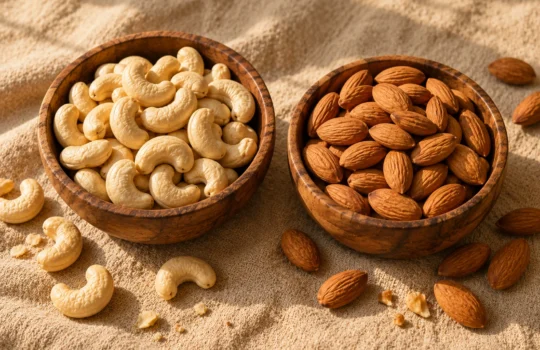
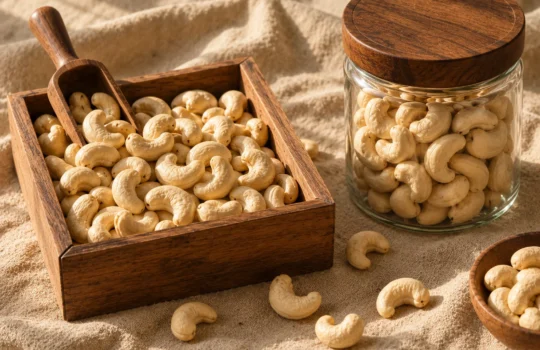
- 1. Anchor nut – the volume base of the hamper. California almonds or whole cashews are the two reliable choices; almonds skew slightly more traditional, cashews slightly more universal.
- 2. Premium accent – the component that signals price tier. Iranian pistachios are the default in 2026; Kashmiri walnut halves work for premium and luxury tiers.
- 3. Dried fruit – the chewy, sweet counterweight. Medjool dates (large, soft, caramel-like) at premium tier; Turkish dried figs or Iranian black raisins at mid tier.
- 4. Traditional staple – the familiar, comforting element. Golden raisins (kishmish), dried apricots (khubani), or chuara dates fit here, and quietly anchor the box in Indian tradition.
- 5. Surprise element – the small unexpected jar that lifts the hamper above standard. A 1g vial of Kashmiri saffron, a 50g jar of raw forest honey, or a small tin of premium green cardamom does this work.
Three sample compositions across price tiers, using this framework: ₹999 hamper – California almonds, whole cashews, golden raisins, chuara dates, small saffron sachet. ₹2,499 hamper – California almonds, whole cashews, Iranian pistachios, Medjool dates, golden raisins, with a small saffron vial. ₹4,999 hamper – Mamra almonds, jumbo cashews, Iranian pistachios, Medjool dates, Turkish figs, golden raisins, A-grade Kashmiri saffron, and raw honey. Browse the mixed dry fruits range to compose your own, or start from our pre-curated festive gift box as a base.
Packaging & presentation matters
Two hampers with identical contents can land very differently depending on the box, lining, and ribbon. Box quality is the most visible signal – a sturdy archival kraft or lacquered hardboard box reads as considered, while a flimsy printed-cardboard box undoes the work of whatever sits inside. Lining matters for the same reason: jute, raw silk, or natural tissue paper looks considered; cheap shredded paper does not. A wide satin or grosgrain ribbon in a single warm tone (gold, deep red, ivory) and a small handwritten kraft message card add the last 10 percent that the recipient actually remembers.
Regional aesthetics split into two broad camps. Kraft and jute presentation reads as rustic-premium and lands well with younger urban recipients and corporate gifting. Lacquered hardboard boxes with embossed metallic detail read as traditional luxury and suit older family recipients and wedding shagun. Sustainability matters more than it did five years ago – over-plastic, individually shrink-wrapped compartments are starting to feel dated, and recipients increasingly notice. All Ammari hampers ship in archival kraft boxes with natural jute lining and a satin ribbon – consistent across every tier – because a single visual brand makes the gift feel finished regardless of what is inside.
References & further reading
For independent reference points, the FSSAI Food Safety & Standards Authority of India is the standardised dataset we cross-check composition against. Clinical work like the NIN-Hyderabad Dietary Guidelines for Indians helps separate marketing claims from evidence.
Frequently Asked Questions
What is the best dry fruit gift for Diwali?
For most Diwali gifting situations in India, a mid-tier hamper of ₹1,500-2,500 covers 80 percent of needs – five components built around California almonds, whole cashews, Iranian pistachios, Medjool dates, and golden raisins, presented in an archival kraft box with a satin ribbon. Add A-grade saffron or raw honey as a surprise fifth element if the recipient is senior or the relationship is important. Avoid plastic-heavy presentation and generic chocolate add-ons – both dilute the gift.
How much should I spend on a corporate Diwali hamper?
Indian corporate Diwali budgets in 2026 typically run ₹500-1,000 for entry-band employees, ₹1,500-2,500 for mid-band, ₹3,000-4,000 for managers, and ₹5,000+ for leadership and key clients. Vendor and channel-partner gifting usually sits at ₹2,000-3,500 per recipient, with a smaller premium tier for top relationships. Most companies deliberately keep employee hampers just under the ₹5,000 perquisite threshold. Bulk pricing typically opens meaningful discounts at 50, 100, 250, and 500 unit brackets.
Can I customise a dry fruit hamper for my wedding?
Yes – wedding customisation typically covers ribbon colour matching, printed or embossed monograms, custom message cards with family names and dates, bespoke compartment selection, and occasionally fully customised box sizes. Lead time runs 10-21 days depending on quantity and complexity, longer if printing or embossing is involved. Mid-size Indian weddings typically order 50-200 hampers across the full ceremony arc; destination weddings can run 300-600. Place enquiries three to four weeks ahead of the function for the smoothest run.
What is the shelf life of a dry fruit gift box?
A sealed dry fruit hamper from a fresh-crop batch keeps for six to nine months at Indian room temperature in a cool, dry place. In humid coastal cities like Mumbai or Chennai, refrigerate the box once opened to push that out to ten to twelve months and prevent the oils in nuts from turning rancid. Vacuum-sealed and nitrogen-flushed compartments hold quality longer. Saffron and honey, if included, keep substantially longer than the nuts. Always check the harvest year on the pack rather than just the packaging date.
How early should I order corporate hampers for Diwali?
For fully customised corporate hampers – logo printing, ribbon colour matching, custom message cards – order three to four weeks before Diwali. The standard floor is 10-15 days lead time, but late October courier networks get heavily congested, and the best customisation slots fill first. Bulk orders above 250 units benefit most from early placement. Off-the-shelf hampers can usually be sourced at one to two weeks notice, but supply tightens sharply in the last ten days before the festival.
Looking for more? explore our premium dry fruit range at Ammari Foods – almonds, pistachios, dates, walnuts and curated gift boxes.