How To Identify Real Kashmiri Walnuts: The Short Answer
Last updated: 19 May 2026
Real Kashmiri walnuts pass seven physical tests. Chilean walnuts relabelled as Kashmiri fail at least three.
- Kernel size: small to medium halves – never the large uniform halves of Chilean
- Kernel colour: deep amber to dark tan, with rich variation between halves
- Flavour: intensely nutty with pronounced bitter undertones from the tannin-rich skin
- Shell character: thicker, more rugged shells with rougher texture (when sold in-shell)
- Oil content: ~65% – the kernel feels denser and oilier than Chilean
- Origin label: “Kashmir” or “Indian” specifically – not “imported” or vague
- Price: ₹1,400 to ₹2,800 per kg for verified Kashmiri. Below ₹900/kg = almost certainly Chilean.
For variety-specific guidance, see our Kashmiri vs Chilean walnuts buying guide.
Why fake Kashmiri walnuts dominate Indian markets
How to identify real kashmiri walnuts – here is what actually matters when you choose. Kashmiri walnut production has declined steadily for decades – orchards converted to apples and other crops, climate change affecting yields, supply chain disruptions in the Valley. Real Kashmiri akhrot today represents a small fraction of total walnut consumption in India. The gap is filled by Chilean imports and California-grown US walnuts, often relabelled as “Kashmiri” or “Indian” for the price premium.
Chilean walnuts retail at ₹700 to ₹1,400 per kg in India; real Kashmiri at ₹1,400 to ₹2,800 per kg. The 2× premium is a real incentive to relabel. Compounding this, most consumers can’t visually distinguish between the two – both are walnut halves, both cream the same in milk-based recipes – so relabelling goes undetected at scale.
The 7 tests, in order of reliability
Run these tests on any pack you suspect:
Test 1 – Kernel size and uniformity (visual)
Pour a sample onto a plate:
- Real Kashmiri: small to medium halves with significant size variation – some halves visibly smaller than others. Length 18 to 22 mm is typical.
- Chilean: larger, more uniform halves. Length 22 to 28 mm. Industrial sizing produces the uniformity.
- Californian: largest of the three, sometimes 28 to 32 mm. Most uniform.
If a “Kashmiri” pack contains uniform large halves, it is NOT real Kashmiri. The size variation in real Kashmiri batches is genetic and harvest-method-driven; it cannot be faked.
Test 2 – Kernel colour (visual)
Look at colour distribution:
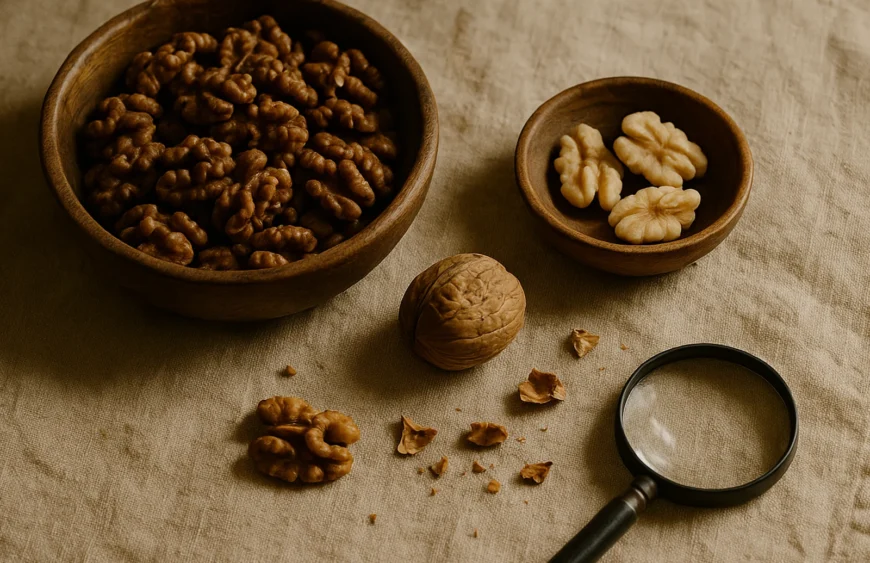
- Real Kashmiri: deep amber to dark tan halves with rich tonal variation – some lighter, some darker. The skin colour reflects the growing climate and traditional dry-on-tree harvesting.
- Chilean: uniformly pale amber to light cream. Industrial drying equalises colour.
- Bleached: unnaturally white kernels – chemical bleach used to mask age. Avoid.
Uniform pale cream kernels = not Kashmiri.
Test 3 – Flavour intensity (sensory)
Taste a kernel:
- Real Kashmiri: intensely nutty with pronounced bitter undertones from the tannin-rich brown skin. Aftertaste lingers complex.
- Chilean: milder nutty flavour, less bitter, cleaner finish.
- Californian: mildest of the three, sweetest, least bitter.
If a “Kashmiri” walnut tastes mild and sweet without bitterness, it is not Kashmiri. The bitter undertone is the variety’s signature.
Test 4 – Shell character (when sold in-shell)
If buying in-shell akhrot:
- Real Kashmiri: thicker, more rugged shells with rougher texture and irregular ridges. Cracking takes more effort.
- Chilean: smoother shells, easier to crack, more uniform shape.
- Californian: thinnest shells, easiest to crack, most uniform.
Kashmiri shells are harder to crack – that’s a feature, not a flaw.
Test 5 – Oil content / density (tactile)
Pick up a few kernels and feel their weight:
- Real Kashmiri: denser, slightly oilier feel; ~65% fat content.
- Chilean: lighter, drier feel; similar fat content but the kernel structure differs.
After eating one, the lingering oily feel on your fingers is more pronounced with real Kashmiri.
Test 6 – Origin label specificity
Read the pack label carefully:
- Real Kashmiri walnuts: explicitly state “Kashmir” or “Kashmiri” or “Indian” with origin details. Sometimes specify region (Anantnag, Baramulla, Kupwara districts).
- Suspect: “Imported”, “Premium walnuts”, “Walnut halves” without origin detail.
- Definitely not Kashmiri: “Chile”, “Chilean”, “California”, “USA” – these are the actual imported origins masquerading.
If the origin is vague, assume it’s not Kashmiri.
Test 7 – Price honesty
The market price floor for real Kashmiri:
- Real Kashmiri walnuts: ₹1,400 to ₹2,800 per kg
- Suspect “Kashmiri” at ₹900-1,300/kg: almost certainly Chilean relabelled
- Definitely not Kashmiri at ₹650-950/kg: Chilean or Californian
- Chilean walnuts (honest pricing): ₹700 to ₹1,400 per kg
- Californian walnuts (honest pricing): ₹650 to ₹1,200 per kg
Real Kashmiri cannot retail profitably below ₹1,400/kg given supply constraints. Anyone selling “Kashmiri” cheaper is selling something else.
What to ask the seller
- “Which Kashmiri district does this come from?” – honest answer: Anantnag, Baramulla, Kupwara, or another specific district. Vague answer = not real Kashmiri.
- “What harvest year?” – Kashmiri walnut harvest is September-October. Should be known.
- “Are these Indian-grown or imported?” – direct question forces honesty.
- “Can I taste a sample?” – refusal is a warning.
Sourcing transparency
- Variety: Kashmiri walnuts (akhrot)
- Origin: Kashmir Valley, India (specific districts: Anantnag, Baramulla, Kupwara, Pulwama)
- Harvest: September through October
- Yield characteristics: declining production over recent decades; supply-constrained
- Verified retail price band: ₹1,400 to ₹2,800 per kilogram
Related reading
References & further reading
For independent reference points, the USDA FoodData Central – nutrient database is the standardised dataset we cross-check composition against. Clinical work like the PubMed – walnuts and cognitive function helps separate marketing claims from evidence.
Frequently Asked Questions
How can I tell if walnut halves are Kashmiri or Chilean?
Three quickest tests: size (Kashmiri has visible size variation, Chilean is uniform large halves), colour (Kashmiri is darker amber with tonal variation, Chilean is uniformly pale), and taste (Kashmiri is intensely bitter from the skin, Chilean is mild). If all three tells say Chilean, it’s Chilean – regardless of label.
Why are real Kashmiri walnuts so expensive?
Three reasons: declining Kashmiri production (orchards converting to other crops), constrained Valley supply chain (transport, climate disruptions), and traditional dry-on-tree harvesting which produces lower yields. The 2× premium over Chilean reflects real production economics, not just brand positioning.
Are Kashmiri walnuts always organic?
Not by default. The variety refers to origin and growing region, not certification. Some Kashmiri walnut growers practice traditional low-input farming that’s effectively organic, but it’s only certified organic if explicitly labelled. Look for separate organic marks if certification matters.
How do I store Kashmiri walnuts?
Refrigerate after opening – Kashmiri walnuts have higher oil and oxidise faster than Chilean. At Indian room temperature in an airtight container, expect 3-5 months of good quality. Refrigerated: 6-9 months. Frozen: up to 12 months. The high oil content is exactly why they go rancid faster – handle with care. When evaluating how to identify real kashmiri walnuts, the key is verification not branding.
Can I trust an FSSAI-certified pack of Kashmiri walnuts?
FSSAI certifies food safety and packaging accuracy at the manufacturing level – but doesn’t guarantee that the variety claim is correct. FSSAI is a baseline; you still need the seven physical tests to confirm the walnuts are actually Kashmiri origin versus Chilean relabelled.
What’s the difference between Kashmiri and Indian walnuts?
“Indian walnuts” is a broader term that includes Kashmiri, Himachali (smaller production), and Uttarakhand walnuts. Kashmiri specifically means Kashmir Valley origin. Most premium “Indian” walnuts are in fact Kashmiri. Some sellers use “Indian” interchangeably; some use it to imply Kashmiri without the price premium.
Is the bitterness in Kashmiri walnuts a quality issue?
No – it’s the variety’s signature. The brown skin (called pellicle) contains tannins that produce the bitter undertone. Soaking walnuts overnight reduces this bitterness significantly; some Indian recipes specifically use Kashmiri’s bitter notes for character. The bitterness is what distinguishes Kashmiri from milder Chilean and Californian.
Why are some “Kashmiri” walnuts much cheaper than others?
Because they probably aren’t Kashmiri. The supply-constrained reality is that real Kashmiri walnut prices have a floor around ₹1,400/kg. Sellers offering “Kashmiri” at ₹900-1,200/kg are usually selling Chilean walnuts with a Kashmiri label for the markup.