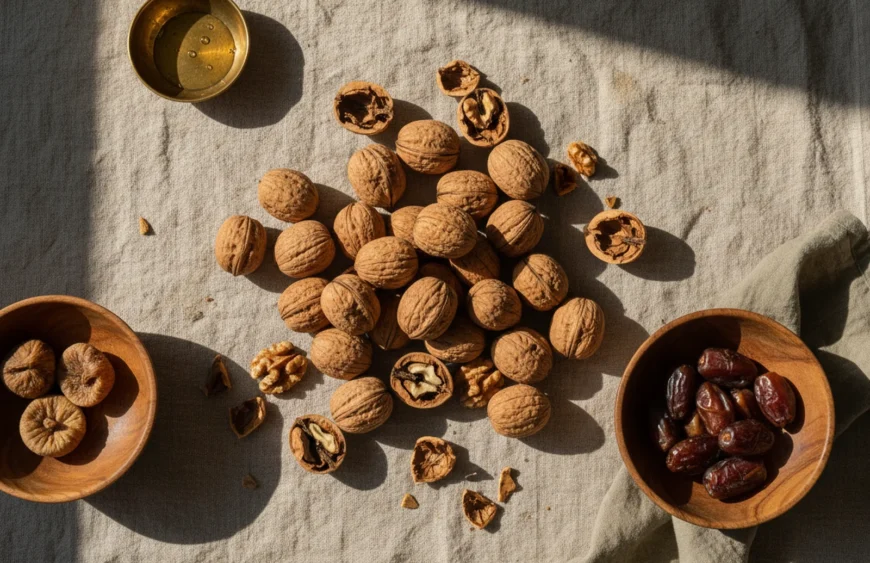
Walnuts For Pregnancy: At a glance
Last updated: 19 May 2026
Walnuts during pregnancy are a useful plant source of omega-3 fats, folate and magnesium for Indian mothers building a diverse trimester diet. A standard 30 g portion delivers roughly 2.5 g of alpha-linolenic acid (ALA), the plant omega-3, alongside about 28 micrograms folate and 47 mg magnesium. The honest caveat: only 5 to 10 percent of dietary ALA converts to DHA in adults, the form fetal brain tissue actually uses. Walnuts contribute meaningfully, but vegetarian and vegan pregnant women may still need an algal DHA supplement on their obstetrician’s advice. ICMR-NIN guidance places nuts within the daily diet, and 5 to 7 walnut halves (akhrot) is the consensus Indian portion across trimesters. Ammari Foods sources its Kashmiri akhrot from the Sopore belt of Kashmir, where paper-shell varieties grow under cooler altitudes. For variety comparison, see our Kashmiri vs Chilean walnuts buying guide.
Are walnuts safe during pregnancy?
Walnuts for pregnancy – here is what actually matters when you choose. Walnuts are safe for most healthy pregnant women across all three trimesters, and Indian obstetricians routinely include them in the standard antenatal diet sheet. The exceptions are narrow but worth respecting: women with a diagnosed tree-nut allergy should avoid walnuts entirely, and those with a documented family history of severe nut allergy may want to discuss introduction with their doctor.
Beyond allergy, a few practical points apply. Pregnancy hormones slow digestion and the high-fat profile of walnuts can feel heavy on an empty first-trimester stomach. Split the daily portion across two intakes if nausea is sharp. Rancid walnuts taste bitter and lose their nutritional value, so always pick origin-labelled, vacuum-sealed packs and store in an airtight container. As with any dietary change during pregnancy, confirm portions with your obstetrician or gynaecologist before scaling up. This is general nutritional guidance, not personalised medical advice.
Why walnuts are recommended during pregnancy: 5 evidence-based reasons
The case for walnuts in the Indian pregnancy diet rests on five nutrients, each closing a common gap.
- Omega-3 ALA for fetal brain development. A 30 g portion of walnuts supplies around 2.5 g of alpha-linolenic acid, the highest ALA content of any common nut. ALA is the plant precursor the body converts (partially) into EPA and DHA, the fats that build fetal brain and retinal tissue across the second and third trimesters.
- Folate for neural-tube formation. Walnuts contribute roughly 28 micrograms folate per 30 g serving. This stacks on top of green leafy vegetables, dals and the folic acid supplement most Indian obstetricians prescribe in the first trimester.
- Magnesium for muscle and cramp relief. Around 47 mg magnesium per 30 g portion supports the muscle relaxation that pregnant women often miss, particularly the calf cramps common in the third trimester.
- Fibre for pregnancy constipation. Walnuts provide about 2 g of fibre per 30 g serving, useful in a phase when iron supplements and reduced motility slow the bowel.
- Polyphenols and antioxidant load. Walnuts carry one of the highest antioxidant profiles among tree nuts, helpful for the heightened oxidative stress of pregnancy. The skin around the kernel holds most of the polyphenol load, so eat them unpeeled.
The DHA caveat: what walnuts can and cannot do
This is the section every pregnancy article skips, and it is the one most worth reading. Walnuts deliver ALA, the plant omega-3, generously. But the form your baby’s developing brain actually uses is DHA (docosahexaenoic acid), and the human body converts only a small fraction of dietary ALA into DHA.
Across published metabolic studies, the conversion efficiency in adults sits around 5 to 10 percent, and it tends to be lower in men and slightly higher in women of reproductive age. Even at the high end, the ALA in 30 g of walnuts converts to perhaps 150 to 250 mg DHA equivalent across the day. The DHA requirement during pregnancy is around 200 to 300 mg per day, per most international obstetric nutrition guidelines.
The practical reading for Indian mothers:
- If you eat fish twice a week, walnuts complement that DHA source comfortably. A 5 to 7 halves daily portion is a useful add-on, not the primary DHA route.
- If you are vegetarian or vegan, walnuts alone will not meet pregnancy DHA targets. Discuss an algal DHA supplement with your obstetrician. Algal DHA is plant-derived, marine-free, and is the standard recommendation for vegetarian Indian pregnant women.
- In all cases, do not abandon walnuts because of this caveat. ALA has independent benefits for maternal cardiovascular health, and walnuts deliver folate and magnesium alongside.
For broader context on walnut omega-3s in non-pregnancy contexts, our walnuts and brain health guide covers the cognitive evidence base.
How many walnuts per day during pregnancy: 5 to 7 halves
The consensus Indian portion is 5 to 7 walnut halves per day, which works out to roughly 25 to 30 grams. This aligns with ICMR-NIN dietary guidance on nuts and matches what most Indian obstetricians recommend on the standard antenatal sheet. Our broader how many walnuts per day guide covers non-pregnancy portions.
Trimester adjustments are modest:
- First trimester: 4 to 5 halves daily, split across breakfast and an afternoon snack if nausea is active.
- Second trimester: 5 to 7 halves daily, the comfortable middle. Pair with milk, curd or a fruit smoothie.
- Third trimester: 6 to 8 halves daily, with the higher end for women with elevated calorie needs or twin pregnancies.
Soak overnight in plain water if you find walnuts heavy on digestion. Soaking softens the kernel, reduces tannins, and is the traditional Ayurvedic preparation for almonds and walnuts alike during pregnancy.
Kashmiri vs Chilean walnuts for pregnancy
Both varieties deliver similar core nutrition (ALA, folate, magnesium are comparable within 5 to 10 percent), so the choice during pregnancy comes down to texture, freshness and supply transparency rather than dramatic nutritional differences.
Kashmiri walnuts (akhrot) are paper-shell, grown in the Sopore belt and surrounding altitudes. The kernels are typically lighter in colour, milder in tannin, and easier on first-trimester nausea. Indian-origin supply chains are shorter, which usually means fresher kernels with less rancidity risk. Our Kashmiri walnuts benefits guide covers the variety in depth.
Chilean walnuts are typically larger kernels with a slightly firmer bite. The Chilean harvest runs in our March-April window, complementing the Indian September-October crop, so a Chilean supply in winter months can sometimes be fresher than older Kashmiri stock. For a detailed head-to-head, see the Kashmiri vs Chilean walnuts buying guide.
For most Indian pregnant women, Sopore Kashmiri walnuts are the gentler default. The premium Kashmiri walnuts (akhrot) we stock are paper-shell, current-season kernels. The premium Chilean walnuts range is a good alternative when winter freshness matters.
What to pair walnuts with during pregnancy
The nutrient gains from walnuts compound when paired with complementary foods on the Indian plate.
- Leafy greens (palak, methi, sarson): the folate in greens stacks with walnut folate, important across the first trimester and beyond.
- Dates (khajoor): walnuts and 2 to 4 dates make a clean afternoon snack that pairs plant omega-3 with iron-rich natural sugars. See our dates during pregnancy guide for the trimester-by-trimester date portion.
- Almonds (badam): a small handful of soaked almonds plus 5 walnut halves rounds out the nut intake with vitamin E and protein. Our almonds for pregnancy guide covers that variety specifically.
- Curd or milk: walnuts crushed into morning curd pair well with the calcium and probiotic load.
- Citrus (orange, amla): vitamin C from citrus improves non-heme iron absorption from the broader meal.
Free delivery on orders over ₹999 keeps the routine simple if you are stocking nuts and dates together.
When to avoid walnuts during pregnancy
A few situations call for stepping back or consulting your doctor before continuing.
- Tree-nut allergy: absolute contraindication. Avoid walnuts and discuss alternative sources of plant omega-3 (flax, chia) with your obstetrician.
- Gestational diabetes (GDM): walnuts are not high glycemic, but their calorie density matters. Stay at the lower end of the portion range (4 to 5 halves) and pair with protein or yoghurt rather than carbohydrates.
- Severe first-trimester nausea: if the fat content triggers reflux, defer to the second trimester or try soaked, peeled walnuts in smaller quantities.
- Rancid or off-smelling kernels: discard immediately. Rancid walnuts taste sharply bitter and the oxidised fats are exactly what pregnant women should avoid.
- Combined high nut intake: if your obstetrician has flagged calorie or weight-gain concerns, count walnuts alongside almonds, pistachios and cashews rather than treating each as a separate add-on.
Sourcing transparency
- Ingredient: Walnuts (akhrot)
- Origin (Kashmiri): Sopore belt, Kashmir
- Varieties: Kashmiri Akhrot (paper-shell)
- Origin (Chilean): Chile, March-April harvest window
- Packed at: Jaipur facility, Rajasthan
- Storage: airtight container in cool dry place; refrigerate during Indian summer to preserve oil freshness
References & further reading
For independent reference points, the NIN-Hyderabad Dietary Guidelines for Indians is the standardised dataset we cross-check composition against. Clinical work like the PubMed – folate intake in pregnancy helps separate marketing claims from evidence.
Frequently Asked Questions
How many walnuts should I eat per day during pregnancy?
The consensus Indian portion is 5 to 7 walnut halves per day, roughly 25 to 30 grams. First trimester: 4 to 5 halves, split across two intakes if nausea is active. Second trimester: 5 to 7 halves daily. Third trimester: 6 to 8 halves, with the higher end for women with elevated calorie needs. Always confirm exact daily portions with your obstetrician or gynaecologist, particularly if you have gestational diabetes or weight-gain concerns.
Do walnuts really provide DHA for the baby’s brain?
Walnuts provide ALA, the plant omega-3, generously (about 2.5 g per 30 g portion). The body converts ALA into DHA, the form fetal brain tissue uses, but the conversion efficiency is only 5 to 10 percent in adults. Walnuts contribute meaningfully but rarely meet pregnancy DHA targets of 200 to 300 mg daily on their own. Vegetarian and vegan pregnant women should discuss an algal DHA supplement with their obstetrician. Fish-eaters get DHA more directly from twice-weekly fish.
Are Kashmiri walnuts better than Chilean during pregnancy?
Nutritionally the two varieties are comparable within 5 to 10 percent across ALA, folate and magnesium. The practical differences are texture and freshness. Sopore Kashmiri akhrot is paper-shell, milder in tannin, and the shorter Indian supply chain often means fresher kernels and less rancidity risk. Chilean walnuts are larger and firmer; their March-April harvest can complement Kashmiri stock through the winter months. For most pregnant Indian women, current-season Kashmiri walnuts are the gentler default.
Can I eat walnuts in the first trimester?
Yes, walnuts are safe in the first trimester for most pregnant women and the folate content actively supports neural-tube formation in this phase. The practical adjustment is portion and timing. Stay at 4 to 5 halves daily rather than 7, and split the portion across breakfast and an afternoon snack to avoid heaviness on an empty stomach. Soaking overnight softens digestion. Avoid entirely if you have a tree-nut allergy, and confirm with your obstetrician before changing diet during pregnancy.