Wedding Dry Fruit Trousseau: At a glance
Last updated: 20 May 2026
Wedding dry fruit hampers are the cornerstone of the modern Indian bridal trousseau, replacing or augmenting the older mithai-and-coconut exchange that travels between the two families during milni, sangeet, and the wedding day itself. Indian weddings account for roughly ₹4.7 lakh crore of household spend annually, per CII estimates, with gifting consuming 20 to 25% of a typical mid-range budget.
Wedding dry fruit trousseau – here is what actually matters when you choose. Trousseau hampers usually span three guest tiers: close family (1 kg+ premium boxes), extended relatives and family friends (200 g mixed hampers), and colleagues and acquaintances (250 g tins). Premium varieties drive the spend: Mamra almonds, Ajwa and Medjool dates, and Akbari pistachios anchor the top tier.
Ammari Foods packs wedding-week orders from our Jaipur facility, with monograms, family crests, and recipient names available on large-format orders. For the full framework, see our dry fruit gifting guide for India.
The trousseau tradition, retold for the modern wedding
The bridal trousseau in India has always been more than the trunk of saris and jewellery that travels with the bride. It is the visible signal of welcome that the bride’s family extends to the groom’s family, and the parallel basket of gifts that travel back. Dry fruits have lived inside that exchange for generations, originally as small wooden boxes of badam-pista pressed into the hands of the priest, the witnesses, and the eldest aunts on each side.
What changed in the last decade is scale and presentation. The five-relative wedding has given way to the 400-guest celebration. Mithai trays no longer travel well across two-day events, and the same gift now needs to read as considered when handed to a CFO uncle and to a college friend in the same afternoon. Premium dry fruit hampers solved this quietly. A wood-veneer box of Mamra almonds, Akbari pistachios, and Medjool dates carries unambiguously across generations, dietary preferences, and social tiers in a way mithai never did.
The trousseau hamper is also the one wedding gift the recipient actually finishes. Saris stack in cupboards; brass thalis migrate to storerooms; dry fruits get eaten through the months that follow the wedding, which keeps the gifting family’s name in the recipient’s home long after the mandap is dismantled.
Guest tiers and quantity guidance
The single most useful rule in wedding hamper planning is to match the hamper to the relationship tier, not the headline budget. Indian weddings carry strong tier conventions, and over-gifting to a colleague reads as oddly as under-gifting to a maternal uncle. Build three tiers and assign each guest to one. When evaluating wedding dry fruit trousseau, the key is verification not branding.
Tier A. Close family (₹4,000 to 15,000 per hamper)
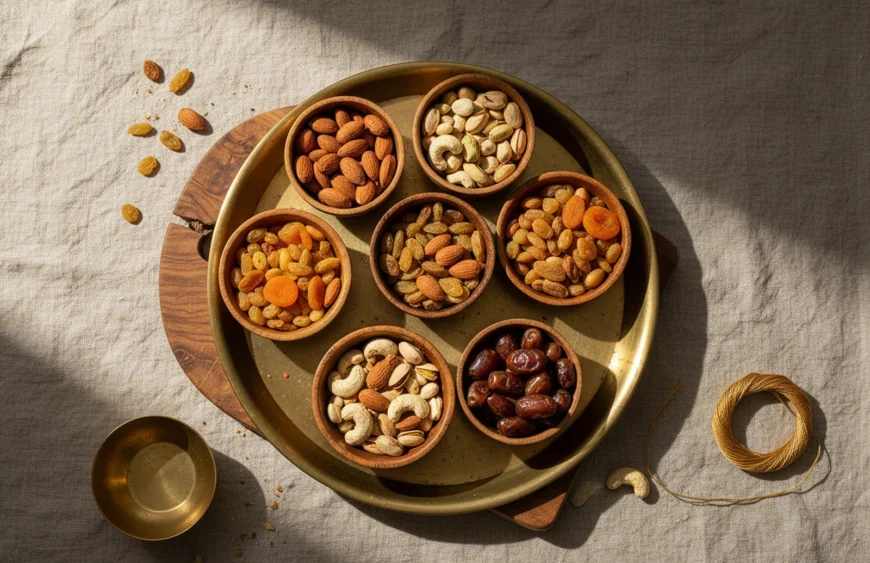
The inner circle: parents-in-law, siblings of both sets of parents, the immediate aunt-uncle ring on each side, and the closest family-friend elders treated as relatives. Expect to assemble 20 to 40 hampers at this tier for a standard north-Indian wedding, more for joint families. The format is a 1 kg to 2 kg large-format crate: Mamra almonds, Akbari pistachios, Ajwa dates and Medjool dates, Kashmiri walnut halves, anjeer, and a heritage addition like saffron or kesar-infused honey. Brass canisters, wooden crates, or velvet-lined boxes signal the relationship weight. This tier carries the family monogram or initials of the bride and groom.
Tier B. Extended family and family friends (₹1,500 to 3,500)
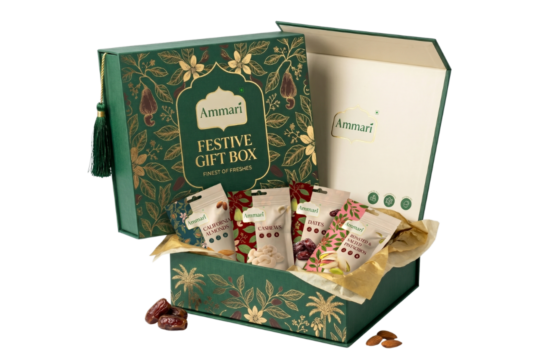
Cousins, second-degree relatives, business-family contacts, parents’ regular social circle, and out-of-town guests staying through the wedding week. Plan for 80 to 150 hampers in this tier. The format is a 200 g four-variety hamper in a wood-veneer or fabric-wrapped box: California almonds, Iranian pistachios, Kashmiri walnuts, and Medjool dates in equal portions. The ready-built option that ships cleanly at this volume is the Ammari Festive Gift Box, which can be re-skinned with the wedding monogram on orders above 50 units.
Tier C. Colleagues, acquaintances, and helpers (₹500 to 1,200)
The professional and social outer ring: office colleagues, neighbours, vendors who supported the wedding, and the helpers and house staff who often go uncounted in trousseau planning but should not. Plan for 100 to 250 hampers in this tier. A 250 g mixed almond-and-pistachio tin, ribbon-tied, with a printed thank-you card carrying the couple’s names and wedding date. The format is light enough that guests carry it home from the reception without inconvenience, and the unit cost stays disciplined.
Total trousseau hamper count for a 400-guest wedding typically lands at 200 to 350 units across all three tiers combined, depending on how much of the gifting happens at the event versus pre- and post-wedding home visits.
Premium varieties that earn the trousseau slot
Trousseau gifting is where premium varieties belong. The 200 g hamper that travels to a senior uncle is not the moment to economise on almond grade. Three varietal anchors carry the top tier reliably.
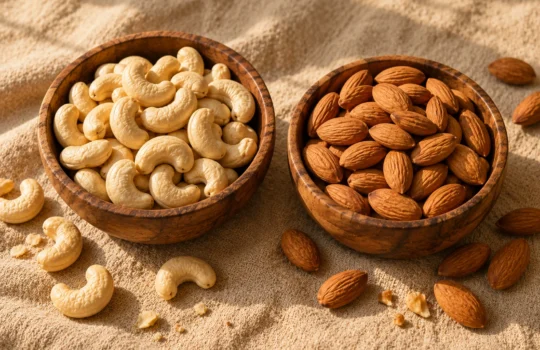
Mamra almonds. The small-batch, stony-soil almond from Aleppo Province in Iran and parts of eastern Afghanistan. Roughly 70% higher in oil content than commercial California almonds, with a sweeter finish and softer bite. The Mamra slot in a trousseau hamper communicates that the gifting family went beyond the supermarket aisle. For a deeper comparison, see our note on Mamra almond benefits.
Akbari and Kerman pistachios. From Kerman Province in Iran, with the long-grained Akbari at the top of the varietal stack and the rounder Kerman just below it. Both grades carry a clean, naturally split shell, deeper green kernel, and the unmistakable pistachio aroma that lab-roasted commercial mixes flatten. The selection logic between the two grades is laid out in our Akbari versus Kerman pistachios breakdown.
Ajwa and Medjool dates. Two varieties that play different roles in the same hamper. Ajwa from Madinah carries religious and ritual weight, particularly meaningful in Muslim and mixed-faith weddings, while Medjool from the Jordan Valley delivers the visible large-fruit luxury signal that guests recognise on sight. For families weighing which to prioritise, our Medjool versus Ajwa dates comparison covers the tradeoffs.
A premium trousseau hamper typically combines all three varietal anchors with supporting volume from Kashmiri walnut halves, anjeer, and pine nuts (chilgoza) for the highest tier only.
Large-format packaging and customisation
The wedding trousseau is the one gifting occasion where large-format presentation reliably justifies its cost. A 250 g tin can travel as a corporate Diwali gift; a wedding hamper for the bride’s maternal uncle needs the weight and visible volume that signals the relationship.
Crate sizing. Tier A hampers move into the 1 kg to 2 kg range, packed in 30 cm to 40 cm wooden crates or fabric-lined trays. Below 1 kg, the trousseau weight signal weakens; above 2 kg, the recipient genuinely cannot finish the contents before they age. Two kilos is the practical ceiling.
Family monograms and initials. The signature wedding personalisation is a laser-etched or foil-stamped monogram combining the bride’s and groom’s first-name initials, often inside a simple ornament motif. Lead times run 14 to 21 days for orders above 25 units, with foil stamping slightly faster than laser etching on wood lids.
Recipient name embossing. For the top Tier A hampers (the 20 to 40 closest family units), each crate carries the recipient’s name embossed or printed on a card slotted under the lid. The thoughtfulness signal is disproportionate to the cost; an embossed name card adds ₹150 to ₹300 to the per-unit cost but transforms a generic premium hamper into a personal one.
Wedding date and venue card. A small printed card carrying the wedding date, the couple’s names, and a one-line note is standard for Tier B and Tier C hampers. It is also the artefact most often kept as a memory by guests. Skip generic “Shubh Vivah” templates; a clean wordmark of the couple’s names ages better in family albums than ornamental Hindi calligraphy.
Material choices. Wooden crates carry the broadest acceptability across regions. Brass canisters work strongly for Tier A in north-Indian and Punjabi weddings where brass already lives in the household. Fabric-wrapped boxes (often using leftover lehenga or sherwani fabric) are an increasingly popular bespoke choice for the top tier, particularly when the wedding has a colour theme the family wants to extend into gifts.
A practical rule mirroring the corporate-gifting one: spend roughly 10 to 15% of the hamper budget on packaging and personalisation. Below 10%, premium contents are wasted on an unremarkable box; above 15%, the contents start to read as an afterthought to wrapping.
When trousseau hampers travel inside the wedding rituals
The Indian wedding week has multiple natural exchange points. Plan the hamper count by event, not by guest list alone.
- Roka and tilak. The earliest formal exchange between the two families. A small, focused 200 g hamper of premium varieties carries between the immediate parents and elders. Volume is small (10 to 20 hampers per side) but quality is the highest of any wedding-week exchange.
- Sagai or engagement. Tier A and selected Tier B hampers travel here. The bride’s family typically prepares larger crates for the groom’s parents and siblings, with reciprocal hampers from the groom’s side.
- Sangeet and mehendi. Tier B hampers move at scale during these family events, particularly when out-of-town relatives are staying in shared accommodation. Hampers reach guest rooms as welcome gifts.
- Milni. The formal meeting of the two families at the wedding venue. Tier A hampers exchange between matched relatives (the bride’s eldest paternal uncle with the groom’s eldest paternal uncle, and so on down the line). This is the most ritually weighted hamper exchange of the entire wedding.
- Vidaai and post-wedding home visits. Tier C hampers travel home with non-staying guests as reception take-home gifts. Tier B hampers travel with the bride to the groom’s home over the first month of post-wedding family visits.
For the broader gifting calendar (Diwali, Raksha Bandhan, and corporate cycles around the wedding window), see our Diwali dry fruit gift ideas for 2026, Raksha Bandhan dry fruit hamper guide, and corporate dry fruit gifting in India playbooks, all of which use the same large-format vendor capabilities.
Lead times and ordering windows
Wedding trousseau orders carry tighter lead-time pressure than any other gifting occasion, because the date is fixed and the count is large.
- Three months before the wedding. Confirm hamper tier mix and total count. Premium varieties (Mamra almonds, Akbari pistachios, Ajwa dates) book at supplier level 6 to 8 weeks ahead for large-format orders.
- Six weeks before the wedding. Finalise monogram artwork, recipient name lists for Tier A, and any fabric or material customisation. Foil stamping and laser etching need 14 to 21 days at this volume.
- Three weeks before the wedding. Production begins. Hampers are assembled, vacuum-sealed, and packed in their final crates or canisters.
- One week before the wedding. Hampers arrive at the venue or the family home. Last 72 hours are reserved for unboxing, recipient-name card slotting, and final ribbon tying. This handwork rarely scales beyond family supervision and should not be left to wedding-day morning.
The most common failure pattern is confirming the wedding guest count three weeks before the event and trying to add 80 hampers to a previously committed order of 200. Premium suppliers can stretch by 10 to 15% on short notice; beyond that, varietal substitutions begin (commercial California almonds replacing Mamra, for example) and the trousseau gift quality drops visibly. Lock the count by the six-week mark.
Sourcing transparency
- Almonds (California): Central Valley, USA; Aug to Oct harvest; , Sonora, Carmel varieties.
- Almonds (Mamra): Aleppo Province, Iran and parts of eastern Afghanistan; Sep to Oct harvest; stony-soil cultivation.
- Pistachios: Kerman Province, Iran; Akbari, Kerman, Ahmad Aghaei varieties.
- Dates (Medjool): Jordan Valley.
- Dates (Ajwa): Madinah region, Saudi Arabia.
- Walnuts: Sopore belt, Kashmir; paper-shell Kashmiri Akhrot.
Ammari Foods assembles wedding trousseau hampers at our Jaipur facility, with monogramming, recipient-name embossing, and fabric or wood customisation available on orders above 25 units. Vacuum sealing happens within 48 hours of dispatch so the premium varieties arrive at the venue or family home in the same condition as a single-pack retail order.
References & further reading
For independent reference points, the NIN-Hyderabad Dietary Guidelines for Indians is the standardised dataset we cross-check composition against. Clinical work like the FSSAI Food Safety & Standards Authority of India helps separate marketing claims from evidence.
Frequently Asked Questions
How many wedding dry fruit hampers should we plan for a 400-guest wedding?
Plan for 200 to 350 total hampers across three tiers. Tier A close family hampers (1 kg+ premium crates) usually run 20 to 40 units, Tier B extended family and family friends (200 g mixed hampers) run 80 to 150 units, and Tier C colleagues and acquaintances (250 g tins) run 100 to 250 units. The exact split depends on how much gifting happens at the event versus through pre- and post-wedding home visits. Confirm the count six weeks before the wedding so premium varieties can be reserved at the supplier level.
What goes inside a premium trousseau hamper?
A Tier A trousseau hamper for the closest family typically combines Mamra almonds, Akbari pistachios, Ajwa and Medjool dates, and Kashmiri walnut halves, with supporting volume from anjeer, pine nuts, and sometimes saffron or kesar-infused honey. The 1 kg to 2 kg crate format gives each variety enough weight to feel substantive. Mid-tier hampers drop to a four-variety mix (California almonds, Iranian pistachios, Kashmiri walnuts, Medjool dates) at 200 g total, which holds the trousseau standard at a lower per-unit cost.
Can wedding hampers carry the family monogram or recipient name?
Yes. Standard wedding personalisation is a laser-etched or foil-stamped monogram combining the bride’s and groom’s first-name initials on the box lid, with lead times of 14 to 21 days for orders above 25 units. The top Tier A hampers usually carry a recipient name embossed on a card slotted under the lid, adding ₹150 to ₹300 per unit. A printed card with the couple’s names, wedding date, and a one-line note travels with every hamper across all three tiers and is often kept as a memento.